News On Japan

Examining the history behind Japan’s love of face masks

Jul 05, 2020 (Japan Times) - In Japan, it’s sometimes said that the eyes speak as much as the mouth.

Perhaps the proverbial phrase captures the essence of the nation’s affinity for face masks, a relationship that can be traced back centuries and a custom to which is attributed Japan’s lower number of deaths from COVID-19 compared with Western nations — in particular the United States, where wearing a mask has recently become a politically charged issue.

Masks are now omnipresent in Japan as a result of the pandemic, thanks in part to an inherent mask-wearing culture. Besides being sporadically worn during hay fever and influenza seasons, masks have expanded beyond their traditional role over the years and have even been adopted by the fashion and beauty industries.

There are masks that cut ultraviolet rays and prevent glasses from fogging, and masks that make the face look slimmer. There’s even a term for women who look good in masks — masuku bijin (masked beauty) — and contests are held to decide who among them looks the most attractive donning one. Apparently, the key, unsurprisingly, is the enhancement of the eyes.

It’s good business, too. With global cases of the novel coronavirus on the rise as Japan’s humid summer arrives, companies across industry lines are rushing to produce cooling and drying face masks to help cope with the sweltering heat that medical experts warn could lead to breathing difficulties and dehydration.

why have masks become so universally accepted in Japan? In other East Asian nations, the public practice became widespread in 2003 when SARS, another variant of the coronavirus, spread from China to neighboring countries. Crippling health care systems and leaving a trail of infections and deaths, the sickness ingrained a profound fear of viral respiratory diseases and opened eyes to the importance of masks in containing outbreaks.

Japan, however, was largely spared from the SARS epidemic, recording zero fatalities. To understand the nation’s relationship with masks, there’s a need to look further back in history, says Tamotsu Hirai, a clinical pharmacist and an avid collector of vintage medical paraphernalia.

Covering the mouth with paper or the sacred sakaki (Japanese cleyera) leaves to prevent one’s “unclean” breath from defiling religious rituals and festivals has been common from ancient times, Hirai says, and is a custom still observed at Yasaka Shrine in Kyoto and the Otori Grand Shrine in Osaka, among others. During the Edo Period (1603-1868), the practice seems to have penetrated a significant portion of the population.

During an interview at his office in Western Tokyo, Hirai pulls out a framed, multicolored woodblock print showing kimono-clad patients receiving treatments from people who appear to be a masseuse, an acupuncturist and a doctor. “This nishiki-e dating from the Edo Period depicts a scene of a medical clinic,” he explains. “If you take a close look, you’ll see one of the patients covering his mouth with what appears to be a piece of cloth.”

News On Japan
POPULAR NEWS

Airports and railway stations across Japan were crowded on September 23 as travelers returned from their hometowns and holiday destinations on the final day of the five-day Silver Week holiday, with international flight arrivals reaching their peak and many afternoon Shinkansen services fully booked.

Extensive railway disruption continued across Chiba Prefecture on September 23 as JR East warned that several lines damaged by Typhoon No. 25 would remain closed beyond the Silver Week holiday, even as flights returned toward normal, all typhoon-related expressway closures were lifted and some highway bus services resumed. The storm has left widespread damage to railway tracks and embankments, with flooding, landslides and fallen trees complicating restoration work.

The death toll from Typhoon No. 25 rose to nine on September 23, with four people still missing in Chiba and Kanagawa prefectures, as renewed rainfall raised fears of further landslides in communities devastated by the storm.

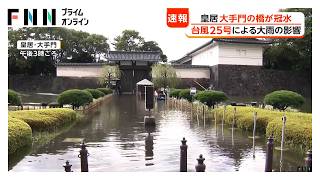
The road leading to Otemon Gate at Tokyo's Imperial Palace was flooded on September 22 after heavy rain from a typhoon caused water in the surrounding moat to overflow.

Japan came within two runs of producing one of international cricket's biggest upsets on September 22, pushing reigning T20 world champion India to the final ball before losing a rain-shortened match at Sano International Cricket Ground in Tochigi Prefecture.

MEDIA CHANNELS
         

MORE Society NEWS

An emu that escaped from the home of a traveling zoo operator was captured after wandering through a residential neighborhood in Moriyama, Shiga Prefecture, on September 23, following a police report from a resident who mistook the bird for an ostrich.

People aged 65 and older accounted for a record 29.6% of Japan's population in 2026, the highest proportion among major countries worldwide, while the number of elderly people in employment also reached an all-time high as Japan marked Respect for the Aged Day on September 21.

Emperor Naruhito and Empress Masako visited Ghibli Park in Aichi Prefecture on September 20, touring exhibits that recreate famous scenes from Studio Ghibli films and posing for a photograph with the character No-Face.

Police in Kanagawa Prefecture have rearrested four teenagers on suspicion of murdering a 17-year-old high school student who died after being assaulted in Sagamihara in August.

Drinking parties remain a lively part of social life in Kansai even as younger generations increasingly turn away from alcohol and izakaya bankruptcies rise at a record pace, with customers describing the gatherings less as occasions to drink heavily and more as opportunities to maintain friendships, meet new people and build connections across generations.

Anonymous and fluid criminal groups known in Japan as "tokuryu" are adopting increasingly elaborate tactics, including a scheme in which elderly victims are persuaded to hide cash inside refrigerators before thieves enter their homes, as authorities struggle to combat networks whose members often have no direct contact with one another.

A luxury mansion in Bangkok described as resembling a palace was being used as a base for a specialized fraud operation targeting Japanese people, with Thai authorities detaining 14 people, including four Japanese men.

Copper roofing has been stripped from Shinano-no-miya Shrine in Oshika Village, Nagano Prefecture, leaving the wooden structure exposed in the latest of a series of similar thefts reported at shrines across the prefecture.