News On Japan

Foreign students campaign against entry ’discrimination’

May 28, 2021 (universityworldnews.com) - International students are speaking out against strict entry policies for foreigners imposed by Japan to control COVID-19 transmission and have started a campaign to lobby for entry permits for around 2,000 students unable to take up their places at Japanese universities this year.

Students said Japan’s border policies make it very difficult to come to Japan to pursue their studies despite being accepted at Japanese universities, causing financial loss and mental anguish.

At an online press conference aired in Japan this week, two Italian students stuck in their country despite being accepted to Japanese universities for this academic year said via video link that Japan’s border controls were discriminatory. They argued such strict regulations are unfair as Japan prepares to permit international athletes to enter for the Olympic Games slated for this July.

Gulia Luzzo, from the University of Turin in Italy, who is pursuing a masters degree in Japanese literature, said Japan is treating foreign students as “invisible”.

Luzzo said she lost her Italian scholarship last year awarded under the European Union’s ErasmusPlus scheme to support her studies in Japan. “The loss is immeasurable both financially and career wise,” she said, adding that she is taking online Japanese language classes at Saitama University, Tokyo, and is working several part-time jobs that will pay for her studies while she waits in limbo.

“The stress is terrible given the uncertainty in my life. I have not slept properly for months as I juggle work and the time differences between Japan and Italy to take online classes,” she said, adding that some international students had changed their plans and gone to more ‘open’ Asian countries such as South Korea.

However, China continues to bar foreign students, as does Australia.

Campaign for entry permits

Filippo Pedretti, a student at Italy’s University of Padua, is still waiting to come to Japan for a masters in religious studies. He said on 26 May that he had started a campaign to lobby entry permits for foreign students and is joined by more than 2,000 students around the world facing similar entry restrictions.

“Foreign students are willing to follow quarantine measures and other safety steps such as continuous PCR tests to stop the spread of COVID-19. We do not want to delay precious time as we work towards our careers,” said Pedretti.

A spokesperson for Japan’s Ministry of Education, Culture, Sports, Science and Technology acknowledged the current situation was “not easy” for international students, given the global pandemic.

“The ministry is aware of the difficulties that have hit aspiring foreign students and have taken new measures to ease the issues,” the spokesperson said, preferring his name not be used. Last year, the ministry increased financial support for universities to improve distance learning and also to encourage flexible measures such as easing limits on credits that can be taken via distance learning, he said.

But with Japan now in its fourth wave of higher coronavirus infections and under an extended emergency state placed on big cities, the government has not unveiled a clear policy on easing entry bans for foreigners or made special provisions for international students.

Under a plan to ease entry last year, Japan’s foreign ministry said Japan would prioritise “business travellers and international talent Japan is in need of” before easing restrictions for foreign students and eventually for tourists, but set out no timetable.


News On Japan
POPULAR NEWS

Japanese Prime Minister Sanae Takaichi and US President Donald Trump held talks at United Nations headquarters in New York in the early hours of September 23 Japan time, demonstrating the strength of the Japan-US alliance and confirming close cooperation on China ahead of an upcoming US-China summit.

Rail services across Chiba Prefecture remained severely disrupted on the morning of September 23, three days after Typhoon No. 25 brought torrential rain to eastern Japan, with extensive suspensions on the Uchibo, Sotobo, Sobu Main and Narita lines expected to continue throughout the final day of the Silver Week holiday. Although some services have resumed and flights at Tokyo's major airports are recovering, damage to railway tracks and embankments is preventing a return to normal operations in several areas.

Typhoon No. 25 has left seven people dead and five missing in Chiba and Kanagawa prefectures, with rescue operations continuing on September 23 as the extent of devastating landslides and flooding across the Kanto region becomes clearer, while widespread power outages, disrupted rail services and submerged neighborhoods hamper recovery efforts.

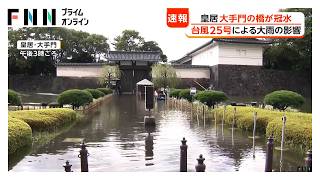
The road leading to Otemon Gate at Tokyo's Imperial Palace was flooded on September 22 after heavy rain from a typhoon caused water in the surrounding moat to overflow.

Japan came within two runs of producing one of international cricket's biggest upsets on September 22, pushing reigning T20 world champion India to the final ball before losing a rain-shortened match at Sano International Cricket Ground in Tochigi Prefecture.

MEDIA CHANNELS
         

MORE Society NEWS

People aged 65 and older accounted for a record 29.6% of Japan's population in 2026, the highest proportion among major countries worldwide, while the number of elderly people in employment also reached an all-time high as Japan marked Respect for the Aged Day on September 21.

Emperor Naruhito and Empress Masako visited Ghibli Park in Aichi Prefecture on September 20, touring exhibits that recreate famous scenes from Studio Ghibli films and posing for a photograph with the character No-Face.

Police in Kanagawa Prefecture have rearrested four teenagers on suspicion of murdering a 17-year-old high school student who died after being assaulted in Sagamihara in August.

Drinking parties remain a lively part of social life in Kansai even as younger generations increasingly turn away from alcohol and izakaya bankruptcies rise at a record pace, with customers describing the gatherings less as occasions to drink heavily and more as opportunities to maintain friendships, meet new people and build connections across generations.

Anonymous and fluid criminal groups known in Japan as "tokuryu" are adopting increasingly elaborate tactics, including a scheme in which elderly victims are persuaded to hide cash inside refrigerators before thieves enter their homes, as authorities struggle to combat networks whose members often have no direct contact with one another.

A luxury mansion in Bangkok described as resembling a palace was being used as a base for a specialized fraud operation targeting Japanese people, with Thai authorities detaining 14 people, including four Japanese men.

Copper roofing has been stripped from Shinano-no-miya Shrine in Oshika Village, Nagano Prefecture, leaving the wooden structure exposed in the latest of a series of similar thefts reported at shrines across the prefecture.

A popular Tokyo nightclub hostess and influencer known as Yamatorino, who says she generated more than 200 million yen in sales during a single month, has been arrested on suspicion of possessing cocaine with her boyfriend at their home in Roppongi.