News On Japan

First Publication of 10-Year Cancer Survival Rates for Children in Japan

TOKYO - The National Cancer Center Japan has published the first-ever compilation of 10-year survival rates for pediatric and adolescent and young adult (AYA) patients, aged from late teens to their 30s, based on data from individuals diagnosed with cancer at cancer base hospitals nationwide.
First Publication of 10-Year Cancer Survival Rates for Children in Japan

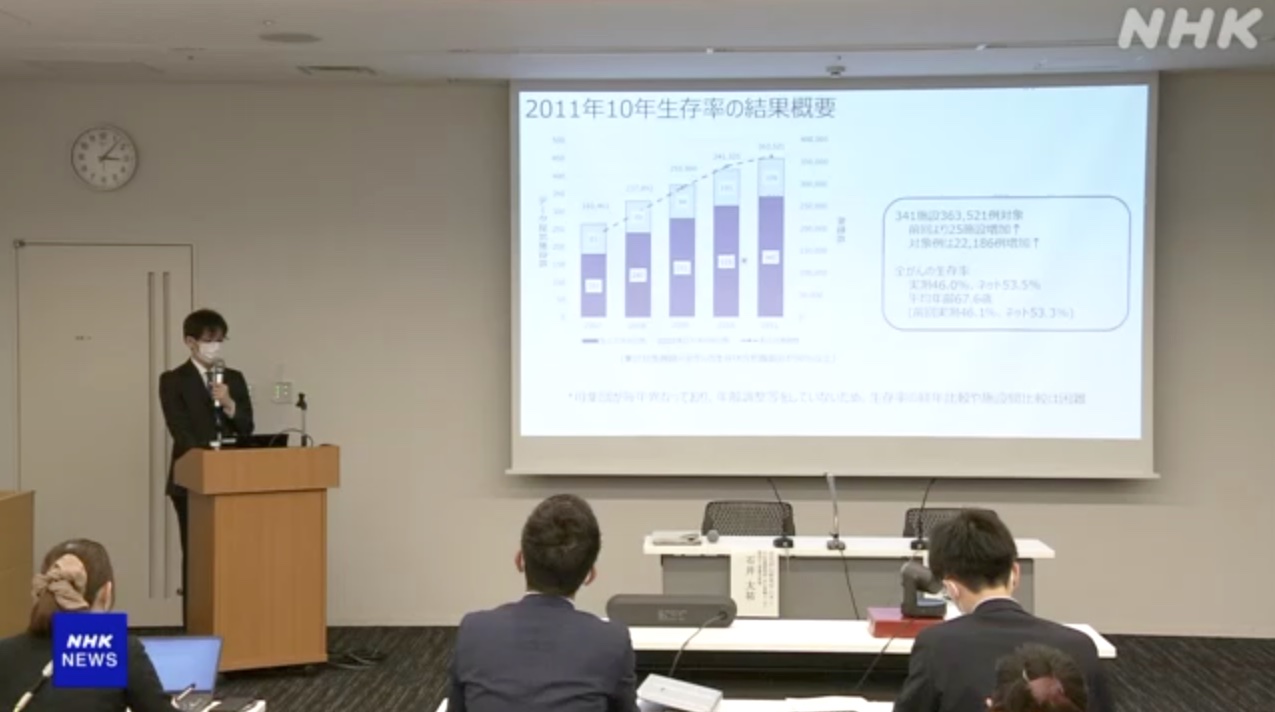
The center analyzed data from over 360,000 people diagnosed with cancer in 2011 at cancer base hospitals across the country.

For the first time, the center calculated the 10-year survival rates from the start of treatment for patients aged 0 to 14 years and those aged 15 to 39 years, known as the AYA generation. Using internationally recognized methods to calculate 10-year survival rates, the results for pediatric cancers were as follows: lymphoma at 91.5%, leukemia at 86.6%, and brain tumors at 71.7%. For cancers in the AYA generation, the rates were cervical and uterine cancers at 87.7%, breast cancer at 84.0%, and brain and spinal tumors at 78.2%.

When comparing the 5-year and 10-year survival rates, there was little decrease in survival rates for pediatric cancers, whereas for the AYA generation, the rates varied by type of cancer, with breast cancer, for example, showing a drop of more than 6 points after 10 years. The 10-year survival rate for all ages, including adults, was 53.5%, which is almost the same as the results published last year.

Dr. Taiyu Ishii of the National Cancer Center Japan stated, "Until now, data on survival rates for pediatric and AYA generation cancers has been limited. The prognosis after treatment for pediatric cancers has been supported by data, but for the AYA generation, the necessary support varies depending on the type of cancer. We hope that this data will be used as a foundation for considering support measures."

For more detailed results on the 10-year survival rates for different types of cancer, including by stage and age group, please visit the "Cancer Information Service" website operated by the National Cancer Center Japan.

Source: NHK

News On Japan
POPULAR NEWS

Strong Typhoon No. 18 was gradually moving away from Okinawa and the Amami Islands on August 26 after disrupting flights and bringing violent winds, rough seas and heavy rain, although Okinawa's main island and Amami Oshima remained at risk of sudden downpours, powerful gusts and waves exceeding 6 meters through around midday. As of 4 a.m. on August 26, the typhoon was located about 80 kilometers west-northwest of Okinoerabu Island and was moving west-northwest at 15 kilometers per hour.

A series of mysterious illegal dumping incidents involving about 39 kilograms of sliced bread has been reported around Mount Daisen and other parts of Tottori Prefecture in August, with officials investigating whether the food may have been deliberately placed to attract wild animals.

An 85-year-old couple have donated a combined 400 million yen to Osaka City with a request that the money be used to create a giant Myaku-Myaku statue about 20 meters tall at the former site of the Osaka-Kansai Expo, envisioning a landmark that could become a lasting symbol of the event and of renewed prosperity for Kansai and Japan.

Lawson plans to cut prices on its main line of onigiri rice balls by 10 yen from September 29 as falling rice prices begin to feed through to retail costs.

Police have established a temporary police post in the whaling town of Taiji, Wakayama Prefecture, ahead of the September 1 opening of the annual drive hunt for whales and dolphins.

MEDIA CHANNELS
         

MORE Sci-Tech NEWS

Residents in Minoh, Osaka Prefecture, have asked the city to take a more active role in explaining and reviewing plans for a large data center to be built on the former site of Osaka University's Minoh Campus, citing concerns over low-frequency noise, loss of sunlight and other potential effects on daily life.

A magnitude 5.9 earthquake centered in southern Ibaraki Prefecture shook a wide area of the Kanto region at around 2 a.m. on August 23, registering a maximum intensity of lower 5 on Japan's seven-level seismic scale in parts of Ibaraki, Saitama, Chiba and Tokyo.

A cognitive trait known as aphantasia, in which people are unable to voluntarily form images in their minds despite knowing what objects look like, may affect about 4% of people, highlighting significant differences in how individuals experience memory, imagination and everyday tasks.

Dangerous heat returned across Japan on August 19, complicating disaster recovery efforts in earthquake-hit Kumamoto and flood-damaged Chiba while unusually low rainfall and limited snowfall pushed reservoirs in several regions toward critical levels.

Japanese researchers are developing a lithium-air battery that uses oxygen from the atmosphere to store and generate electricity, promising nearly five times the capacity of conventional lithium-ion batteries at less than half the weight and potentially opening the way to far longer electric vehicle driving ranges.

Security camera footage captured the moment part of the Hinagu Fault Zone broke through the ground during the Kumamoto earthquake on July 28, as strong shaking lifted the surface of a rice field and moved a nearby light truck violently.

New research is reshaping long-held assumptions about Tyrannosaurus rex, including suggestions that the giant predator may have lived to around 40 years rather than 28, while advances in fossil analysis are also offering new clues about dinosaur growth, posture and even color.

Japan's H3 Rocket No. 9 successfully placed the Michibiki No. 7 navigation satellite into its planned orbit after lifting off from the Tanegashima Space Center in Kagoshima Prefecture at 4:23 a.m. on August 11, marking the country's second consecutive successful H3 launch.