News On Japan

Visual Weather Observations to Cease Across Japan

TOKYO - The Japan Meteorological Agency (JMA) will end its practice of visual weather observations across the country, except in Tokyo and Osaka, from March 26.

The JMA has been conducting visual observations every three hours since the Meiji era.

An observer explains, "First, we look across the sky to determine how much cloud cover there is. We regularly observe the amount of clouds, the visibility range, and special phenomena like yellow sand."

While basic observations will shift to automated systems, certain assessments deemed challenging for machines, such as the degree of clear skies, types and amounts of clouds, and distinguishing between hail and sleet, will end.

JMA retirees welcome the maintenance of observation accuracy but express regret over the interruption of records.

Takeshi Furukawa, a retired JMA observer, says, "No two weather events are the same; they always differ. Recording them allows for future analysis of why they occurred. If possible, it’s crucial to continue documenting... While it's regrettable, the information from current automated observations is highly accurate. There's no problem in using it comprehensively."

The JMA intends to continue visual observations in Tokyo and Osaka as part of its personnel training, leveraging human experience to verify the validity of machine-based judgments.

Source: ANN

News On Japan
POPULAR NEWS

Japan’s World Cup campaign ended in the cruelest possible fashion on June 29, as Gabriel Martinelli scored in the fifth minute of stoppage time to give Brazil a 2-1 victory over the Samurai Blue in their knockout match in Houston. Japan had led in the first half and were still level at 1-1 in the final moments, but Martinelli’s late strike sent Brazil into the Round of 16 and eliminated Japan from the tournament.

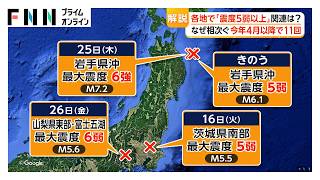
Strong earthquakes have continued to shake parts of Japan in recent weeks, with 11 temblors measuring lower 5 or above on the Japanese seismic intensity scale recorded across the country since April 2026.

A Kintetsu Railway train derailed inside Kyoto Station on the morning of June 29, forcing partial suspensions on the Kintetsu Kyoto Line for the rest of the day and causing long delays that hit commuters, students and tourists.

A section of stone wall at Hikone Castle, one of Japan’s few surviving original Edo-period castles and a National Treasure whose main keep remains intact more than 400 years after its construction, collapsed after heavy rain caused by Typhoons No. 7 and No. 8, Hikone city officials said.

Japan advanced to the knockout stage of the World Cup after a 1-1 draw with Sweden on June 25, finishing second in Group F and setting up a Round of 32 clash with Brazil in Houston.

MEDIA CHANNELS
         

MORE Sci-Tech NEWS

Japan is set to begin its first clinical trial of xenotransplantation involving the transplant of pig kidneys into human patients, in a step that could open a new option for people with kidney failure.

A new treatment that uses healthy tissue from the heart removed from a transplant patient and transplants it into another patient has been approved in Japan for the first time, with the National Cerebral and Cardiovascular Center preparing to carry out the procedure.

For those involved in medical research and biostatistics, understanding the intricacies of recovery processes is crucial.

The KAGRA gravitational-wave research facility in Kamioka, Hida, Gifu Prefecture, was opened to the public on June 20 for the first special viewing in nine years, giving 200 visitors a rare chance to tour the underground observatory with Nobel laureate Takaaki Kajita.

Mosquitoes are appearing earlier than usual this year, raising fears of a major summer outbreak as experts warn that warm May weather and repeated light rain have created ideal breeding conditions across residential areas.

New cases of hand, foot and mouth disease in Fukuoka Prefecture remained at alert level for the third consecutive week, prompting the prefectural government to urge residents to take preventive measures against the infection, which spreads through droplets and physical contact.

A Japanese startup is seeking to transform manufacturing inspections with a world-first lighting technology that eliminates reflected light, making previously hidden defects, contaminants, and irregularities visible to the human eye.

You likely interact with Japanese innovation daily without realizing it. Walk through any modern facility, and you encounter systems where hardware and software fuse flawlessly.