TOKYO - With just one week left in the month, many individuals are currently preparing to move due to changes in their environment with the new fiscal year. This time of year typically sees a high concentration of relocations, but this year, it appears even more difficult to secure moving reservations.
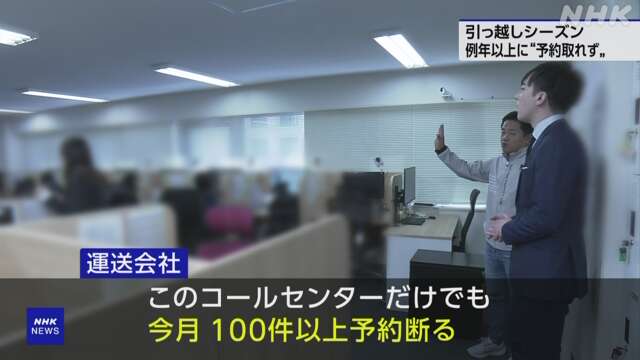
"We are unfortunately in a situation where we cannot accept more reservations," says the president of a Tokyo-based transportation company inundated with moving reservation calls as the fiscal year-end approaches. The company, which operates four call centers nationwide, reports that just one of these centers has had to decline over 100 reservations since the beginning of the month.
The president of the transportation company, Moji Housou, expresses regret: "Our capacity to take reservations is completely full, so we're sadly unable to accept any more. It's truly unfortunate, as we are grateful for those who have learned about our company and reached out to us."
On social media, posts about the inability to move can be found, with some users sharing their experiences of not being able to book a mover for their desired period. "I was told that reservations are full due to the season of job transfers and legal changes. I won't make it by my start date," and "I was informed that there's a shortage of workers due to the work style reform for drivers. My large furniture will have to stay at my parents' home for a while."
Among those unable to book a mover, there are posts about people finding alternative solutions, such as "I'll move with a light truck from my parents' home," or "I sent only my cardboard boxes via courier service," indicating attempts to move without relying on professional services. Others have been presented with estimates far exceeding their budget, leading to comments like "I have no choice but to move by myself."
For those unable to secure a moving company, storage units have become an alternative. A man who has found a new home but could not find a mover says, "I contacted six or seven moving companies, but couldn't get a reservation. I honestly didn't expect this situation. I want to move as soon as possible." He is using a storage unit temporarily for his belongings, which would have already been in his new home under normal circumstances.
Yamato Ikeda, Senior Manager of the Marketing Department at a storage company, notes an increase in inquiries from those who want to move but cannot find a mover, saying, "We're getting more inquiries than usual from people who can't find a moving company."
Behind this is the "2024 problem." The transportation companies attribute the refusal to accept more moves to a significant factor: a shortage of workers in the logistics industry. While they aim to raise employee salaries to secure talent, the situation remains challenging. The "2024 problem," which is expected to further exacerbate this shortage, refers to the upcoming regulation that will cap the annual overtime hours for truck drivers at 960 hours, starting next month. While this regulation is anticipated to improve working conditions, it also raises concerns about a deepening labor shortage and a potential decrease in transportation volume in the logistics industry.
The impact extends beyond moving companies. Major delivery services have announced price increases in an effort to improve driver conditions. Japan Post has stated that starting next month, delivery times for Yu-Pack and express mail services will be extended by up to half a day in some regions. Experts warn that the effects will spread even closer to our daily lives.
Professor Yuji Yano of the University of Distribution and Economics, an expert on logistics issues, points out potential consequences: "For example, we may no longer be able to maintain the same variety of fresh produce transported over long distances. The freshness could naturally decline due to longer transportation times, and costs will inevitably rise. The economy has been running on the premise of excessive long working hours and heavy burdens on drivers, but we're reaching a point where we need to change that basis."
Source: NHK