News On Japan

Japan Airlines' First Female President Discusses "Diversity in Talent"

TOKYO - Mitsuko Tottori, the first female president of a major airline in Japan, discusses her strategies for promoting diversity within Japan Airlines during a recent interview.
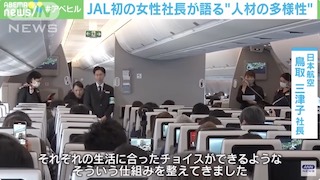
Japan Airlines' First Female President Discusses

Having taken the helm on the first of April, Tottori gave her first solo media interview, expressing a modest discomfort with her new role, noting the increased public attention has limited her freedom somewhat.

When asked how she has adjusted to being president, she replied, "It's hard to say; I haven't quite settled into it yet. It’s certainly made it more difficult for me to go out and about."

Advocating for Gender Neutrality in Leadership

Tottori emphasized her desire to be recognized not for her gender but for her capabilities. "I hardly hold any special feelings about being a woman myself. I want to be approached as an individual, and I hope it soon becomes normal not to make a point of saying, 'Ah, the president is a woman.' I look forward to a world where women becoming presidents is a common occurrence."

Reflecting on a Recent Incident

A few weeks prior to the official announcement of her presidency, a Japan Airlines aircraft was involved in a collision with a coast guard plane at Haneda Airport. The cabin crew were lauded for their calm and efficient handling of the situation, which attracted international attention. "If I happen to meet the crew members involved, I would like to personally tell them, 'You did really well,'" Tottori commented. Although the incident resulted in the tragic loss of five aboard the coast guard plane, all passengers and crew of the Japan Airlines flight were unharmed.

Diversity and Inclusion Initiatives

President Tottori has played a significant role in shaping policies to support women's career development within the airline. She discussed the importance of creating systems that allow women to easily return to their careers after life events. "We've worked on enabling mechanisms such as carrying over the career credits accumulated before a break and offering part-time work options to those with children."

With these efforts, Japan Airlines is on track to achieve a target set by Keidanren (Japan Business Federation) to have 30% of management roles filled by women by March next year.

Outlook on Male Cabin Crew Representation

Despite male cabin crew making up only about 5% of new hires this spring, Tottori is optimistic about increasing their presence, "We're gradually increasing their numbers without setting a specific target. We want to make the cabin crew role appealing to men as well and choose candidates on their merits."

In conclusion, Tottori's leadership at Japan Airlines marks a significant step toward embracing diversity in the aviation sector, underscoring a progressive outlook towards inclusive growth within the industry.

Source: ANN

News On Japan
POPULAR NEWS

Japan’s World Cup campaign ended in the cruelest possible fashion on June 29, as Gabriel Martinelli scored in the fifth minute of stoppage time to give Brazil a 2-1 victory over the Samurai Blue in their knockout match in Houston. Japan had led in the first half and were still level at 1-1 in the final moments, but Martinelli’s late strike sent Brazil into the Round of 16 and eliminated Japan from the tournament.

Strong earthquakes have continued to shake parts of Japan in recent weeks, with 11 temblors measuring lower 5 or above on the Japanese seismic intensity scale recorded across the country since April 2026.

A Kintetsu Railway train derailed inside Kyoto Station on the morning of June 29, forcing partial suspensions on the Kintetsu Kyoto Line for the rest of the day and causing long delays that hit commuters, students and tourists.

A section of stone wall at Hikone Castle, one of Japan’s few surviving original Edo-period castles and a National Treasure whose main keep remains intact more than 400 years after its construction, collapsed after heavy rain caused by Typhoons No. 7 and No. 8, Hikone city officials said.

Japan advanced to the knockout stage of the World Cup after a 1-1 draw with Sweden on June 25, finishing second in Group F and setting up a Round of 32 clash with Brazil in Houston.

MEDIA CHANNELS
         

MORE Business NEWS

Tokyo stocks edged higher on June 29 as investors bought back selected shares after a sharp AI-led selloff, but gains were capped by caution over high technology valuations, Middle East tensions and a weakening yen that fell to its lowest level against the dollar since 1986.

Tokyo stocks fell sharply on June 26 as investors locked in profits from Japan’s record-setting AI-driven rally, with SoftBank Group and chip-related shares leading a broad retreat after reports that OpenAI may delay its initial public offering.

Japanese households held 2,386 trillion yen in financial assets at the end of March, up 7.1% from a year earlier, as rising share prices, wider use of the new NISA investment program and the weaker yen lifted the value of assets held by individuals.

The sale of religious corporations that operate temples and shrines across Japan is drawing growing scrutiny from authorities, who fear the transactions could be used for tax evasion and money laundering, as brokers openly advertise properties and corporate status for tens or even hundreds of millions of yen.

The Nikkei Stock Average fell for a second straight session in Tokyo as investors locked in profits from a rapid rally in artificial intelligence and semiconductor-related shares, briefly sending the benchmark down more than 1,300 yen before bargain hunting helped it recover part of the loss.

Imabari Shipbuilding, Kawasaki Heavy Industries, and Namura Shipbuilding are aiming to resume construction of liquefied natural gas carriers around 2035, as Japan’s shipbuilding industry looks for a path to recovery after losing much of the global market to lower-cost rivals in South Korea and China.

Finance Minister Katayama held online talks with U.S. Treasury Secretary Scott Bessent as the yen approached its weakest level in about 39 years, with the two sides believed to have discussed possible responses, including foreign exchange intervention.

Every year, thousands of people save money by buying through the Japanese auction process. But many do not realize they've paid too much until the vehicle arrives.