TOKYO - In Japan, where women's salaries remain at about three-quarters of men's, the government initiated a new project team on April 24 focused on rectifying gender pay disparities.
The challenges differ across industries, and to delve deeper into this issue, Megumi Niwano from the Gender Desk and Shota Shiroma from the Economic Section, who covers corporate pay rises and business economy, engaged in a detailed discussion.
Niwano from the Gender Desk shared, "On April 24, the government launched a new project team dedicated to addressing the wage disparity between men and women."
"Among the 19 members, surprisingly, 13 are women, which is unusual for such government meetings. It just so happens that those handling this issue currently are predominantly women, which also signifies an increase in female executives in central ministries," Niwano explained.
Shiroma recalled, "When I covered Kasumigaseki's ministries about 5-6 years ago, the impression was that meeting members and experts were predominantly male."
Niwano added, "The gender pay gap essentially means that even within the same company, where men and women perform the same job, men earn what is equated to 100 while women earn about 70 to 80."
In 2023, American economist Claudia Goldin, a Nobel laureate in Economics, clarified that the main factors of labor market disparities are not due to different occupations between genders, but even within the same job and status as regular employees, the wages differ based on gender.
Shiroma mentioned, "The Japan Business Federation has also acknowledged the gender wage gap, leading to a revision in July 2022 by the Ministry of Health, Labour, and Welfare that mandates businesses with over 301 employees to disclose their pay disparities. Subsequent surveys showed that pre-determined salaries for women were about three-quarters of those for men. The question remains, why does this wage gap occur?"
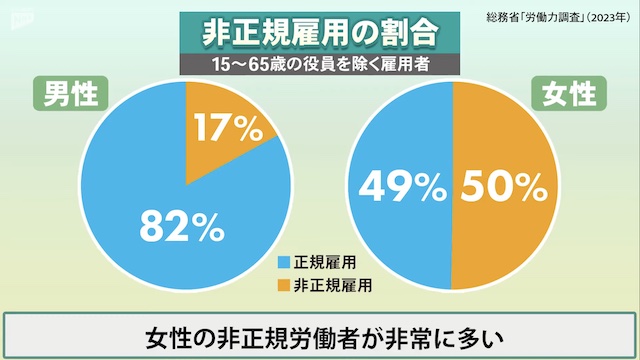
Niwano pointed out, "There are several factors, but the primary one is the lack of implementation of 'equal pay for equal work.' The reality that strikes first is the wage difference between non-regular employees and regular employees. Women often fall into the non-regular category, hence ending up with lower wages."
"Some women work part-time within their husband's dependency range to avoid paying into pensions and other insurances, keeping their income low. Additionally, there are young women who would prefer regular employment but end up in non-regular jobs due to circumstances, which can lead to 'women's poverty,'" explained Niwano.
Shiroma noted, "The employment rate 'M curve' that dips during childbearing phases is decreasing, but the 'L curve,' where regular employment drops after the late twenties, persists. Once a woman's career is interrupted for childbirth or childcare, returning to regular employment becomes challenging."
Niwano concluded, "Certainly, the high number of women in non-regular roles is problematic. However, according to Goldin's analysis, even among men and women who continue to work as regular employees, pay differs. The reason is that those available for long hours or sudden night calls are paid more, typically men, and in the absence of the husband, the wife might switch to a lower-paying job to manage the household."
Shioma mentioned, "Recently, there's been an increase in men from corporate communications saying they're taking paternity leave. If male paternity leave becomes more common, it might reduce the gendered division of roles."
Niwano added, "Another factor is the low number of women in management positions. Despite women in Japan highly advancing in education to universities and professional schools, they rarely make it to higher positions due to enduring practices like 'lifetime employment' and 'seniority-based promotions,' making it hard for women who step out for childcare to return to high-paying managerial roles."
Shioma concluded, "While industry norms are slowly changing, with banks like Mitsubishi UFJ, Mitsui Sumitomo, and Mizuho reporting equal pay for identical positions, the rate of women in management roles remains low, around 20%. This situation highlights the subtle, yet persistent wage inequalities even within the same position requiring nationwide relocation typically filled by men."
Niwano reflected, "A deeper look reveals that the background varies by industry."
Shioma added, "In recent years, efforts have been made to eliminate the traditional separation between general and comprehensive positions, and to strengthen the hiring of women into comprehensive roles. As women from this generation approach managerial levels in the next few years, significant improvements are expected."
Niwano remarked, "According to Takumi Fujinami, a senior researcher at the Japan Institute of Comprehensive Research, in industries like hospitality and food service where non-regular female workers are prevalent, women in positions like store manager do not have much wage difference compared to men."
"The response measures differ by industry, so officials from ministries responsible for each industry are part of this new project team. They will compile ways to change outdated practices from May onwards, and then approach businesses and industries to implement these changes," explained Niwano.
Shiroma humorously concluded, "If women are promoted more in the future, perhaps I won't rise as quickly, and my female peers might advance ahead of me. How do you think men feel about that?"
Niwano concluded, "I hope that wages will be based on ability and performance without gender bias."
"With Japan's aging population and the ongoing labor shortage, the capabilities and motivation of educated women are essential for sustaining the national economy and industries, and this also contributes to personal happiness," Niwano expressed.
Source: 日テレNEWS