News On Japan

Pension Revisions Spark Debate Over Spousal Benefits

TOKYO - Japan’s pension system is under review, and a key focus is on the "spousal pension" benefits. For homemakers, this is a pressing concern.
Pension Revisions Spark Debate Over Spousal Benefits

Homemaker (40s): "The thought of not receiving what we’ve been getting so far is quite alarming."

Homemaker (30s): "It’s worrying to think that the money we’re supposed to get might be reduced or eliminated."

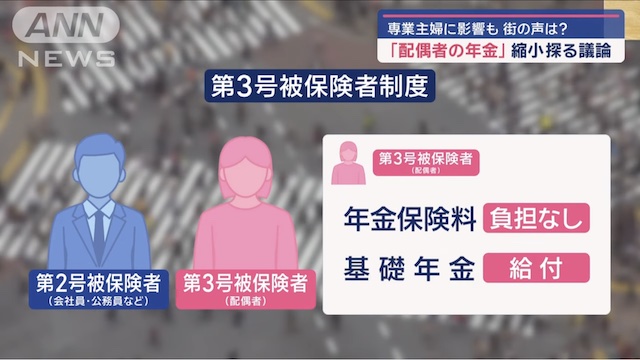
The debate centers around the "Category III insured persons system," which allows homemakers to receive pensions without paying premiums.

However, even under the current system...

Single person (50s): "When I realized that homemakers can get pensions without paying for them, I felt it was a bit unfair."

The revision of the pension system has sparked mixed reactions. What’s your stance?

Job-seeking student (20s): "In the past, there was the term 'marriage retirement,' but nowadays, everyone is expected to work, and both parents are expected to be employed, so I want to work until the end."

Will this affect women's employment? On May 13, the Ministry of Health, Labour and Welfare held a social security council where the Category III insured persons system was a key topic.

The Category III insured persons system allows spouses of company employees to receive a basic pension without paying insurance premiums.

Conditions include being the spouse of an employee covered by employees' pension insurance, being between 20 and 59 years old, and earning less than 1.3 million yen annually. Over 7 million people are currently eligible.

The main criticism of the Category III insured persons system is its perceived unfairness.

Dual-income household (40s): "Looking at my pay slip, I feel the burden of paying insurance premiums. It feels unfair compared to homemakers."

Forty years ago, households with homemakers were the majority, but now they have reduced to less than half of dual-income households, highlighting a discrepancy with current realities.

Single person (50s): "Why should people who aren’t working get pensions? I’ve been paying into the system every month. It feels unfair. Maybe I should have become a homemaker. But everyone has their own path in life, so I guess it can’t be helped."

Another issue is the so-called "1.3 million yen barrier," which limits the work of women who wish to remain eligible.

While working patterns are changing, about 30% of women in their late 30s and older fall under the Category III insured persons system.

If abolished, homemakers would need to pay new insurance premiums, potentially disrupting their financial plans. Additionally, there is concern that future pension payments could decrease.

Homemaker (40s): "If we don’t get the pension, we’ll need to save separately for the future costs of raising children. What should we do?"

In the recent council meeting, many opinions were voiced that the system should be revised to make it easier to join the employees' pension system, thus reducing the number of eligible recipients.

Source: ANN

News On Japan
POPULAR NEWS

Typhoon No. 25 had left four people dead and six others missing in Chiba and Kanagawa prefectures by September 22, as the storm moved away from Japan and the extent of flooding and landslide damage across the Kanto region became clearer.

Transport disruption from Typhoon No. 25 continued across Chiba Prefecture on September 22 even as flights and major highways returned toward normal, with entire sections of the JR network remaining suspended for the day and all Narita Express services canceled because of flooding, landslides and damage to railway infrastructure.

Japan came within two runs of producing one of international cricket's biggest upsets on September 22, pushing reigning T20 world champion India to the final ball before losing a rain-shortened match at Sano International Cricket Ground in Tochigi Prefecture.

Japan's Asian Games campaign continued across a packed Day 4 schedule on September 22, with the women's badminton team securing another medal, the women's basketball team completing an unbeaten group stage, and Japan adding a historic bronze medal in mixed air rifle shooting as several of the host nation's biggest medal opportunities moved into the evening.

Japan collected another 12 medals on Day 3 of the Aichi-Nagoya Asian Games on September 21, with 17-year-old swimmer Shin Ohashi and karateka Kakeru Nishiyama winning gold, while the host nation also advanced strongly in women's volleyball, baseball, soccer, handball and hockey.

MEDIA CHANNELS
         

MORE Politics NEWS

China held commemorative events across the country on September 18 to mark the 95th anniversary of the Mukden Incident, the 1931 railway explosion that Japan's Kwantung Army used as a pretext to seize Manchuria and which became a major turning point in the deterioration of relations between Japan and China.

Prime Minister Sanae Takaichi launched her first cabinet reshuffle since taking office, keeping core economic, foreign-policy and security ministers in place while replacing a broad group of other ministers in an attempt to stabilize her government before a difficult autumn of tax, budget, monetary policy and diplomatic battles.

Japan's Air Self-Defense Force has concluded that a large Global Hawk unmanned reconnaissance aircraft that lost communication off Tottori Prefecture on September 15 crashed into the sea.

Prime Minister Sanae Takaichi launched a new Liberal Democratic Party executive team on September 16, retaining most of the party’s senior leadership while pledging to unite the government and ruling party to overcome a difficult political and economic environment.

A Japan Air Self-Defense Force Global Hawk unmanned reconnaissance aircraft went missing over international waters about 50 kilometers north of Tottori Prefecture on September 15, with floating debris and oil later found in the area where communications were lost.

Prime Minister Sanae Takaichi’s government entered a decisive political week on September 15 after approving an outline for food-tax relief and household payouts without settling how the package will be funded, keeping fiscal concerns alive just days before the Bank of Japan is expected to decide whether to raise interest rates again.

Japan's government is set to approve tax reform guidelines on September 15 that will reduce the consumption tax on food from the current 8% to 1% for two years starting in April 2027 as part of measures to ease the burden of rising prices.

Genta Koja, a former deputy mayor of Naha who accepts the relocation of the U.S. Marine Corps Air Station Futenma to Henoko in Nago, won the Okinawa gubernatorial election on September 13, defeating incumbent Governor Denny Tamaki and bringing an end to 12 years of prefectural administrations committed to blocking the project.