TOKYO - The financial results of Japan's five major trading companies for the fiscal year ending March 2024 shows Mitsui & Co. has surpassed Mitsubishi Corporation to top the list with a net profit exceeding one trillion yen, while Sumitomo Corporation struggled with significant impairment losses. Although these companies have benefited from the weakening yen, the situation is more complex than it appears.
Warren Buffett has invested in these companies, making them highly watched both domestically and internationally as indicators of Japanese corporate performance. With the ongoing yen depreciation and potential interest rate hikes by the Bank of Japan, we will review their financial results and forecast their future business activities.
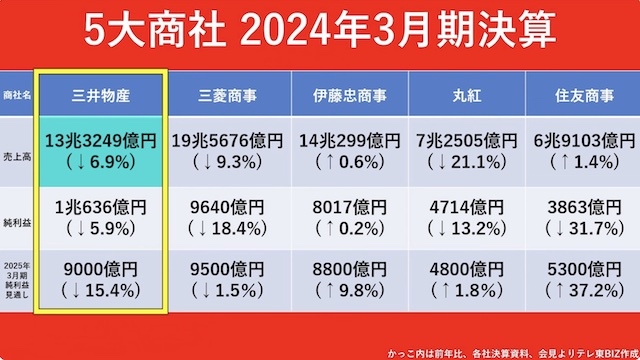
Mitsui & Co reported sales of 3.3249 trillion yen and a net profit of 1.0636 trillion yen. This is the second consecutive year that Mitsui & Co. has exceeded one trillion yen in net profit, maintaining this level while Mitsubishi Corporation fell below the one trillion yen mark, making Mitsui the top performer. The company achieved this through various strategic initiatives, maintaining a balanced and diversified portfolio across developed and emerging markets, showing strong resilience to environmental changes.
For the fiscal year ending March 2025, Mitsui & Co. plans to focus on food businesses such as shrimp and poultry farming and will also start lithium extraction in Brazil, anticipating the growing demand for batteries in electric vehicles. The company aims to strengthen its earning power by initiating new projects as planned. Despite this success, there are concerns about the Arctic LNG 2 project in Russia. The project, involving Russian company Novatek, faces sanctions from the United States due to Russia's invasion of Ukraine, potentially halting operations and utilization of the extracted LNG. Mitsui & Co. remains committed to the project for now but faces significant impairment risks if the project cannot proceed.
Mitsubishi Corporation reported sales of 19.5676 trillion yen and a net profit of 964 billion yen. Although it remains a giant, its net profit has decreased compared to the previous year due to continued coal production during the pandemic, resulting in operational strains. The fiscal year ending March 2025 is expected to see a slight decline in net profit to 950 billion yen. Mitsubishi Corporation plans to focus on next-generation energy businesses such as green hydrogen and green ammonia, as well as developing lithium and nickel resources in preparation for the widespread adoption of electric vehicles.
Itochu Corporation is less dependent on volatile resource sectors, resulting in stable sales and net profit. Sales amounted to 14.299 trillion yen, with a net profit of 801.7 billion yen, securing the third position among the trading companies. Itochu Corporation’s convenience store subsidiary, FamilyMart, continues to perform well, contributing to the company’s stable earnings. The company emphasizes profits from consumer-oriented businesses, distinguishing itself from Mitsubishi and Mitsui.
A significant point of interest for Itochu Corporation this fiscal year is the acquisition of the used car business from Big Motor. The company aims to reform Big Motor’s organizational culture and restore its reputation, focusing on customer satisfaction and earning public trust.
Marubeni Corporation reported sales of 7.25 trillion yen, a decrease of about 20% year-on-year, and a net profit of 474 billion yen, a decrease of approximately 13%. The company recorded a fixed asset impairment loss of 189 billion yen due to revised sales and production plans for its cardboard raw material manufacturing business in Vietnam. For the fiscal year ending March 2025, Marubeni forecasts a net profit increase of 1.8% to 480 billion yen, driven by profits from agriculture-related businesses and construction equipment operations.
In contrast, Sumitomo Corporation faced challenges with its nickel business in Madagascar, resulting in a significant impairment loss of 89 billion yen due to operational issues. The company’s net profit fell by over 30% to 386.3 billion yen, dropping it from the ranks of the top three trading companies. The company is working to normalize production but has not ruled out withdrawing from the project if necessary.
Source: テレ東BIZ