News On Japan

Ameyoko Restaurants Run by Foreigners, Mainly Chinese

TOKYO - Tokyo's downtown market district, Ameyoko, which attracts hundreds of thousands of shoppers, especially around New Year, is undergoing a major transformation. Traditional fresh fish stores have dwindled, while multinational restaurants have surged. What is happening?
Ameyoko Restaurants Run by Foreigners, Mainly Chinese

'70% of Restaurants' Run by Foreigners

The "Ameyoko Shopping Street," spanning about 500 meters along the elevated tracks from JR Ueno Station to JR Okachimachi Station in Tokyo, is a popular spot with around 400 shops. However, a change has occurred in recent years.

The area has become home to various international restaurants, particularly Chinese ones.

At "Chuan Chuan Xiang," a shop selling authentic Chinese dishes like pig's trotters and roast chicken, tourists from Taiwan take a break.

Tourist from Taiwan: 'We came to Japan for sightseeing, but we missed Chinese food and came here to eat. The taste is just like home.'

Chuan Chuan Xiang Staff: 'Ameyoko has many foreigners, not just Japanese customers, making it easier to do business. People from Vietnam, Myanmar, Thailand, and the Philippines also buy from us.'

According to Hayato Chiba, the vice chairman of the Ameyoko Shopping Street Union, who has been selling leather goods for 33 years, the number of restaurants has increased rapidly in recent years.

Hayato Chiba: 'About a dozen years ago, the first kebab shop appeared, and I thought it was unusual. About 5 to 6 years ago, the number suddenly increased. Now, there are about 50 restaurants out of around 400 shops. There were almost none in the past.'

Of the approximately 50 restaurants, 35 are run by foreigners, making up 70%.

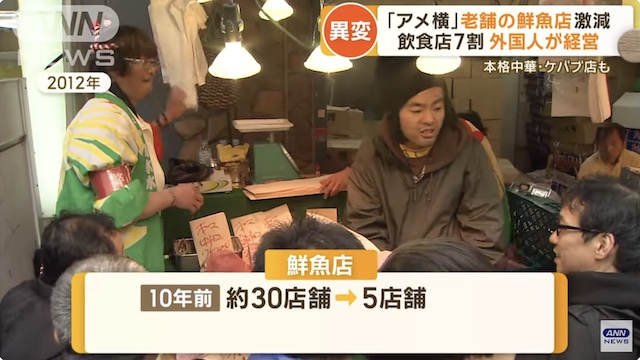
Fish Stores Decrease from 30 to 5 Stores

In contrast to the increasing number of restaurants, fish and dried food stores are decreasing. The bustling Ameyoko at the end of the year, with people searching for ingredients for New Year's, was a traditional scene...

Hayato Chiba: 'There used to be about 20 fish stores here. Now, there are five.'

Ten years ago, there were about 30 fish stores, but now there are only five, due to a lack of successors and the impact of COVID-19.

Kenko Mochimaru, President of Mochimaru Suisan: 'Before COVID-19, there were more than 10 stores, but since then, many have closed down. There are no successors, and some decided to quit because of the pandemic.'

As soon as a property becomes vacant, foreigners quickly rent it, transforming the area into the current multinational restaurant street.

Mochimaru, President: 'The momentum is incredible. As soon as a place becomes available, they move in.'

Focus on Traditional Retail Stores

The clientele of Ameyoko has also changed, with foreign tourists increasing about five years ago, now making up around 70% of visitors.

Tourist from Israel: 'It's a nice place, full of good ingredients like fruits, meat, and fish.'

Tourist from Mexico: 'There are many interesting shops selling fascinating items.'

With more foreign tourists unfamiliar with raw fish, the sales of surviving fish stores are declining, prompting them to consider new strategies.

Mochimaru, President: 'We are thinking of doing something besides fish, like grilling items for people to eat while walking.'

Ameyoko, rooted in the post-war black market, has evolved through the Showa, Heisei, and Reiwa eras. While accepting change, Chiba hopes people will also pay attention to the traditional retail stores that embody Ameyoko's essence.

Chiba, Vice Chairman: 'Restaurants have become essential, but as Ameyoko, a retail district, I hope people enjoy eating and drinking but also explore inside the underpass. It's a place where you can find anything except cars. It's like a treasure hunt; you always find something you want.'

Source: ANN

News On Japan
POPULAR NEWS

Typhoon No. 25 had left four people dead and six others missing in Chiba and Kanagawa prefectures by September 22, as the storm moved away from Japan and the extent of flooding and landslide damage across the Kanto region became clearer.

Transport disruption from Typhoon No. 25 continued across Chiba Prefecture on September 22 even as flights and major highways returned toward normal, with entire sections of the JR network remaining suspended for the day and all Narita Express services canceled because of flooding, landslides and damage to railway infrastructure.

Japan came within two runs of producing one of international cricket's biggest upsets on September 22, pushing reigning T20 world champion India to the final ball before losing a rain-shortened match at Sano International Cricket Ground in Tochigi Prefecture.

Japan's Asian Games campaign continued across a packed Day 4 schedule on September 22, with the women's badminton team securing another medal, the women's basketball team completing an unbeaten group stage, and Japan adding a historic bronze medal in mixed air rifle shooting as several of the host nation's biggest medal opportunities moved into the evening.

Japan collected another 12 medals on Day 3 of the Aichi-Nagoya Asian Games on September 21, with 17-year-old swimmer Shin Ohashi and karateka Kakeru Nishiyama winning gold, while the host nation also advanced strongly in women's volleyball, baseball, soccer, handball and hockey.

MEDIA CHANNELS
         

MORE Travel NEWS

A phone booth that converts the voice of the person on the other end of a call into real-time text has been installed at Haneda Airport for four days, offering visitors a glimpse of technology designed for people who have difficulty hearing telephone conversations.

Peach Aviation began scheduled flights between Narita Airport and South Korea's Incheon International Airport on September 20, marking the low-cost carrier's first new international route from Narita in seven years.

Japan's Silver Week began on September 19 with five consecutive days off for the first time in 11 years, drawing crowds to food and festival events across the country despite rainy weather in the Kanto region as Typhoon No. 25 approached.

Volcanic smoke continues to rise from Mount Tokachi (Tokachidake), an active volcano in Daisetsuzan National Park in Hokkaido, one week after its eruption alert level was raised to Level 3, restricting entry to the mountain and prompting a series of cancellations at nearby hot spring inns just before the peak autumn foliage season.

The Kyushu Shinkansen will resume operations along its entire route on September 18 after suffering extensive track and other damage in the Kumamoto earthquake, raising hopes that the long-awaited restoration will help revive tourism in disaster-hit areas ahead of the Silver Week holiday period.

A black bear has been spotted near one of the most popular hiking trails on Mount Takao in western Tokyo, prompting authorities to urge visitors to take precautions ahead of the five-day Silver Week holiday and the approaching autumn foliage season.

Prolonged rain is disrupting tourism ahead of Japan's Silver Week holidays, forcing Nagatoro's popular river cruises to remain suspended for an 11th consecutive day while increased water flow at Fukuroda Falls in Ibaraki Prefecture is drawing more visitors.

A new top-tier "Supreme Class" offering fully private compartments above the level of Green Car service will debut on the Tokaido and Sanyo Shinkansen on October 1, with passengers able to experience the new seating at a demonstration booth at Shin-Osaka Station.