News On Japan

Japan’s Growing Problem of Vacant Homes

TOKYO - The number of vacant homes in Japan has reached a record high of approximately 9 million due to factors such as an aging population and declining birth rates. Wakayama Prefecture, with a vacancy rate of 21.2%, and Setagaya Ward in Tokyo, which has the highest number of vacant homes among municipalities with 50,000 homes, have been the focus of recent investigations.
Japan’s Growing Problem of Vacant Homes

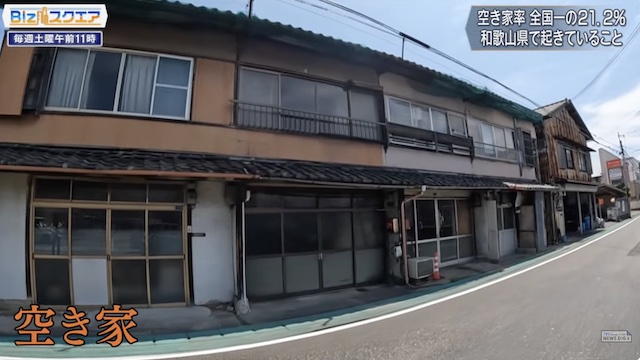
Located in the southern part of Wakayama Prefecture, Tanabe City is famous for its plum production but now faces the growing issue of vacant homes. A local neighborhood association recently reported a vacant house with a broken pillar, prompting an immediate inspection. The wooden one-story house, approximately 46 square meters in size, had a broken pillar and a leaning wall. A drone inspection revealed that half of the roof had collapsed.

Nearby residents expressed concern over the safety of such structures. The vice president of the neighborhood association, who also owns a vacant house, reported the issue. The city contacted the property owner, who agreed to demolish the house, leading to the arrival of a demolition contractor within two hours. With municipal subsidies, demolition commenced six days later.

Such vacant house issues are prevalent nationwide. According to a survey released by the Ministry of Internal Affairs and Communications in April, the number of vacant houses in Japan reached approximately 9 million, a record high. Wakayama Prefecture's vacancy rate of 21.2% is the highest in the country. In such regional cities, the cost of land often becomes cheaper than the demolition costs, leading to abandoned properties.

Tanabe City has been addressing this issue since 2017 by offering free demolition cost estimates and providing up to 500,000 yen in subsidies for houses at risk of collapse. This program's budget covers 12 demolitions, amounting to 6 million yen. Additionally, the city has introduced unique measures to utilize vacant land, such as transforming former vacant house sites into community gardens. A program launched in July allows neighboring residents to acquire adjacent land for a nominal fee, facilitating the extension of their property and ensuring community safety. This system has been utilized 53 times so far.

Efforts to repurpose vacant houses are also underway. A program matches residents wanting to start businesses with vacant houses, allowing them to renovate the property for use as study rooms for high school students or accommodation for university interns. Annual rent for such properties is 97,000 yen. The city has also conducted briefings with local businesses to promote further utilization of vacant houses.

However, the issue of vacant houses is not confined to regional cities. In Tokyo’s Setagaya Ward, areas like the quiet residential neighborhood near Komazawa Park have sections where vacant houses have become overgrown and dilapidated. Despite high property values, many owners prefer to hold onto these properties as assets, delaying decisions to sell or demolish them. Setagaya Ward has received approximately 200 annual inquiries about vacant houses, leading to detailed investigations and safety measures.

According to Nomura Research Institute, the vacancy rate in Japan is expected to double in the next 20 years. Setagaya Ward is focusing on preventive measures and supporting owners to avoid properties becoming vacant.

Source: TBS

News On Japan
POPULAR NEWS

Typhoon No. 25 had left four people dead and six others missing in Chiba and Kanagawa prefectures by September 22, as the storm moved away from Japan and the extent of flooding and landslide damage across the Kanto region became clearer.

Transport disruption from Typhoon No. 25 continued across Chiba Prefecture on September 22 even as flights and major highways returned toward normal, with entire sections of the JR network remaining suspended for the day and all Narita Express services canceled because of flooding, landslides and damage to railway infrastructure.

Japan came within two runs of producing one of international cricket's biggest upsets on September 22, pushing reigning T20 world champion India to the final ball before losing a rain-shortened match at Sano International Cricket Ground in Tochigi Prefecture.

Japan's Asian Games campaign continued across a packed Day 4 schedule on September 22, with the women's badminton team securing another medal, the women's basketball team completing an unbeaten group stage, and Japan adding a historic bronze medal in mixed air rifle shooting as several of the host nation's biggest medal opportunities moved into the evening.

Japan collected another 12 medals on Day 3 of the Aichi-Nagoya Asian Games on September 21, with 17-year-old swimmer Shin Ohashi and karateka Kakeru Nishiyama winning gold, while the host nation also advanced strongly in women's volleyball, baseball, soccer, handball and hockey.

MEDIA CHANNELS
         

MORE Society NEWS

People aged 65 and older accounted for a record 29.6% of Japan's population in 2026, the highest proportion among major countries worldwide, while the number of elderly people in employment also reached an all-time high as Japan marked Respect for the Aged Day on September 21.

Emperor Naruhito and Empress Masako visited Ghibli Park in Aichi Prefecture on September 20, touring exhibits that recreate famous scenes from Studio Ghibli films and posing for a photograph with the character No-Face.

Police in Kanagawa Prefecture have rearrested four teenagers on suspicion of murdering a 17-year-old high school student who died after being assaulted in Sagamihara in August.

Drinking parties remain a lively part of social life in Kansai even as younger generations increasingly turn away from alcohol and izakaya bankruptcies rise at a record pace, with customers describing the gatherings less as occasions to drink heavily and more as opportunities to maintain friendships, meet new people and build connections across generations.

Anonymous and fluid criminal groups known in Japan as "tokuryu" are adopting increasingly elaborate tactics, including a scheme in which elderly victims are persuaded to hide cash inside refrigerators before thieves enter their homes, as authorities struggle to combat networks whose members often have no direct contact with one another.

A luxury mansion in Bangkok described as resembling a palace was being used as a base for a specialized fraud operation targeting Japanese people, with Thai authorities detaining 14 people, including four Japanese men.

Copper roofing has been stripped from Shinano-no-miya Shrine in Oshika Village, Nagano Prefecture, leaving the wooden structure exposed in the latest of a series of similar thefts reported at shrines across the prefecture.

A popular Tokyo nightclub hostess and influencer known as Yamatorino, who says she generated more than 200 million yen in sales during a single month, has been arrested on suspicion of possessing cocaine with her boyfriend at their home in Roppongi.