News On Japan

Challenges of Cultural Differences: Indonesian Care Worker Navigates Japan's Expanding Home Care Services

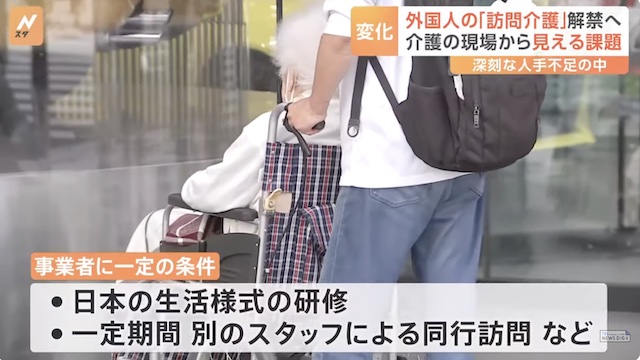
TOKYO - Japan's Ministry of Health, Labor and Welfare plans to lift restrictions on "home care" for foreign workers with specific skills and technical intern trainees under certain conditions. This change aims to address the ongoing labor shortage in the caregiving sector. What challenges have emerged from the field?
Challenges of Cultural Differences: Indonesian Care Worker Navigates Japan's Expanding Home Care Services

Elma, a 27-year-old Indonesian care worker, provides home care services for a woman with a severe illness, assisting with meals and repositioning her body.

Elma, who loves Japanese culture, came to Japan at 18, inspired by the demand for caregivers and a desire to help. She studied at a specialized school and obtained her qualifications in about three years.

Elma recalls the early struggles with communication and cultural differences, often relying on a dictionary and taking notes.

"In home care, you must handle emergencies by yourself," Elma explains. The one-on-one nature of home care means it has been limited to those with a caregiving qualification, like Elma. Unqualified foreigners have not been permitted to provide these services.

However, due to the severe labor shortage, the Ministry’s review committee approved a draft report today to allow foreigners with specific skills and technical intern trainees to perform home care duties. Employers will need to ensure these workers receive training in Japanese lifestyles and initially accompany other staff members.

Elma, a Muslim, prays five times a day, obtaining permission from her clients to do so during her visits.

Miyazato, president of Pukkuru Care where Elma works, distributes handmade leaflets to help clients understand these cultural practices.

"We take these leaflets and explain to clients, asking for their cooperation," Miyazato says, emphasizing the need for employers to facilitate understanding and acceptance.

With Japan's aging population, mutual understanding becomes increasingly important.

Source: TBS

News On Japan
POPULAR NEWS

Japan’s World Cup campaign ended in the cruelest possible fashion on June 29, as Gabriel Martinelli scored in the fifth minute of stoppage time to give Brazil a 2-1 victory over the Samurai Blue in their knockout match in Houston. Japan had led in the first half and were still level at 1-1 in the final moments, but Martinelli’s late strike sent Brazil into the Round of 16 and eliminated Japan from the tournament.

A Kintetsu Railway train derailed inside Kyoto Station on the morning of June 29, forcing partial suspensions on the Kintetsu Kyoto Line for the rest of the day and causing long delays that hit commuters, students and tourists.

A section of stone wall at Hikone Castle, one of Japan’s few surviving original Edo-period castles and a National Treasure whose main keep remains intact more than 400 years after its construction, collapsed after heavy rain caused by Typhoons No. 7 and No. 8, Hikone city officials said.

Japan advanced to the knockout stage of the World Cup after a 1-1 draw with Sweden on June 25, finishing second in Group F and setting up a Round of 32 clash with Brazil in Houston.

A powerful earthquake with a maximum seismic intensity of upper 6 struck off Iwate Prefecture at around 7:30 a.m. on June 25, shaking parts of Aomori Prefecture and leaving Hachinohe, which was hit by a similarly strong quake last December, facing fresh damage.

MEDIA CHANNELS
         

MORE Education NEWS

A major job fair in Hamamatsu, Shizuoka Prefecture, drew more than 3,700 high school students as local businesses, government and schools joined forces to stem the outflow of young people and encourage future U-turn employment.

A U.S. family took part in a Japanese school experience program at a former school building in Chiba Prefecture, joining calligraphy, disaster drills, school lunch duty and a sports day-style event in a six-hour program that has attracted more than 200 foreign participants since it began about a year ago.

Urakawa, a Hokkaido town of about 10,000 people known as one of Japan's leading thoroughbred breeding centers, is seeing a rapid increase in Indian residents as local farms turn to experienced overseas workers to offset a shrinking pool of Japanese horse trainers.

A certification exam testing knowledge and skills related to ninjas was held in Koka, Shiga Prefecture, a city known as one of Japan's historic ninja centers.

The Tokyo Fire Department has called for greater public cooperation with emergency medical services following a rise in incidents involving interference with ambulance crews, including cases in which paramedics have been assaulted while carrying out rescue operations.

The University of Tokyo and TOPPAN Holdings announced the establishment of the AI Innovation Research Center, a new initiative aimed at advancing research and development for the practical application of artificial intelligence in society.

As bear sightings continue at an unusually high pace across Akita Prefecture, a veteran wildlife photographer who has spent nearly 30 years observing and photographing Asian black bears says the animals are appearing more frequently, moving closer to human settlements, and increasingly adapting their behavior to survive.

The Blue Angels, the cheerleading squad of Joto High School's support and cheering club, are winning over audiences with their sparkling smiles and dynamic performances.