News On Japan

Bank's Decision to Scrap Seniority System Marks Shift in Japan's Corporate Culture

Bank's Decision to Scrap Seniority System Marks Shift in Japan's Corporate Culture

TOKYO - The long-standing seniority-based system in Japanese companies is being phased out. Many have considered it natural to rise with age, but there have been times when people desired recognition based on ability. With this deeply ingrained system now under review, will the decision by a major bank change Japan's corporate culture?

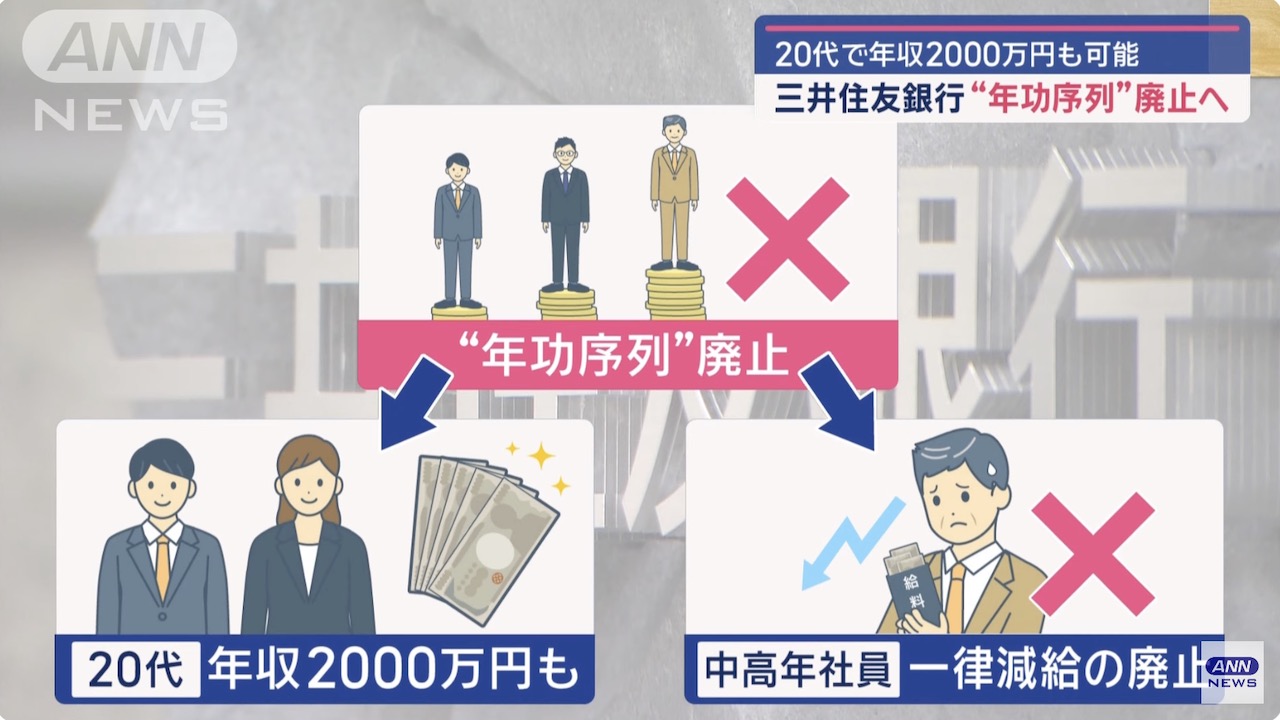
It has been revealed that Sumitomo Mitsui Banking Corporation, one of Japan's three mega-banks, is planning a major overhaul of its personnel system. One of the significant changes is the abolition of the seniority-based system. Currently, salaries and positions increase with years of service. Sumitomo Mitsui, with approximately 30,000 employees, plans to abolish this system within two years. The bank aims to shift to a performance-based system.

The seniority system was introduced during Japan's post-war economic boom to ensure long-term employment. Mega-banks, which have historically hired large numbers of new graduates, have adhered strongly to this system. What is Sumitomo Mitsui's main goal? The bank wants to attract and retain talented individuals. Recognizing and rewarding young professionals for their contributions, regardless of age, is expected to strengthen their appeal to the younger generation. It will also ensure that even older employees who deliver results receive appropriate compensation. The key point is that under the new system, even a 20-something could earn an annual salary of 20 million yen based on performance.

This move also abolishes the automatic reduction of salaries for middle-aged and older employees. How do people on the streets perceive this change? Opinions are mixed. One man in his 40s welcomes the end of the seniority system, believing it to be beneficial for the younger generation. Another 40-something appreciates the predictability of the old system for financial planning. A pair of 20-somethings expressed divided opinions; one felt motivated by the change, while the other worried about the risk of salary decreases.

Business leaders also have varied views. One executive supports the idea, emphasizing the desire to reward high performers regardless of age. However, evaluating abilities remains challenging.

Experts believe that the abolition of the seniority system by a major bank signals a significant shift. They expect this change to influence smaller companies as well. Small and medium-sized enterprises (SMEs), which struggle to secure talent, are likely to follow suit in adjusting their wage structures. The collapse of the seniority system is expected to accelerate rapidly.

From the workers' perspective, it's challenging to determine which system is better. The current pressure on Japanese companies to attract top talent to remain competitive internationally highlights the urgency of such reforms.

Source: ANN

News On Japan
POPULAR NEWS

Typhoon No. 25 had left four people dead and six others missing in Chiba and Kanagawa prefectures by September 22, as the storm moved away from Japan and the extent of flooding and landslide damage across the Kanto region became clearer.

Transport disruption from Typhoon No. 25 continued across Chiba Prefecture on September 22 even as flights and major highways returned toward normal, with entire sections of the JR network remaining suspended for the day and all Narita Express services canceled because of flooding, landslides and damage to railway infrastructure.

Japan came within two runs of producing one of international cricket's biggest upsets on September 22, pushing reigning T20 world champion India to the final ball before losing a rain-shortened match at Sano International Cricket Ground in Tochigi Prefecture.

Japan's Asian Games campaign continued across a packed Day 4 schedule on September 22, with the women's badminton team securing another medal, the women's basketball team completing an unbeaten group stage, and Japan adding a historic bronze medal in mixed air rifle shooting as several of the host nation's biggest medal opportunities moved into the evening.

Japan collected another 12 medals on Day 3 of the Aichi-Nagoya Asian Games on September 21, with 17-year-old swimmer Shin Ohashi and karateka Kakeru Nishiyama winning gold, while the host nation also advanced strongly in women's volleyball, baseball, soccer, handball and hockey.

MEDIA CHANNELS
         

MORE Business NEWS

Tokyo’s stock market was closed on September 21 for Respect for the Aged Day, leaving the Nikkei 225 without a cash close after finishing the previous session at 65,019, while currency and futures markets focused on the yen, the Bank of Japan’s latest rate hike and intervention risks during Japan’s Silver Week holiday.

Japan's first five-day Silver Week holiday in 11 years has put renewed attention on household finances, with persistently high food prices and a weakening yen threatening to erode the benefits of the government's planned consumption tax cut on food.

A list of providers with identical promises turns selection into brute-force sorting. The differences do exist; they are just hidden somewhere other than the homepage.

The Bank of Japan raised its policy rate from 1.0% to 1.25% on September 18, taking borrowing costs to their highest level in 31 years and accelerating the pace of monetary tightening as persistent inflation and concerns over fiscal expansion put upward pressure on interest rates.

The yen strengthened by more than 1 yen against the dollar in a short period late on September 18 after the Bank of Japan conducted a rate check, a step commonly taken in preparation for possible intervention in the foreign exchange market.

Tokyo stocks rose sharply on September 18, with the Nikkei 225 climbing to around 65,350 in afternoon trading after the Bank of Japan raised interest rates to 1.25%, as the yen weakened and investors bought artificial intelligence and semiconductor-related shares.

The Bank of Japan raised its policy interest rate from 1.0% to 1.25% on September 18, lifting borrowing costs to their highest level in 31 years as policymakers moved to contain growing inflation risks, but the yen weakened sharply after the decision as markets focused on two dissenting votes and uncertainty over the pace of further increases.

A market spread is generally the difference between two market prices. Most commonly, traders use the term to describe the bid-ask spread: the difference between the highest price a buyer is currently prepared to pay and the lowest price a seller is prepared to accept.