News On Japan

Yen Plunges to Historic Low; Intervention Likely

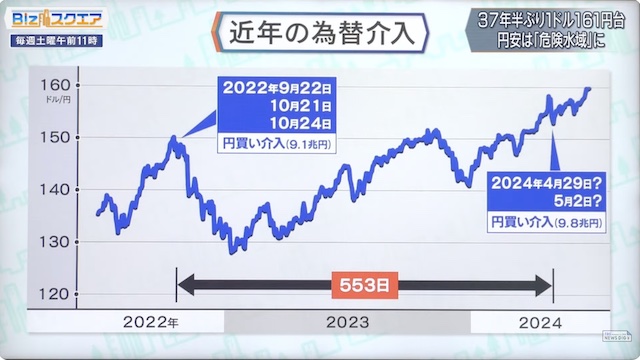
TOKYO - On the 28th, the yen temporarily fell to the 161-yen level against the dollar, marking the weakest level in approximately 37 and a half years. Market concerns are growing over potential currency intervention by the government and the Bank of Japan (BOJ).
Yen Plunges to Historic Low; Intervention Likely

The yen started the week on Monday at levels approaching the critical 160-yen mark in the Tokyo foreign exchange market. The BOJ, during its policy meeting this month, hinted at the need for intervention if necessary, but the impact on the currency market was limited.

Changes occurred on Wednesday when a Federal Reserve Board official indicated that lowering interest rates was not yet appropriate due to the risk of reaccelerating inflation, pushing the yen down to 160.80 yen to the dollar. This level of depreciation had not been seen since December 1986, following the Plaza Accord when major countries intervened to correct the strong dollar.

During an interview, Finance Minister Kanda recognized the current rapid movements and indicated that the government would take necessary measures against excessive movements. Despite this, the yen fell to 161.20 yen to the dollar before 10 AM, further advancing the historic depreciation of the yen.

The market remains wary that the government and the BOJ might step in to intervene in the currency market as the yen's rapid fall past the 160-yen mark in just two days heightened concerns. The Finance Minister's warning did little to calm the market, and the yen continued to fluctuate around 161 yen in the afternoon.

The market perceives that the interest rate differential between Japan and the US will remain unchanged for the foreseeable future, prompting investors to seek higher returns in other currencies. Kazuo, a strategist at Barita Research, expressed frustration over the lack of intervention, stating that interventions alone cannot stop the yen's depreciation without substantial and sustained measures.

BOJ Governor Ueda, during the policy meeting on June 18th, mentioned that raising policy rates in July was a possibility, though the market reaction was minimal. Analysts suggest that the yen's depreciation might be viewed as a result of Japan's continued accommodative monetary policy. The effectiveness of past interventions has diminished, as evidenced by the yen's quick return to weaker levels.

While the BOJ and the government have repeatedly signaled their intent to intervene if necessary, the market views these actions as insufficient to reverse the yen's slide. The yen's fall to the 160-yen level has led to discussions about Japan's willingness to tolerate a weaker currency, reflecting political rather than purely economic motives.

The market awaits stronger and more decisive actions from Japanese authorities to halt the yen's decline. The upcoming BOJ meeting in July and potential policy adjustments will be critical in shaping the future of the yen's exchange rate.

Source: TBS

News On Japan
POPULAR NEWS

Typhoon No. 25 had left four people dead and six others missing in Chiba and Kanagawa prefectures by September 22, as the storm moved away from Japan and the extent of flooding and landslide damage across the Kanto region became clearer.

Transport disruption from Typhoon No. 25 continued across Chiba Prefecture on September 22 even as flights and major highways returned toward normal, with entire sections of the JR network remaining suspended for the day and all Narita Express services canceled because of flooding, landslides and damage to railway infrastructure.

Japan came within two runs of producing one of international cricket's biggest upsets on September 22, pushing reigning T20 world champion India to the final ball before losing a rain-shortened match at Sano International Cricket Ground in Tochigi Prefecture.

Japan's Asian Games campaign continued across a packed Day 4 schedule on September 22, with the women's badminton team securing another medal, the women's basketball team completing an unbeaten group stage, and Japan adding a historic bronze medal in mixed air rifle shooting as several of the host nation's biggest medal opportunities moved into the evening.

Japan collected another 12 medals on Day 3 of the Aichi-Nagoya Asian Games on September 21, with 17-year-old swimmer Shin Ohashi and karateka Kakeru Nishiyama winning gold, while the host nation also advanced strongly in women's volleyball, baseball, soccer, handball and hockey.

MEDIA CHANNELS
         

MORE Business NEWS

Tokyo’s stock market was closed on September 21 for Respect for the Aged Day, leaving the Nikkei 225 without a cash close after finishing the previous session at 65,019, while currency and futures markets focused on the yen, the Bank of Japan’s latest rate hike and intervention risks during Japan’s Silver Week holiday.

Japan's first five-day Silver Week holiday in 11 years has put renewed attention on household finances, with persistently high food prices and a weakening yen threatening to erode the benefits of the government's planned consumption tax cut on food.

A list of providers with identical promises turns selection into brute-force sorting. The differences do exist; they are just hidden somewhere other than the homepage.

The Bank of Japan raised its policy rate from 1.0% to 1.25% on September 18, taking borrowing costs to their highest level in 31 years and accelerating the pace of monetary tightening as persistent inflation and concerns over fiscal expansion put upward pressure on interest rates.

The yen strengthened by more than 1 yen against the dollar in a short period late on September 18 after the Bank of Japan conducted a rate check, a step commonly taken in preparation for possible intervention in the foreign exchange market.

Tokyo stocks rose sharply on September 18, with the Nikkei 225 climbing to around 65,350 in afternoon trading after the Bank of Japan raised interest rates to 1.25%, as the yen weakened and investors bought artificial intelligence and semiconductor-related shares.

The Bank of Japan raised its policy interest rate from 1.0% to 1.25% on September 18, lifting borrowing costs to their highest level in 31 years as policymakers moved to contain growing inflation risks, but the yen weakened sharply after the decision as markets focused on two dissenting votes and uncertainty over the pace of further increases.

A market spread is generally the difference between two market prices. Most commonly, traders use the term to describe the bid-ask spread: the difference between the highest price a buyer is currently prepared to pay and the lowest price a seller is prepared to accept.