TOKYO - The charm of Japanese antique markets lies in discovering rare items before they fade into obscurity. These markets have become a gathering spot for foreign treasure hunters, whose interest now surpasses that of Japanese collectors.
Rare Film: 'Young Lincoln'
At the Saitama Antique Fair on June 11, a wide variety of items were on display, from traditional Japanese furniture to Western armor. Yannick, a 24-year-old student from Germany, was on the lookout for vintage cameras.
Yannick said, "I got this one for 1,000 yen at another antique market. It was broken and didn’t work, but I took it apart and fixed it myself."
Yannick often buys damaged cameras at a low price and repairs them. Occasionally, he comes across rare finds.
"This camera is extremely rare—it doesn’t even have a serial number," Yannick explained. Surprisingly, he bought it for just 300 yen.
This is the thrill of antique markets, where one can find a personal treasure. The fair, featuring over 140 vendors, was filled with mysterious antiques that were not always easy to identify.
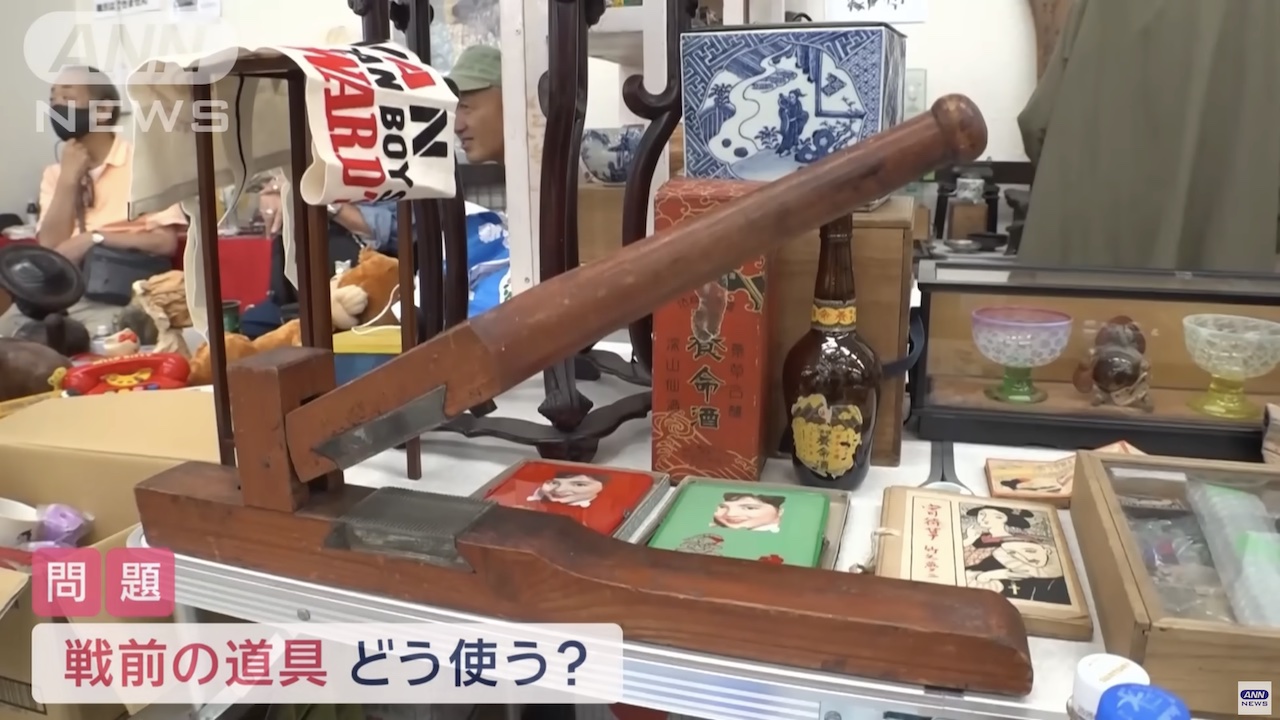
One vendor held up an item, asking, "Do you know what this is?"
It was a tool from the Edo period, with part of it made from iron. You might have seen something like it in period dramas.
"This is a striker used for lighting fires, made from obsidian or another material. You strike it to produce sparks and start a fire. You’ve probably seen it in samurai films."
A closer look revealed a pocket where cotton was stored for starting fires.
Another curious item resembled a prewar camera, but it was actually a lantern projector, used to project images by manually winding film through the device. The vendor even had a rare film of 'Young Lincoln,' which may have been used in schools.
A Lifelong Love for Antiques
At the Yokohama Kotto World antique fair, another unique item caught the attention of Lisa Westberg (in her 40s), who was visiting from Zushi with her husband.
"I’ve never seen anything like this before. I wonder what it was used for," she said.
The tool, mostly made of wood with some glass, was used for squeezing juice from persimmons to dye fabrics.
Lisa’s interest in antiques began with her father, Hogan, 76.
"I love traditional designs. How much is this?" Hogan asked.
"It’s 1,000 yen," the vendor replied.
"I’ll take it," Hogan said.
The Westberg family’s love for antiques is evident in their home, which is filled with treasures from various countries. In their Japanese-style room stands a gold statue from China, and the veranda is adorned with a Mexican plant pot with traditional patterns.
Lisa shared, "I’m drawn to items that reflect different cultures. I love displaying them."
Passion for Japan’s History
In Kyoto, the largest antique fair in western Japan attracted over 300 vendors and long lines of people, with more than 300 attendees waiting to enter.
Many foreigners, like Peter from Canada, were drawn to this event. Peter, 59, had been searching for a specific item and was thrilled to finally purchase a piece of samurai armor called 'hanbo.'
"A hanbo is a protective mask that covers the cheeks and chin," Peter explained. "I paid 50,000 yen for it."
Though the price might seem steep, Peter wasn’t fazed. "It’s not expensive at all—my love for Japanese history is strong."
Peter’s home in Canada houses an impressive collection, including a helmet from the Momoyama period and a box used for storing armor from the Sekigahara battle era. His latest purchase was a Taisho-era military medal.
Peter proudly added, "I also collect Japanese medals."
The asking price for one medal was 4,000 yen, but Peter managed to negotiate a discount. "I’ll buy all 10 for 15,000 yen. The condition isn’t great, so I’d like a better price," he said, sealing the deal.
Remaking Kimonos Found at Antique Markets
One particularly devoted visitor to these fairs is Andrea, a Hungarian woman in her 20s who has lived in Japan for five years. Andrea regularly attends antique markets, where she buys old kimonos to remake into stylish outfits.
"I wear kimonos all the time," Andrea said. "I’m even going to work in this outfit today."
Andrea works for an IT company and often wears her kimono to meetings. She embellishes her outfits with embroidery inspired by traditional Hungarian designs.
Before coming to Japan, Andrea dressed conservatively, but since discovering kimonos, her creativity has flourished. She has remade over 150 kimonos into her unique designs.
"It’s fun, but I don’t have many friends who understand this passion," she admitted.
The Allure of Japanese Antiques for Foreign Collectors
At a Kyoto antique market, Chris, a 48-year-old American, caught attention. Chris spent 10 years working at Christie’s, one of the most prestigious auction houses in the world.
Despite his vast experience with global antiques, Chris purchased a humble item—a tanzaku (poem card) from the Edo period.
"This is a work by Rengetsu, a female poet from the Edo period," Chris shared.
Though his home in the U.S. boasts a remarkable collection, including silver plates adorned with the Tokugawa family crest and plates from the Azuchi-Momoyama period, Chris has a special fondness for a chipped Edo-era water pitcher.
"In China, when a ceramic piece is flawed, they throw it away. But in Japan, they value these imperfections. This concept of 'wabi' exists only in Japan, and that’s what makes Japanese art so interesting," he said.
Japanese antique markets continue to captivate foreign collectors with their rich history and unique charm.
Source: ANN