News On Japan

Industrial Land Shortage Poses Challenge to Japan’s Manufacturing Comeback

Industrial Land Shortage Poses Challenge to Japan’s Manufacturing Comeback

TOKYO - With the weakening yen and growing demand for semiconductors, Japan's manufacturing industry is experiencing a resurgence. New industrial clusters, such as those in Kyushu's 'Silicon Island,' are emerging. However, a shortage of suitable 'industrial land' - land with convenient transportation links and easy access to materials - is becoming increasingly evident.

The development of large-scale industrial parks was rapid during Japan’s period of high economic growth, driven by national initiatives. These parks provided ample land for industries to set up their facilities. However, following the economic bubble and subsequent rise in the yen, many businesses relocated their production bases to China and Southeast Asia, leaving industrial land unused.

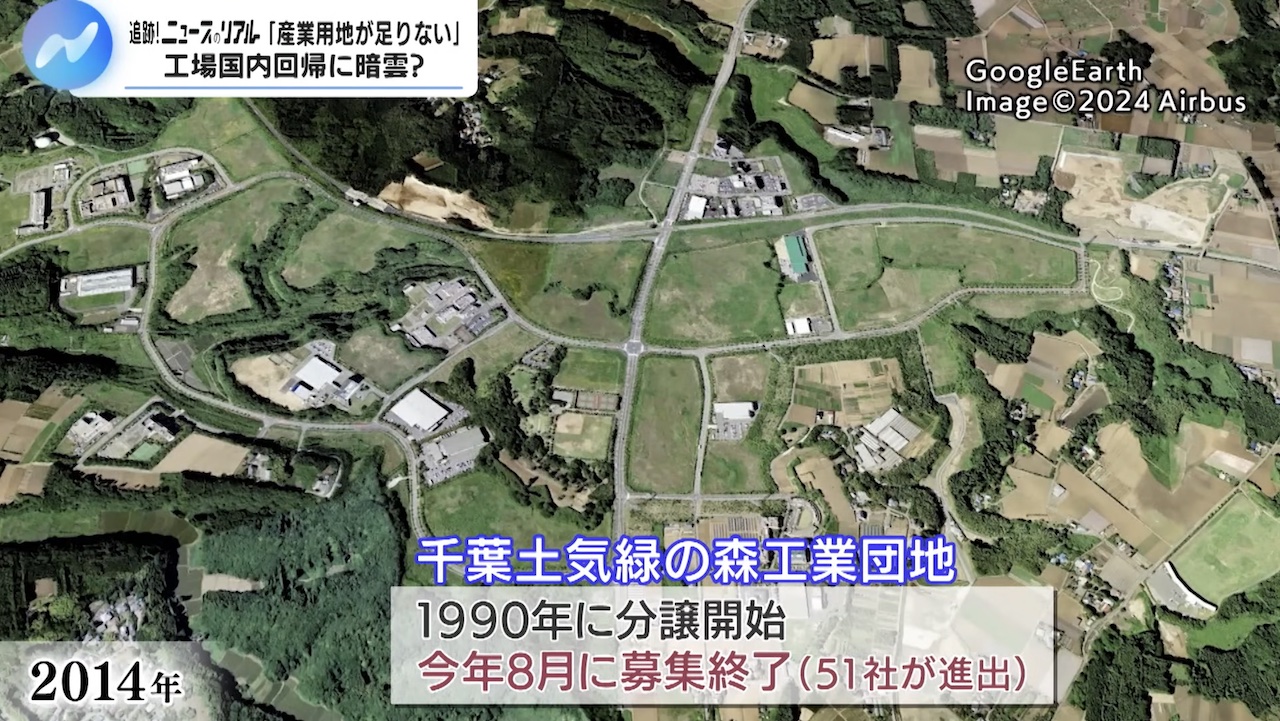
Yet, recently, signs of change have appeared. In Chiba City's Midori Ward, a bustling industrial park spans an area of roughly 160 hectares, equivalent to 34 Tokyo Domes. Factories and research facilities are rapidly filling the available space, with more than 50 companies setting up operations. This industrial park, which saw stagnation following the bubble burst, is now fully occupied.

Even more industrial land, about 50 kilometers away, is also seeing high demand. The Chiba prefectural government reports that inquiries from companies looking to secure industrial land have increased by 20% in the past five years, receiving around 150 inquiries per year. A prefectural official expressed hope that this could create job opportunities and boost local economies.

Nevertheless, Japan is facing an overall shortage of industrial land. The Japan Industrial Location Center, a foundation established in 1962 to consult on industrial land development, attributes the shortage to the continuous depletion of available land. During the bubble and the global financial crisis, excess land remained in stock, but as companies resumed domestic operations, that supply dwindled. Local governments, wary of financial risks, are hesitant to develop new industrial parks, leaving them with a significant shortage.

The lack of experience in industrial land development, coupled with a dwindling workforce knowledgeable in the field, has made it even harder to expand the supply. This problem has persisted over the past three decades, with many municipalities now uncertain about how to restart industrial land development from scratch.

To tackle this issue, the Japan Industrial Location Center has been dispatching experienced personnel to help local governments across Japan. In Nagano, a 11-hectare site has already been secured for semiconductor-related manufacturers, with plans to attract more companies to boost the region's economy.

Professor Kazuo Kadokawa from Tokai University’s Department of Political Economy commented that the increasing demand for industrial land must be addressed, but the supply-side constraints remain a significant challenge. As companies show renewed interest in relocating production facilities domestically, the shortage of industrial land could hinder Japan’s economic revival efforts.

Source: テレ東BIZ

News On Japan
POPULAR NEWS

Typhoon No. 25 had left four people dead and six others missing in Chiba and Kanagawa prefectures by September 22, as the storm moved away from Japan and the extent of flooding and landslide damage across the Kanto region became clearer.

Transport disruption from Typhoon No. 25 continued across Chiba Prefecture on September 22 even as flights and major highways returned toward normal, with entire sections of the JR network remaining suspended for the day and all Narita Express services canceled because of flooding, landslides and damage to railway infrastructure.

Japan came within two runs of producing one of international cricket's biggest upsets on September 22, pushing reigning T20 world champion India to the final ball before losing a rain-shortened match at Sano International Cricket Ground in Tochigi Prefecture.

Japan's Asian Games campaign continued across a packed Day 4 schedule on September 22, with the women's badminton team securing another medal, the women's basketball team completing an unbeaten group stage, and Japan adding a historic bronze medal in mixed air rifle shooting as several of the host nation's biggest medal opportunities moved into the evening.

Japan collected another 12 medals on Day 3 of the Aichi-Nagoya Asian Games on September 21, with 17-year-old swimmer Shin Ohashi and karateka Kakeru Nishiyama winning gold, while the host nation also advanced strongly in women's volleyball, baseball, soccer, handball and hockey.

MEDIA CHANNELS
         

MORE Business NEWS

Tokyo’s stock market was closed on September 21 for Respect for the Aged Day, leaving the Nikkei 225 without a cash close after finishing the previous session at 65,019, while currency and futures markets focused on the yen, the Bank of Japan’s latest rate hike and intervention risks during Japan’s Silver Week holiday.

Japan's first five-day Silver Week holiday in 11 years has put renewed attention on household finances, with persistently high food prices and a weakening yen threatening to erode the benefits of the government's planned consumption tax cut on food.

A list of providers with identical promises turns selection into brute-force sorting. The differences do exist; they are just hidden somewhere other than the homepage.

The Bank of Japan raised its policy rate from 1.0% to 1.25% on September 18, taking borrowing costs to their highest level in 31 years and accelerating the pace of monetary tightening as persistent inflation and concerns over fiscal expansion put upward pressure on interest rates.

The yen strengthened by more than 1 yen against the dollar in a short period late on September 18 after the Bank of Japan conducted a rate check, a step commonly taken in preparation for possible intervention in the foreign exchange market.

Tokyo stocks rose sharply on September 18, with the Nikkei 225 climbing to around 65,350 in afternoon trading after the Bank of Japan raised interest rates to 1.25%, as the yen weakened and investors bought artificial intelligence and semiconductor-related shares.

The Bank of Japan raised its policy interest rate from 1.0% to 1.25% on September 18, lifting borrowing costs to their highest level in 31 years as policymakers moved to contain growing inflation risks, but the yen weakened sharply after the decision as markets focused on two dissenting votes and uncertainty over the pace of further increases.

A market spread is generally the difference between two market prices. Most commonly, traders use the term to describe the bid-ask spread: the difference between the highest price a buyer is currently prepared to pay and the lowest price a seller is prepared to accept.