News On Japan

How Much Do Japanese Kids Pay for Smartphones?

TOKYO - As smartphones become a normal part of childhood, many Japanese families are struggling with when to give them to their children and how to set effective rules around their use.

According to a recent segment of "Today’s Price Tag", which explores everyday expenses to uncover social trends, the average monthly cost for a child’s smartphone in Japan is 3,710 yen. The figure reflects a growing reality: more students are now using smartphones—and at an earlier age—than ever before.

The most common starting point is the first year of junior high school, with 22.7% of users beginning at this stage. This is followed by first-grade and sixth-grade elementary students—children typically entering new phases in life when receiving a smartphone becomes more common.

Commentator Kinoshita, whose son has just entered junior high, said he is still unsure about allowing him to have a smartphone. "He tells me, 'Everyone else already has one,' but I remember using that same line myself when I was a kid," he joked. Still, he acknowledged that having a smartphone can be convenient for activities like attending lessons alone or playing outside.

The reasons for giving children smartphones vary by age. For elementary schoolers, the main purpose is communication, such as phone calls with family. Among junior high students, phones are increasingly necessary for maintaining friendships and social contact.

But with smartphone use comes the risk of trouble, prompting many families to set clear rules. Educational service provider Benesse has published sample guidelines to help families do just that. These rules cover usage times, charging locations, and even written agreements like, "If I break the rules, I won’t complain when my phone is taken away." Children are often asked to sign these agreements to reinforce their commitment.

Still, compliance is far from guaranteed. In fact, surveys show that many children admit to breaking the rules. When asked how many students actually disobey family smartphone rules, responses revealed that 58% of fourth to sixth graders had done so. The number may seem surprisingly low—but it highlights a persistent challenge for parents.

Instead of reacting with anger, Kinoshita—who shares his parenting experiences on Instagram—has tried to find alternative approaches. In one video, he playfully redirects his child’s sulking by asking what color cotton candy they wanted. The shift in tone brings the child from frustration to laughter within moments.

"It only works when I’ve got the emotional energy," he admitted. "Honestly, I end up losing my temper just as often as that 58% who break the rules."

Asked about his parenting approach, Kinoshita said, "Rather than just scolding them, I try to ask why they did something wrong. Maybe it came from curiosity—and that’s not a bad thing. I try to find the positive side and acknowledge it, even if I can’t always do it perfectly."

In the end, building daily dialogue and trust with children may be the most effective rule of all.

Source: TBS

News On Japan
POPULAR NEWS

Typhoon No. 7's impact on Japan's transport network continued to ease on June 28, with major airports and Shinkansen services operating largely as normal, although disruptions remained on several JR conventional lines in eastern Japan and road problems continued in areas affected by heavy rain and landslides.

According to updates at 6:20 a.m. on June 28, Kanto remained under cloudy rainy-season skies after two typhoons brought record rain, flooding and fallen trees across parts of Japan the previous day, with rain clouds already reaching Yamanashi and expected to spread across the region during the morning.

Japan advanced to the knockout stage of the World Cup after a 1-1 draw with Sweden on June 25, finishing second in Group F and setting up a Round of 32 clash with Brazil in Houston.

A powerful earthquake with a maximum seismic intensity of upper 6 struck off Iwate Prefecture at around 7:30 a.m. on June 25, shaking parts of Aomori Prefecture and leaving Hachinohe, which was hit by a similarly strong quake last December, facing fresh damage.

A powerful earthquake registering a maximum intensity of 6 upper on Japan’s seismic scale struck Aomori Prefecture at around 7:30 a.m. today. According to the Japan Meteorological Agency, the epicenter was off the coast of Iwate Prefecture, with a depth of about 50 kilometers. The earthquake’s magnitude was estimated at 6.9.

MEDIA CHANNELS
         

MORE Education NEWS

A U.S. family took part in a Japanese school experience program at a former school building in Chiba Prefecture, joining calligraphy, disaster drills, school lunch duty and a sports day-style event in a six-hour program that has attracted more than 200 foreign participants since it began about a year ago.

Urakawa, a Hokkaido town of about 10,000 people known as one of Japan's leading thoroughbred breeding centers, is seeing a rapid increase in Indian residents as local farms turn to experienced overseas workers to offset a shrinking pool of Japanese horse trainers.

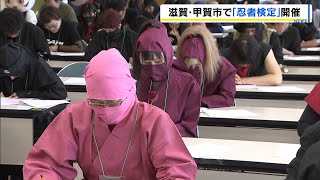
A certification exam testing knowledge and skills related to ninjas was held in Koka, Shiga Prefecture, a city known as one of Japan's historic ninja centers.

The Tokyo Fire Department has called for greater public cooperation with emergency medical services following a rise in incidents involving interference with ambulance crews, including cases in which paramedics have been assaulted while carrying out rescue operations.

The University of Tokyo and TOPPAN Holdings announced the establishment of the AI Innovation Research Center, a new initiative aimed at advancing research and development for the practical application of artificial intelligence in society.

As bear sightings continue at an unusually high pace across Akita Prefecture, a veteran wildlife photographer who has spent nearly 30 years observing and photographing Asian black bears says the animals are appearing more frequently, moving closer to human settlements, and increasingly adapting their behavior to survive.

The Blue Angels, the cheerleading squad of Joto High School's support and cheering club, are winning over audiences with their sparkling smiles and dynamic performances.

A group of university students in Okinawa is working to combat menstrual poverty and improve understanding of menstruation through educational programs aimed at both children and adults, addressing a problem that affects roughly one in three young women in Japan.