News On Japan

Rice Thefts Surge Across Japan

GIFU, May 07, 2025 (News On Japan) - Police have launched a public awareness campaign to warn local rice farmers about rampant thefts driven by soaring prices.

The initiative took place at a storage facility run by the agricultural cooperative Minami Hida Hane Farm in Gifu Prefecture, which manages about 25 hectares of rice fields in the area. The harvested rice, which has already been sold, is stored on-site awaiting delivery.

During the campaign, officers from the Gero Police Station distributed leaflets with the message: "Beware of rice thieves!"

A representative from the farm expressed concern: "If the rice we store on behalf of others is stolen, it would be a major problem. Nothing has happened in this area yet, but we are still worried."

Police are urging farmers to take preventive measures, including locking up storage facilities and installing security cameras.

Rice prices in Japan have been rising sharply, driven by a combination of poor weather conditions, shrinking farmland, and surging production costs. Wholesale prices for domestically produced rice have reached their highest levels in nearly a decade, with certain premium varieties seeing even steeper hikes. Farmers cite increasing costs for fuel, fertilizer, and labor as key factors squeezing margins and pushing up retail prices. At the same time, supply has been constrained in some regions due to irregular rainfall and reduced yields, contributing to a tighter market.

Consumer habits are also shifting in response to the price increases. Supermarkets and restaurants are exploring alternatives such as lower-grade rice or imported varieties to control costs, while households are starting to feel the pinch in their grocery bills. The government has taken notice, with the Ministry of Agriculture monitoring the situation and considering measures to stabilize supply and support producers. However, concerns remain that prolonged price pressure could accelerate structural changes in Japan’s agricultural sector, including further consolidation of small farms and an increased reliance on imports. For now, rice remains a staple of the Japanese diet, but its affordability—once taken for granted—is beginning to show signs of strain.

Source: Nagoya TV News

News On Japan
POPULAR NEWS

A prolonged eruption at Sakurajima on June 7th blanketed parts of Kagoshima City in volcanic ash, turning roads gray and prompting long lines of vehicles seeking car washes after a plume of smoke rose 1,300 meters above the crater.

A powerful earthquake struck off Mindanao Island in the southern Philippines at 8:38 a.m. (Japan time) on June 8th, generating tsunami waves across parts of the Pacific, causing building collapses and casualties near the epicenter, and prompting the Japan Meteorological Agency to issue tsunami advisories along a wide stretch of Japan's Pacific coastline before lifting all of them at 4:50 p.m.

A clinic director and a former Peruvian staff member have been referred to prosecutors after the man allegedly performed medical procedures without a license, including an external cephalic version—a procedure used to manually turn a baby into the correct position before birth—at an obstetrics and gynecology clinic in Fukuoka City, raising concerns about patient safety and oversight in maternity care.

A large bear was captured on security camera footage running through a shopping arcade in central Utsunomiya, Tochigi Prefecture, in the early hours of June 7th, as authorities stepped up warnings following a series of bear sightings across the city.

Japan's Meteorological Agency announced on June 7th that the rainy season is believed to have begun in the Tokai and Kanto-Koshin regions, marking the seasonal shift to wetter weather across a broad area of the country.

MEDIA CHANNELS
         

MORE Business NEWS

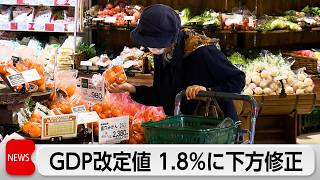
Japan's economy grew at an annualized rate of 1.8% in the January–March quarter of 2026, according to revised gross domestic product (GDP) data released by the Cabinet Office, with the figure marked down from the preliminary estimate due largely to weaker-than-expected capital investment.

Japanese stocks suffered a sharp sell-off on June 8th as weakness in U.S. technology shares and growing concerns over higher global interest rates triggered widespread selling, sending the Nikkei Stock Average down 2,563.52 points, or about 3.8%, to close at 64,024.60.

Japan's current account surplus expanded 64.9% from a year earlier to 3.9078 trillion yen in April, marking the 15th consecutive month of positive balance, according to balance of payments data released by the Finance Ministry on June 8th.

Rapid inflation and the weakening yen continue to squeeze household budgets across Japan, prompting renewed debate over the country's economic policies. Former Bank of Japan Governor Haruhiko Kuroda, who spearheaded the central bank's aggressive monetary easing campaign under Abenomics, argues that the overall economy remains on a positive trajectory and that wage growth is now exceeding inflation.

A court is set to hand down its verdict on August 28th in the trial of former Momuri president Shinji Tanimoto and his wife Shiori, who are accused of violating Japan's Attorney Act by illegally referring clients of the retirement agency service to lawyers.

Japan's household spending fell for the fifth consecutive month in April, highlighting continued pressure on consumers as rising prices and growing concerns over instability in the Middle East weighed on household budgets.

Japan's largest electronics retailer, Yamada Holdings, and Osaka-based Edion announced on June 5th that they have agreed to integrate their businesses, creating a group with annual sales of approximately 2.5 trillion yen as competition in the consumer electronics industry intensifies and companies seek new ways to boost growth in a shrinking domestic market.

Japan's real wages rose 1.9% in April from a year earlier, marking the fourth consecutive month of growth and the longest stretch of positive gains in about five years as this year's spring labor-management wage negotiations began feeding through into workers' paychecks.