News On Japan

Ruling Party Pushes Through Record 122 Trillion Yen Budget in 44 Hours

TOKYO - Prime Minister Sanae Takaichi, who launched the second Takaichi Cabinet on February 18th, signaled strong determination to secure passage of next fiscal year’s budget within the current fiscal year, even as a proposal to drastically shorten parliamentary deliberations has triggered backlash from opposition parties accusing the government of disregarding the Diet.

Although deliberations on the record budget of more than 122 trillion yen have been delayed by about one month due to the dissolution of the House of Representatives, Takaichi has made clear she has not abandoned the goal of enacting the budget before the fiscal year ends. She said the government intends to aim for passage of both the fiscal 2026 budget and bills that must be enacted by the end of the current fiscal year.

Ordinarily, it takes just under 20 days for the initial budget bill to clear the House of Representatives, and with deliberations also required in the House of Councillors, passage within the fiscal year is widely seen as difficult. Against that backdrop, some within the ruling coalition have begun floating a proposal to shorten deliberation time.

A senior Liberal Democratic Party official said that if deliberations in the lower house were limited to 44 hours, passage within the fiscal year would be possible. However, the benchmark for deliberation time on an initial budget is typically 70 to 80 hours in the House of Representatives, and in 2025, when the ruling bloc was in a minority, deliberations lasted 92 hours. Since 2000, the shortest deliberation period was 66 hours and 30 minutes in 2007.

Within the ruling party, there are calls to significantly reduce the amount of questioning time allocated to the ruling bloc while maintaining time for opposition questioning in order to secure passage of next year’s budget within the fiscal year. Junichi Ishii, the LDP’s secretary-general in the House of Councillors, said he had confirmed during a recent meeting at the Prime Minister’s Office that achieving passage within the fiscal year was a strong priority for Takaichi, adding that he had offered advice on the timeline required if the lower house were to complete its work by the end of March.

Opposition parties, however, have strongly criticized the idea of shortening deliberations, calling it a sign of disrespect toward the Diet. Takahiro Yasuno, leader of Team Mirai, said that if necessary deliberation were skipped, it would be putting the cart before the horse, stressing that while there is shared recognition of the need for passage, thorough debate must be ensured. Yoshitaka Saito, chair of the Constitutional Democratic Party’s upper house Diet affairs committee, said the legislature could not avoid accusations of being disregarded and called for substantial deliberations.

The debate over how to handle deliberations on next year’s budget has raised broader questions about the functioning of the Diet itself. Commentators noted that even if the ruling bloc pushes the bill through the lower house by compressing schedules, it still lacks a majority in the upper house, casting doubt on whether the budget can be enacted in time. Normally it takes around 20 days for the budget to pass the lower house, leaving little time for the upper house to deliberate, and the government will need to strike a balance between pushing the bill forward and avoiding a backlash from the opposition.

Source: TBS

News On Japan
POPULAR NEWS

Typhoon No. 25 was moving away from Japan over waters to the east early on September 22, bringing an end to rainfall across the Kanto region while remaining a strong storm as it tracked northeast at 45 kilometers per hour at 3 a.m.

Severe transport disruption continued across Chiba Prefecture on the morning of September 22 even as Typhoon No. 25 moved away from Japan, with major JR lines still suspended, rail access to Narita Airport disrupted by river flooding, highways closed across the Boso Peninsula and thousands of travelers dealing with the aftermath of the previous day's cancellations.

Japan collected another 12 medals on Day 3 of the Aichi-Nagoya Asian Games on September 21, with 17-year-old swimmer Shin Ohashi and karateka Kakeru Nishiyama winning gold, while the host nation also advanced strongly in women's volleyball, baseball, soccer, handball and hockey.

People aged 65 and older accounted for a record 29.6% of Japan's population in 2026, the highest proportion among major countries worldwide, while the number of elderly people in employment also reached an all-time high as Japan marked Respect for the Aged Day on September 21.

Emperor Naruhito and Empress Masako watched Japan defeat Kazakhstan in a women’s basketball preliminary-round game at the 20th Asian Games in Nagoya.

MEDIA CHANNELS
         

MORE Politics NEWS

China held commemorative events across the country on September 18 to mark the 95th anniversary of the Mukden Incident, the 1931 railway explosion that Japan's Kwantung Army used as a pretext to seize Manchuria and which became a major turning point in the deterioration of relations between Japan and China.

Prime Minister Sanae Takaichi launched her first cabinet reshuffle since taking office, keeping core economic, foreign-policy and security ministers in place while replacing a broad group of other ministers in an attempt to stabilize her government before a difficult autumn of tax, budget, monetary policy and diplomatic battles.

Japan's Air Self-Defense Force has concluded that a large Global Hawk unmanned reconnaissance aircraft that lost communication off Tottori Prefecture on September 15 crashed into the sea.

Prime Minister Sanae Takaichi launched a new Liberal Democratic Party executive team on September 16, retaining most of the party’s senior leadership while pledging to unite the government and ruling party to overcome a difficult political and economic environment.

A Japan Air Self-Defense Force Global Hawk unmanned reconnaissance aircraft went missing over international waters about 50 kilometers north of Tottori Prefecture on September 15, with floating debris and oil later found in the area where communications were lost.

Prime Minister Sanae Takaichi’s government entered a decisive political week on September 15 after approving an outline for food-tax relief and household payouts without settling how the package will be funded, keeping fiscal concerns alive just days before the Bank of Japan is expected to decide whether to raise interest rates again.

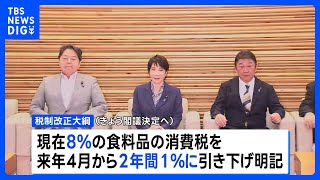
Japan's government is set to approve tax reform guidelines on September 15 that will reduce the consumption tax on food from the current 8% to 1% for two years starting in April 2027 as part of measures to ease the burden of rising prices.

Genta Koja, a former deputy mayor of Naha who accepts the relocation of the U.S. Marine Corps Air Station Futenma to Henoko in Nago, won the Okinawa gubernatorial election on September 13, defeating incumbent Governor Denny Tamaki and bringing an end to 12 years of prefectural administrations committed to blocking the project.