TOKYO - The situation surrounding the Strait of Hormuz, a critical chokepoint for global energy transport, is growing increasingly complex, with U.S. President Donald Trump urging Japan to assist in securing the waterway while Iran signals it may allow passage depending on negotiations, and as prospects for a swift resolution fade, Japanese industries including automobiles, ethylene, and polyvinyl chloride resin have begun scaling back production.
The impact of tensions involving Iran is already being felt among Japanese companies, with products such as automobiles manufactured by Toyota and Nissan, as well as ethylene and vinyl chloride resin produced by major chemical firms including Mitsubishi Chemical Group and Shin-Etsu Chemical, now subject to production cuts due to what amounts to a de facto blockade of the Strait of Hormuz, raising concerns that such measures could expand further if the disruption persists.
As uncertainty deepens over whether the conflict involving Iran, the United States, and Israel will become prolonged, attention is turning to how Japanese companies should respond to mounting risks tied to unstable crude oil supplies.
According to Takashi Moi of KPMG Consulting, an expert in economic security and geopolitical risk focused on the Middle East, the situation has shifted from an effective blockade of the strait to what he describes as a phase of “selective control,” in which Iran appears to permit passage for certain vessels while leveraging the waterway for political and economic pressure.
Iran’s Revolutionary Guard Corps had effectively closed the strait around March 10th by declaring that ships would not be allowed to pass, but vessels from countries such as India, Pakistan, and China have since reportedly transited the route, suggesting that Tehran is using negotiations to determine access while maintaining strategic control.
Concerns remain over reports that Iran has deployed naval mines in the area, with the possibility that some may be seabed-based or remotely detonated, allowing normal passage in peacetime while retaining the capability to disrupt shipping in the event of escalation, alongside other threats such as underwater drones.
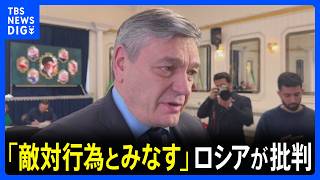
Amid these developments, Trump has said the United States is in talks with around seven countries regarding naval deployments to the Strait of Hormuz and is increasing pressure on Japan to cooperate, while Prime Minister Koichi Takai stated on March 19th that the government is examining what actions are legally feasible.
Moi emphasized that Japan should maintain its neutral diplomatic stance, warning that overt military alignment with the United States could result in Iran treating Japan as a hostile actor, a risk that has led countries such as the United Kingdom and Germany to adopt cautious positions.
He suggested that Japan could instead play a constructive role as a mediator, noting that while Gulf states have traditionally facilitated dialogue, their increasing involvement in the conflict may limit their neutrality, potentially opening the door for Japan to act as a third-party intermediary.
At the same time, concerns are rising over terrorism risks, particularly if Iran’s political or military structures are significantly weakened, which could lead to the emergence of decentralized groups capable of carrying out asymmetric attacks even after formal hostilities subside.
While some scenarios still allow for a swift ceasefire, Moi stressed that companies should prepare for a prolonged conflict as the baseline assumption, especially as the nature of the confrontation has expanded beyond missile exchanges to include attacks on energy infrastructure and maritime routes.
Iran’s capacity to sustain drone-based attacks remains significant, with estimates suggesting it can produce around 10,000 units per month, while missile production is more limited, making drones an increasingly central tool in its strategy.
Against this backdrop, Japanese companies are being forced to revise business plans, with production cuts already underway in sectors tied to Middle Eastern demand and petrochemical inputs, and the Ministry of Land, Infrastructure, Transport and Tourism reporting that some fuel distributors have begun restricting sales of kerosene and heavy oil.
As instability in the Middle East continues, the challenge for Japan’s corporate sector will be how to secure stable energy supplies and adapt operations in an environment where geopolitical risks are no longer temporary disruptions but potentially long-term structural constraints.
Source: テレ東BIZ