News On Japan

Fuji Eruption Could Blanket Tokyo in 10cm of Ash

TOKYO - A government and Tokyo metropolitan task force held its first joint meeting with private-sector participants on March 25th to discuss countermeasures for a potential large-scale eruption of Mount Fuji that could blanket central Tokyo in volcanic ash and severely disrupt daily life.

A simulation video created by the Cabinet Office showed large amounts of volcanic ash falling over the skyscrapers of Shinjuku, illustrating the potential scale of damage if Mount Fuji were to erupt.

Estimates indicate that ash accumulation in central Tokyo could reach up to 10 centimeters, raising concerns over widespread disruption, including logistics delays caused by transport paralysis, suspension of railway services, and major outages in electricity and communications.

In response, the Cabinet Office and the Tokyo Metropolitan Government convened the meeting with private companies for the first time to coordinate preparedness measures.

Morikubo Tsukasa, a senior official at the Cabinet Office, said: "It is extremely meaningful for infrastructure operators, lifeline providers, and various administrative bodies to come together and discuss a unified direction."

Participants agreed to focus future discussions on maintaining daily life at home, ensuring mobility and evacuation, and managing the removal and disposal of volcanic ash.

Source: TBS

News On Japan
POPULAR NEWS

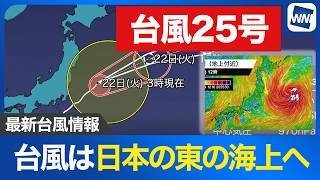
Typhoon No. 25 was moving away from Japan over waters to the east early on September 22, bringing an end to rainfall across the Kanto region while remaining a strong storm as it tracked northeast at 45 kilometers per hour at 3 a.m.

Severe transport disruption continued across Chiba Prefecture on the morning of September 22 even as Typhoon No. 25 moved away from Japan, with major JR lines still suspended, rail access to Narita Airport disrupted by river flooding, highways closed across the Boso Peninsula and thousands of travelers dealing with the aftermath of the previous day's cancellations.

Japan collected another 12 medals on Day 3 of the Aichi-Nagoya Asian Games on September 21, with 17-year-old swimmer Shin Ohashi and karateka Kakeru Nishiyama winning gold, while the host nation also advanced strongly in women's volleyball, baseball, soccer, handball and hockey.

People aged 65 and older accounted for a record 29.6% of Japan's population in 2026, the highest proportion among major countries worldwide, while the number of elderly people in employment also reached an all-time high as Japan marked Respect for the Aged Day on September 21.

Emperor Naruhito and Empress Masako watched Japan defeat Kazakhstan in a women’s basketball preliminary-round game at the 20th Asian Games in Nagoya.

MEDIA CHANNELS
         

MORE Sci-Tech NEWS

A rare pod of around 50 dolphins was spotted swimming through the Seto Inland Sea off Ozu, Ehime Prefecture, with dozens of dorsal fins repeatedly breaking the surface as the animals moved together.

Tesla unveiled its Cybercab in Japan for the first time on September 11, showcasing an AI-powered autonomous taxi designed without a steering wheel or pedals.

Large volumes of floodwater poured into the Metropolitan Area Outer Underground Discharge Channel in Kasukabe, Saitama Prefecture, following heavy rain on September 7, prompting the massive underground flood-control facility known as the "Underground Temple" to go into operation.

Fluorescent lamps that have illuminated Japanese homes and workplaces for decades are approaching the end of production, with Panasonic preparing to wind down a business it has operated since 1951 while experts warn that incorrectly replacing some fixtures with LEDs could create a fire risk.

Osaka-based spray nozzle maker IKEUCHI is expanding applications for its proprietary "Dry Fog," an ultra-fine mist that can cool, humidify and create visual effects without leaving surfaces wet, with the technology now being used in factories, livestock farming, crop cultivation and tourist attractions in Japan and overseas.

Japanese companies are moving closer to commercializing photonics-electronics convergence technology that replaces part of conventional electrical data transmission with optical signals, potentially allowing huge volumes of data to move with lower latency while sharply reducing power consumption as artificial intelligence drives rapid growth in electricity demand from data centers.

A new generation of optoelectronic integration technology developed over four decades by Japanese companies is moving closer to commercialization, offering a way to transmit huge volumes of data with low latency while sharply reducing the electricity consumed by data centers as artificial intelligence drives explosive growth in computing demand.

Dyson CameraJet™ turns the smart toothbrush into an active sensing product, making useful feedback and clear privacy design part of the same engineering brief.