News On Japan

Toyota to Halt Production at 13 Domestic Plants as Typhoon No. 6 Approaches

TOKYO - Toyota Motor will suspend production at 13 domestic factories on June 3rd as Typhoon No. 6 approaches Japan, with the company prioritizing the safety of employees and contractors as severe weather is expected to affect a wide area from western to eastern Japan.

According to Toyota, the typhoon is forecast to pass very close to the Pacific coast of western and eastern Japan, prompting the automaker to halt all production lines at its 13 domestic plants from early morning until around 3 p.m. on June 3rd. The suspension will apply to all domestic factories except its plant in Fukuoka Prefecture.

The company said the decision was made with employee safety as the highest priority amid concerns over strong winds, heavy rainfall and transportation disruptions associated with the storm.

Toyota added that whether operations resume after 3 p.m. will depend on weather conditions and safety assessments at each facility, with final decisions to be made after monitoring the typhoon's progress.

Regarding the impact on vehicle production, Toyota said it intends to minimize disruptions by adjusting output and increasing production at a later stage if necessary. The company said it will take measures to offset lost production once normal operations resume.

Source: TBS

News On Japan
POPULAR NEWS

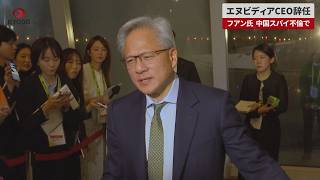
The resignation of Nvidia CEO Jensen Huang on November 12 following allegations involving a woman suspected of links to Chinese intelligence has raised concerns in Japan over the potential impact on semiconductor investment, financial markets and the yen, as uncertainty surrounding the American AI chipmaker threatens to disrupt the global technology industry.

Japan launched a new national disaster management agency on November 2nd to strengthen its response to major emergencies, just days before a powerful earthquake struck Aichi Prefecture, injuring 24 people and renewing concerns over the possibility of a catastrophic Nankai Trough earthquake.

Russia's Foreign Ministry on November 11 defended the government's unilateral decision to place the local subsidiary of Japan Tobacco (JT) under the management of a Russian company, describing the move as a countermeasure against what it called Japan's "blatantly hostile actions."

East Japan Railway (JR East) announced on November 10th that it will introduce touch-free ticket gates at 40 stations, including every station on Tokyo's Yamanote Line, from spring 2028, allowing passengers using Mobile Suica to pass through without taking their smartphones out of their pockets or bags.

Japan's Children and Families Agency unveiled its first national guidelines on November 10th for parental involvement in children's internet use, dividing those aged 0 to 18 into six developmental stages as the government considers tighter regulations on social media platforms to protect young people from online bullying, exploitation, and other growing risks.

MEDIA CHANNELS
         

MORE Business NEWS

Kobe is undergoing a sweeping transformation, with major redevelopment projects around Sannomiya Station, the planned closure and renovation of the Mosaic shopping complex at Harborland, and the international expansion of Kobe Airport raising hopes that the port city can attract more overseas visitors while improving everyday life for residents.

Japan's Nikkei 225 Stock Average fell about 429 points, or 0.7%, to close near 60,819 on Thursday, November 12, ending a three-day winning streak as reports concerning Nvidia chief executive Jensen Huang triggered heavy selling in semiconductor-related shares, while the broader TOPIX index edged 0.2% higher to around 3,937.

SoftBank Group raised a record 1 trillion yen through bonds aimed at individual investors in September, offering an annual interest rate of 4.75% on seven-year securities as the Japanese technology investment giant seeks to finance massive investments in artificial intelligence and strengthen its cash reserves.

Japan's corporate goods price index rose 7.1% in October from a year earlier, returning to the 7% range for the first time in two months and highlighting persistent inflationary pressures on businesses, according to data released by the Bank of Japan on November 12th.

A survey of more than 20,000 full-time employees in Japan has revealed a significant gap between actual and preferred overtime hours, with workers averaging 23.8 hours of overtime a month compared with an ideal of 14.1 hours, a difference of 9.7 hours.

Tokyo stocks extended their recovery on Wednesday, November 11th, with the Nikkei 225 closing at 61,248.59 points as of 3:30 p.m., up 789.01 points, or 1.31%, from Tuesday, marking a third consecutive session of gains as investors bought semiconductor and artificial intelligence-related shares despite renewed concerns over US inflation and interest rates.

SoftBank Group reported a net loss of 768 billion yen for the six months from April to September, largely due to losses associated with a review of its artificial intelligence data center plans in the United States, but the Japanese technology investment giant said it would continue pursuing its long-term AI strategy despite the financial setback.

Japan's benchmark Nikkei 225 Stock Average surged 1,684.08 points, or 2.87%, to close at 60,459.58 on Tuesday, November 10, 2026, at 3:30 p.m. Japan time, recovering the psychologically important 60,000 level for the first time in three trading sessions as investors bought back artificial intelligence and semiconductor shares following a sharp rebound on Wall Street.