News On Japan

Peeling Back the Real Purpose of Miso Container Paper

TOKYO - When you open a container of miso, you often find a thin sheet of paper inside the lid. Should you leave it in or throw it away? To solve this common dilemma, we investigated the actual role of this paper in miso packaging.
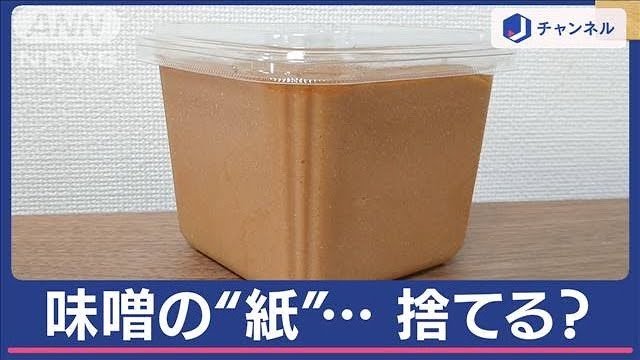
Peeling Back the Real Purpose of Miso Container Paper

Miso soup, a comforting staple for many in Japan, often features prominently in various dishes. But what about that paper found on the miso? What do people typically do with it?

Individuals from various age groups shared their practices:

A person in their 70s said, "I leave the paper in place and peel it back as I use the miso."

Someone in their 60s mentioned, "I remove the paper."

A person in their 30s commented, "I was worried it would dry out on top, so I just leave the paper on."

Is the paper there to prevent the miso from drying out, or is it just for easy peeling? What is its true purpose?

We consulted Nobuhiro Suda, a miso expert and "Miso Ambassador" for Marukome, a major miso manufacturer, who conducts over 50 miso workshops annually.

According to Suda, "The paper doesn't actually play any significant role; it's just paper."

Surprised by this revelation, many people wondered, what is its purpose then? Should it be kept or discarded?

The true identity of the paper is indeed "just paper." It does not prevent the miso from oxidizing. Suda explained, "The paper is only there to prevent the oxygen absorber in the miso pack from sinking into the miso."

Once the miso pack is opened, the oxygen absorber, which has used up its effectiveness, can also be discarded. "By the time it’s on the store shelf, the oxygen absorber has already expended its energy and can be thrown away after opening," Suda advised.

Despite many people leaving the paper in place, if it does not serve to protect the miso, then what is the best way to store it?

Suda recommends, "Press cling film tightly over the surface of the miso to prevent air exposure. This method helps prevent oxidation at the surface of the miso."

Once the miso pack is opened, remove the paper and the oxygen absorber, and seal the miso's surface with cling film for longer-lasting freshness.

As many people expressed surprise and interest in these insights, Suda highlighted that miso storage also requires care. The recommended storage locations are the refrigerator or freezer, where lower temperatures help prevent changes in the miso's properties.

Source: ANN

News On Japan
POPULAR NEWS

Typhoon No. 25 had left four people dead and six others missing in Chiba and Kanagawa prefectures by September 22, as the storm moved away from Japan and the extent of flooding and landslide damage across the Kanto region became clearer.

Transport disruption from Typhoon No. 25 continued across Chiba Prefecture on September 22 even as flights and major highways returned toward normal, with entire sections of the JR network remaining suspended for the day and all Narita Express services canceled because of flooding, landslides and damage to railway infrastructure.

Japan came within two runs of producing one of international cricket's biggest upsets on September 22, pushing reigning T20 world champion India to the final ball before losing a rain-shortened match at Sano International Cricket Ground in Tochigi Prefecture.

Japan's Asian Games campaign continued across a packed Day 4 schedule on September 22, with the women's badminton team securing another medal, the women's basketball team completing an unbeaten group stage, and Japan adding a historic bronze medal in mixed air rifle shooting as several of the host nation's biggest medal opportunities moved into the evening.

Japan collected another 12 medals on Day 3 of the Aichi-Nagoya Asian Games on September 21, with 17-year-old swimmer Shin Ohashi and karateka Kakeru Nishiyama winning gold, while the host nation also advanced strongly in women's volleyball, baseball, soccer, handball and hockey.

MEDIA CHANNELS
         

MORE Food NEWS

For more than six decades, Sanyuken Fukasawa Branch in Tokyo's Setagaya Ward has served generations of customers with familiar Chinese dishes, as its 72-year-old second-generation owner and his wife continue to run the 14-seat neighborhood restaurant largely by themselves.

Authorities are warning people not to rely on artificial intelligence, guidebooks or internet searches to decide whether wild mushrooms are safe to eat after food poisoning cases involving toxic species, including one in which AI mistakenly identified a poisonous mushroom as edible.

Tokyo's Fuchu Prison is adapting its meals and living arrangements to a growing foreign inmate population, with about one in four prisoners coming from overseas and staff balancing religious, cultural and dietary needs against tight budgets and the demands of running one of Japan's largest prisons.

The cost of making a serving of curry rice at home in Japan fell below 350 yen in July for the first time in 11 months, helped by declining rice prices, according to Teikoku Databank.

Grape-picking season has reached its peak at tourist farms in Kashiwara, Osaka Prefecture, where hot weather from spring through summer has produced particularly sweet, richly flavored fruit this year, although prolonged rain has reduced visitor numbers and could shorten the season.

The autumn red snow crab season has opened on the Sea of Japan coast, with the first auction at Kasumi Fishing Port in Kami, Hyogo Prefecture, recording a top price of 300,000 yen for a single crab on September 4.

Japan's Environment Ministry will conduct its first survey of animal cafes, where customers can interact with animals including exotic species, as concerns grow over infection risks, injuries and the welfare burden placed on animals.

Japan byFood and Shizuka are back with Worth The Trip the series where we will discover food spots in Japan that are actually worth traveling for! This time we are going to award-winning eats around Tokyo under one rule – we can only eat for $10 or around ¥1,600 yen.