News On Japan

A Breakthrough in Aquaculture: Mackerel that Produce Tuna

TOKYO - Novelist Hitoshi Mayama explores a groundbreaking next-generation aquaculture technology at Tokyo University of Marine Science and Technology with Professor Goro Yoshizaki. This innovative method allows desired fish species to be bred by transplanting their reproductive stem cells into surrogate fish.
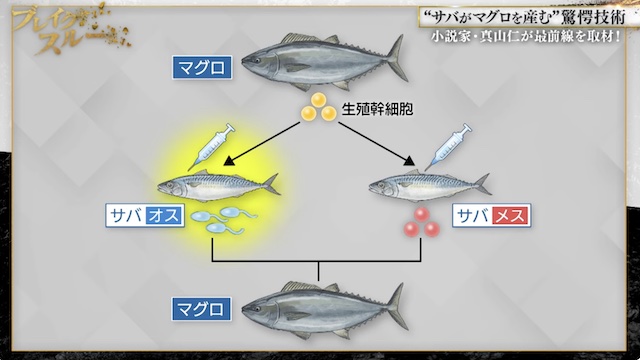
A Breakthrough in Aquaculture: Mackerel that Produce Tuna

Mayama interviews pioneers who started the startup "Fish Dream" last July, discussing the technology's current status and its business potential.

In the heart of Tokyo lies a university that conducts cutting-edge fisheries research. "Initially, I was skeptical about the idea of mackerel producing tuna, but after talking to them, I realized it all comes down to human ego, how we manipulate nature, and the importance of passion in these endeavors," Mayama reflected during his investigation.

As black tuna faces extinction, the potential of reviving extinct fish species or radically changing current aquaculture practices grows. The key lies in mysterious objects contained within small tubes, where essential cells sleep, potentially reshaping the history of the fisheries industry.

"We're making a surrogate fish that can produce the offspring of another species," explains Yoshizaki, who has been researching fish farming techniques for over 30 years. This surrogate parent technology could lead to the creation of completely new fish from existing species.

Yoshizaki's work at Tokyo University of Marine Science and Technology involves developing technologies that are closely watched worldwide. He has achieved a first in the world by increasing reproductive cells in the lab, aiming to solve significant issues like the potential extinction of Pacific black tuna by letting mackerel produce tuna.

The challenges are complex, involving the creation of sperm and eggs from different fish species, a process taking two decades. Yoshizaki humorously notes, "We always say 'another five years,' but it’s not a joke; it’s about how we foresee the timeline for our experiments."

This pioneering journey continues as they aim to revolutionize aquaculture by turning ideas once considered impossible into reality, navigating uncharted scientific territories without a map.

Source: テレ東BIZ

News On Japan
POPULAR NEWS

Typhoon No. 25 had left four people dead and six others missing in Chiba and Kanagawa prefectures by September 22, as the storm moved away from Japan and the extent of flooding and landslide damage across the Kanto region became clearer.

Transport disruption from Typhoon No. 25 continued across Chiba Prefecture on September 22 even as flights and major highways returned toward normal, with entire sections of the JR network remaining suspended for the day and all Narita Express services canceled because of flooding, landslides and damage to railway infrastructure.

Japan came within two runs of producing one of international cricket's biggest upsets on September 22, pushing reigning T20 world champion India to the final ball before losing a rain-shortened match at Sano International Cricket Ground in Tochigi Prefecture.

Japan's Asian Games campaign continued across a packed Day 4 schedule on September 22, with the women's badminton team securing another medal, the women's basketball team completing an unbeaten group stage, and Japan adding a historic bronze medal in mixed air rifle shooting as several of the host nation's biggest medal opportunities moved into the evening.

Japan collected another 12 medals on Day 3 of the Aichi-Nagoya Asian Games on September 21, with 17-year-old swimmer Shin Ohashi and karateka Kakeru Nishiyama winning gold, while the host nation also advanced strongly in women's volleyball, baseball, soccer, handball and hockey.

MEDIA CHANNELS
         

MORE Business NEWS

Tokyo’s stock market was closed on September 21 for Respect for the Aged Day, leaving the Nikkei 225 without a cash close after finishing the previous session at 65,019, while currency and futures markets focused on the yen, the Bank of Japan’s latest rate hike and intervention risks during Japan’s Silver Week holiday.

Japan's first five-day Silver Week holiday in 11 years has put renewed attention on household finances, with persistently high food prices and a weakening yen threatening to erode the benefits of the government's planned consumption tax cut on food.

A list of providers with identical promises turns selection into brute-force sorting. The differences do exist; they are just hidden somewhere other than the homepage.

The Bank of Japan raised its policy rate from 1.0% to 1.25% on September 18, taking borrowing costs to their highest level in 31 years and accelerating the pace of monetary tightening as persistent inflation and concerns over fiscal expansion put upward pressure on interest rates.

The yen strengthened by more than 1 yen against the dollar in a short period late on September 18 after the Bank of Japan conducted a rate check, a step commonly taken in preparation for possible intervention in the foreign exchange market.

Tokyo stocks rose sharply on September 18, with the Nikkei 225 climbing to around 65,350 in afternoon trading after the Bank of Japan raised interest rates to 1.25%, as the yen weakened and investors bought artificial intelligence and semiconductor-related shares.

The Bank of Japan raised its policy interest rate from 1.0% to 1.25% on September 18, lifting borrowing costs to their highest level in 31 years as policymakers moved to contain growing inflation risks, but the yen weakened sharply after the decision as markets focused on two dissenting votes and uncertainty over the pace of further increases.

A market spread is generally the difference between two market prices. Most commonly, traders use the term to describe the bid-ask spread: the difference between the highest price a buyer is currently prepared to pay and the lowest price a seller is prepared to accept.