News On Japan

The Hidden Struggles of Popular Sushi Shops

TOKYO - Have you ever experienced the sudden disappearance of your local sushi shop? Amid the success of major conveyor belt sushi chains, 'neighborhood sushi shops' are now facing an existential crisis.
The Hidden Struggles of Popular Sushi Shops

Expected Increase in Bankruptcies Since COVID-19

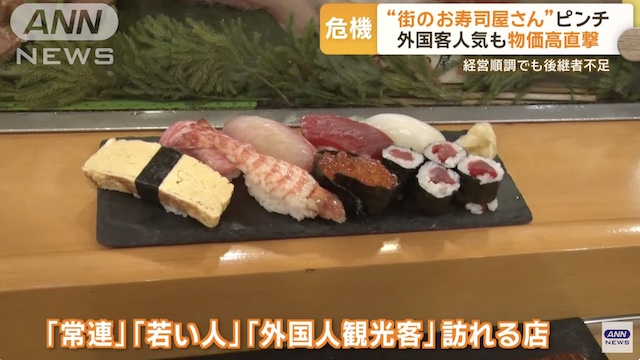
Ichihachi Fukuzushi, located in Sumida Ward, Tokyo, was established in 1965. This longstanding sushi restaurant has been in business for over half a century. Currently, the second-generation owner, Kazuya Kurumizawa, 54, has taken over the business from his father. Kurumizawa: 'Because it's a small shop, we need to be agile. When customers support us, we need to respond in kind. Even in a neighborhood like this, the number of lodging facilities has increased. As a result, foreign visitors find us through searches and come to our shop.' The restaurant, which attracts not only regular customers but also young people and foreign tourists, is now in crisis. While major conveyor belt sushi chains such as Kura Sushi have opened stores in Ginza targeting inbound tourists, sushi is currently very popular among foreign visitors. Despite the expected demand from inbound tourism, five small, independently run sushi shops went bankrupt in January alone. Unlike the thriving major chains, it is forecasted that the annual number of bankruptcies will exceed 30, a level not seen since the COVID-19 pandemic. The main factors squeezing these businesses are rising costs for ingredients and utilities.

Lack of Successors Despite Business Success

In some cases, despite stable business, shop owners are considering closing. Kurumizawa's shop is one such example. Kurumizawa: 'My son, who is 26 this year, works as a company employee and will not take over the business. It’s tough. I really wish he would continue.' With his son working as a company employee, there is no successor to the business. Kurumizawa: 'He told me, “It’s not for me, I have things I want to do.” I thought, it can’t be helped. You can’t force someone to do this kind of work. I don’t think the artisan world can be sustained with reluctance.' What does the future hold for the shop? Kurumizawa: 'If it comes to that, I'll close the shop neatly and build a house where I can live with my child, and that will be the end of it. I have confidence that I can keep going until I’m 70, so for now, I’ll do my best until then.'

Source: ANN

News On Japan
POPULAR NEWS

Typhoon No. 25 had left four people dead and six others missing in Chiba and Kanagawa prefectures by September 22, as the storm moved away from Japan and the extent of flooding and landslide damage across the Kanto region became clearer.

Transport disruption from Typhoon No. 25 continued across Chiba Prefecture on September 22 even as flights and major highways returned toward normal, with entire sections of the JR network remaining suspended for the day and all Narita Express services canceled because of flooding, landslides and damage to railway infrastructure.

Japan came within two runs of producing one of international cricket's biggest upsets on September 22, pushing reigning T20 world champion India to the final ball before losing a rain-shortened match at Sano International Cricket Ground in Tochigi Prefecture.

Japan's Asian Games campaign continued across a packed Day 4 schedule on September 22, with the women's badminton team securing another medal, the women's basketball team completing an unbeaten group stage, and Japan adding a historic bronze medal in mixed air rifle shooting as several of the host nation's biggest medal opportunities moved into the evening.

Japan collected another 12 medals on Day 3 of the Aichi-Nagoya Asian Games on September 21, with 17-year-old swimmer Shin Ohashi and karateka Kakeru Nishiyama winning gold, while the host nation also advanced strongly in women's volleyball, baseball, soccer, handball and hockey.

MEDIA CHANNELS
         

MORE Food NEWS

For more than six decades, Sanyuken Fukasawa Branch in Tokyo's Setagaya Ward has served generations of customers with familiar Chinese dishes, as its 72-year-old second-generation owner and his wife continue to run the 14-seat neighborhood restaurant largely by themselves.

Authorities are warning people not to rely on artificial intelligence, guidebooks or internet searches to decide whether wild mushrooms are safe to eat after food poisoning cases involving toxic species, including one in which AI mistakenly identified a poisonous mushroom as edible.

Tokyo's Fuchu Prison is adapting its meals and living arrangements to a growing foreign inmate population, with about one in four prisoners coming from overseas and staff balancing religious, cultural and dietary needs against tight budgets and the demands of running one of Japan's largest prisons.

The cost of making a serving of curry rice at home in Japan fell below 350 yen in July for the first time in 11 months, helped by declining rice prices, according to Teikoku Databank.

Grape-picking season has reached its peak at tourist farms in Kashiwara, Osaka Prefecture, where hot weather from spring through summer has produced particularly sweet, richly flavored fruit this year, although prolonged rain has reduced visitor numbers and could shorten the season.

The autumn red snow crab season has opened on the Sea of Japan coast, with the first auction at Kasumi Fishing Port in Kami, Hyogo Prefecture, recording a top price of 300,000 yen for a single crab on September 4.

Japan's Environment Ministry will conduct its first survey of animal cafes, where customers can interact with animals including exotic species, as concerns grow over infection risks, injuries and the welfare burden placed on animals.

Japan byFood and Shizuka are back with Worth The Trip the series where we will discover food spots in Japan that are actually worth traveling for! This time we are going to award-winning eats around Tokyo under one rule – we can only eat for $10 or around ¥1,600 yen.