TOKYO - Japan's beloved pickles are facing a crisis. Starting next month, stricter rules for pickle production will come into effect, forcing many farmers to abandon their pickle-making operations.
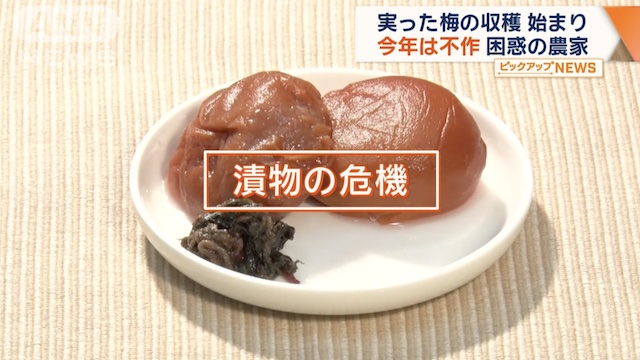
Wakayama Prefecture Starts Ume Harvest Amid Predictions of Poor Yield
The harvest of the renowned Nanko Ume, a national brand of Japanese apricots, has begun in Wakayama Prefecture. However, due to a mild winter, this year’s yield is expected to be just 62% of the average, marking an unprecedented poor harvest.
Ume farmer Yuki Yorimoto stated, 'This year’s crop is as bad as a disaster. In my 15 years of farming, I’ve never seen such a poor yield. It’s a first.'
This poor yield trend is seen nationwide, raising concerns about the impact on umeboshi (pickled plums).
Yorimoto added, 'We’ve had extensive damage from hail and stink bugs this year.'
Pickling Crisis: 'Renovation Costs 2 Million Yen'
The pickling industry is also facing a threat from a change in the law. Akiko Yokohata, a 79-year-old ume farmer in Aichi Prefecture, sells homemade umeboshi and pickled plums at a local market. This year, she had to renovate her workshop for pickle production.
Yokohata explained, 'It cost a lot to renovate. We’ve been pickling ume here from the start, but the application didn’t go through, so we had to rebuild everything.'
The trigger was the amendment to the Food Sanitation Law. From July 1, pickle production and sales require a business license, which necessitates facilities meeting high hygiene standards.
Yokohata detailed, 'We had to replace all the wooden surfaces with materials that can be washed with water, including the ceiling and floors. The renovation cost around 2 million yen.'
Popular Ume Pickles from 91-Year-Old Mother Discontinued
Some farmers have decided to give up pickle-making altogether. Kazutaka Kakihara, whose 91-year-old mother makes popular ume pickles, will stop selling them this year. Shoppers expressed regret over the reduction in homemade pickles.
A customer lamented, 'It’s tough for those who work hard to produce delicious umeboshi. It’s sad that we won’t have as many choices.'
Overcoming the Pickling Crisis
The amendment to the Food Sanitation Law was prompted by an incident in 2012, where eight people died in Sapporo from food poisoning caused by lightly pickled Chinese cabbage. This led to heightened efforts to ensure food safety, culminating in the 2018 revision of the law.
As a result, pickle production has required licensing since 2021, and those without permits by June 30 will no longer be able to sell pickles.
Many farmers unable to meet the stringent hygiene standards have chosen to close their businesses. For instance, a JA direct sales store in Aichi Prefecture, which used to sell handmade pickles from about 50 farmers, will see the number of suppliers drop to a tenth of the original number starting next month.
However, some efforts are being made to overcome this crisis. In Akita Prefecture, known for its 'Iburigakko' pickles, only 6% of producers wanted to continue in 2021. The prefecture responded with subsidies covering up to a third of the equipment costs (up to 10 million yen), and Yokote City provided additional support.
As a result, a similar survey last year showed that about 52% of producers intended to continue their businesses.
In Shizuoka Prefecture, famous for 'Mizukake-nazuke' pickles, Gotenba City and Oyama Town are also offering subsidies for facility renovations.
The JA Fuji Izu Gotenba District office explained that they are setting up a communal processing center that meets the revised law’s standards to support small producers and those struggling with renovations.
An official emphasized, 'We must not let the traditional food culture, which has continued since the Meiji era, decline. We are all working together to protect our food culture.'
Source: ANN