Tokushima, Jun 11, 2024 (News On Japan) - Despite being over two hours away from Tokushima Airport, Iya, located in Miyoshi City, Tokushima Prefecture, has seen a significant influx of foreign tourists. This increase is part of a broader trend of international visitors seeking out Japan's most remote and scenic areas.
Iya: One of Japan's Three Great Hidden Regions
Nestled in central Shikoku, the Iya region of Miyoshi City is surrounded by 1,000-meter-high mountains and offers untouched natural beauty and stunning views. One notable feature is the "Hi no Ji Valley," named for its resemblance to the Japanese character "ひ" (hi), where visitors can sometimes witness a sea of clouds creating a dreamlike scene.
Another local highlight is the statue of a peeing boy perched on a cliff 200 meters above the valley floor, inspired by local children's bravery tests. The "Ochiai Hamlet," spread across steep slopes with a 400-meter vertical drop, features traditional thatched-roof houses, preserving a glimpse of Japan's past.
Iya, alongside Shirakawa-go in Gifu and Shiiba Village in Miyazaki, is considered one of Japan's three great hidden regions. The Yoshino River carved out the beautiful Oboke Gorge over 200 million years, named for the perilous nature of walking along its steep cliffs. Sightseeing boats at Oboke Gorge often see a steady stream of foreign tourists disembarking from tour buses.
An Australian tourist remarked, "It's like a painting. Unlike Australia, the trees here change with the seasons."
A staff member at the Oboke Gorge sightseeing boat service added, "We even get visitors from countries we've never heard of, like Honduras and Angola."
At JR Oboke Station, the gateway to the hidden region, trains and buses regularly bring in foreign tourists carrying large backpacks and suitcases.
The iconic Kazura Bridge, a 45-meter-long suspension bridge made of vine, was historically designed to be cut down if pursued by enemies. The bridge is a popular attraction, drawing over 45,000 foreign visitors last year.
A tourist from South Africa commented, "It's scary and fun at the same time."
A French visitor shared, "It's wonderful! A great experience blending nature and culture."
While many tourists enjoy crossing the bridge, Daniel and his wife from Germany were captivated by the Iya River below.
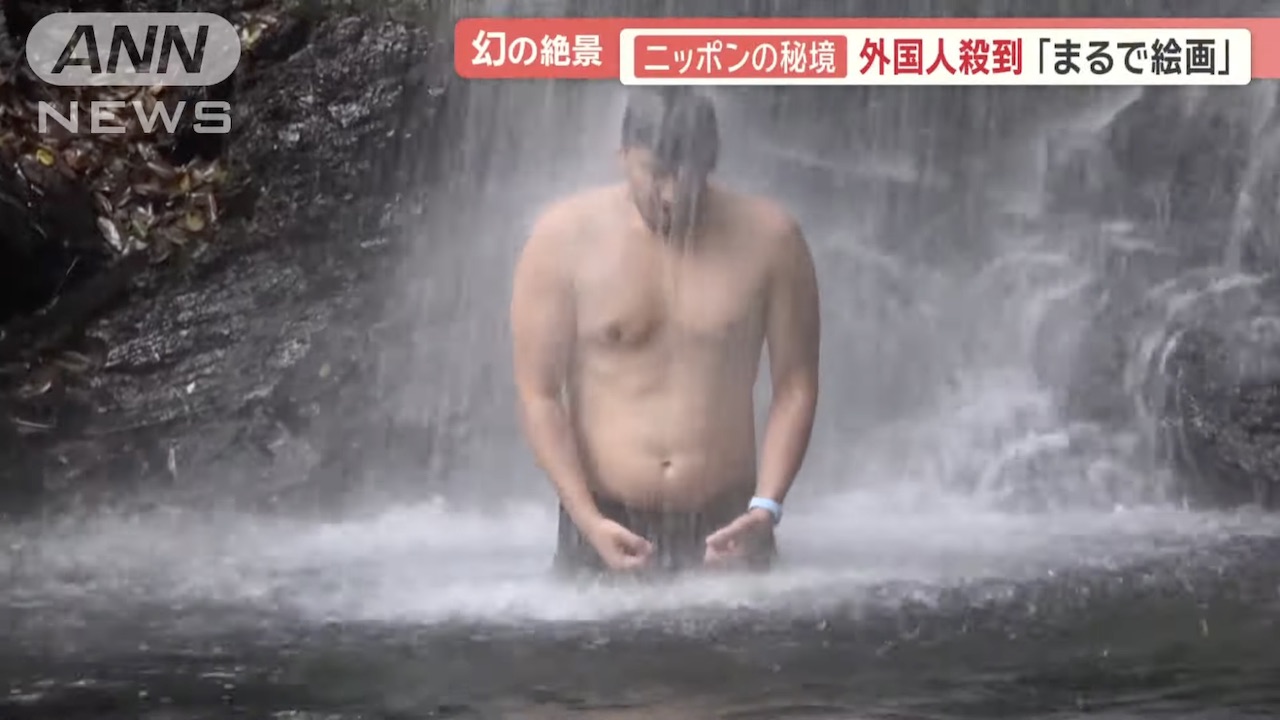
Daniel exclaimed, "It's so beautiful," before wading into the river despite getting his pants wet. "I feel one with nature," he said.
His wife Paula noted, "He's an adventurer, always diving into things."
Daniel added, "I've traveled through Europe, North and South America, and parts of Asia, but the nature and gorges here are the most beautiful."
Still excited, Daniel later took a dip in a nearby waterfall, saying, "It felt like being hit by ice. Connecting with nature in this way is the best."
An Authentic Cultural Experience at a Remote Inn
Why do so many foreigners visit Iya, one of Japan's great hidden regions?
Kajiya Iya Romantei, an inn renovated from an 80-year-old farmhouse, only accepts one group per day, and 80% of its guests are foreigners from countries like the United States, France, and Finland. The inn is fully booked through autumn this year.
On Booking.com, it boasts a rating of 9.5 out of 10, with reviews praising the experience of traditional Japanese life and the magical atmosphere of Iya.
A family of four from the Netherlands arrived at the inn during their three-week trip across Japan.
Lindsey said, "It's very beautiful. It's my first time in such a building and place."
Soon after arriving, the inn's owner, Yasuki Shinomiya, took the family outside for a traditional firewood splitting activity, using the wood to heat a "Goemon" bath.
Lindsey struggled with the task but continued, saying, "It's very hard!"
After an hour of splitting wood, the family gathered around the irori (a traditional sunken hearth) for a dinner featuring local specialties like stone tofu and Awaodori chicken.
Lindsey's wife, Ineke, remarked, "It's wonderful. The chicken is tender, and the hearth adds so much to the experience."
Their daughter, Lotze, despite initial difficulties starting the fire, successfully cooked rice in a traditional pot.
"It's a great success," said Lotze, "It's moist and flavorful."
The family ended their day enjoying the gentle glow of Japanese candles, reflecting on their unique experience.
Lindsey concluded, "It's beyond imagination. We will never have such an experience again."
A Village of Scarecrows in a Remote Settlement
Foreign tourists are even venturing into deeper parts of the hidden region. Nagoro, a village at an altitude of around 800 meters, attracts visitors with its human-like scarecrows. About 20 Italian tourists recently visited this village, home to only 25 residents, 70% of whom are elderly.
The village is known for its 350 scarecrows, placed in various poses around the settlement. An Italian tourist noted, "There are no villages like this in Italy."
Nagoro is also called the "Scarecrow Village in the Sky." Ayano Tsukimi, a local scarecrow artist, started making scarecrows modeled after her father 20 years ago, and their number has gradually increased. A video by a German student ten years ago introduced the scarecrow village to the world.
Ayano said, "I never imagined foreigners would come to see the scarecrows. I'm so happy."
Two tourists from the Netherlands, who had been planning their visit for five years, were finally able to see the village.
"It's incredible! We were looking forward to this the entire trip," they said.
Ayano then guided them to a former school building filled with scarecrows depicting various scenes, including a tug-of-war and Awa Odori dance.
The tourists marveled, "It's unbelievable! We've truly experienced a part of Japan we couldn't have known from just Tokyo, Kyoto, and Osaka."
Source: ANN