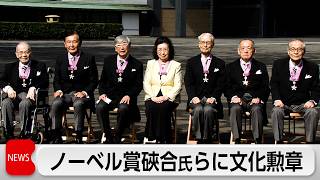
TOKYO - Emperor Naruhito presented the Order of Culture to seven recipients at the Imperial Palace in Tokyo on November 3rd, Japan's Culture Day, honoring their outstanding achievements and contributions to the country's cultural development.
The recipients began arriving at the Imperial Palace shortly after 9:30 a.m., including Kenzo Soai, 76, an honorary professor at Tokyo University of Science who was selected as a recipient of this year's Nobel Prize in Chemistry, and composer Shunichi Tokura, 78, known for writing numerous hit songs, including "Pepper Keibu" for the popular female pop duo Pink Lady.
The ceremony took place in the Matsu-no-Ma, or Pine Room, of the Imperial Palace, where the Emperor personally handed each recipient a medal before offering his congratulations.
"I am truly pleased that you have devoted yourselves to improving culture through many years of hard work and outstanding achievements," the Emperor said.
Following the ceremony, the seven recipients gathered in the palace's East Garden courtyard for a commemorative photograph, proudly wearing their medals under clear autumn skies.
Kenso Soai, 76, is an honorary professor at Tokyo University of Science and a recipient of the 2026 Nobel Prize in Chemistry. He is internationally recognized for discovering asymmetric autocatalysis, a chemical reaction in which molecules promote the production of more molecules with the same structural orientation. Known as the "Soai reaction," his discovery has helped scientists investigate why biological molecules favor particular mirror-image forms, a fundamental question concerning the origins of life.
Shunichi Tokura, 78, is one of Japan's most successful popular music composers, having helped shape the country's music industry during the 1970s and 1980s. His compositions include Pink Lady's "UFO" and "Pepper Keibu," along with hits performed by Momoe Yamaguchi and Linda Yamamoto. He also served as commissioner of Japan's Agency for Cultural Affairs and has played an influential role in music copyright protection.
Motoko Ishii, 88, is a pioneer of architectural and urban lighting design, best known for illuminating some of Japan's most recognizable landmarks, including Tokyo Tower, Rainbow Bridge and Tokyo Gate Bridge. After studying design in Finland and Germany, she established her own lighting design company in 1968. Her work has helped establish lighting as an artistic discipline, with major projects extending across Europe and Asia.
Toyo Ito, 85, is an internationally acclaimed Japanese architect known for innovative buildings that combine advanced engineering with organic shapes and open spaces. His major works include Sendai Mediatheque, the National Taichung Theater in Taiwan and Gifu Media Cosmos. Winner of the prestigious Pritzker Architecture Prize in 2013, he has also promoted community-centered architecture and reconstruction initiatives following natural disasters.
Tsuneyoshi Kuroiwa, 84, is a professor emeritus at the University of Tokyo who has made important discoveries about how mitochondria and chloroplasts, the energy-producing structures inside cells, divide and reproduce. His research has advanced understanding of cellular evolution, organelle inheritance and the fundamental mechanisms that sustain life. He is also known for pioneering research using primitive red algae to investigate cell biology.
Tetsuya Shiokawa, 81, is a distinguished scholar of French literature and professor emeritus at the University of Tokyo. He is internationally recognized for his research on the 17th-century French philosopher and mathematician Blaise Pascal. His studies of Pascal's religious and philosophical writings, particularly "Pensées," have earned recognition in both Japan and France. He has also translated major French literary and philosophical works into Japanese.
Shigekazu Nagata, 77, is a leading molecular biologist and immunologist affiliated with Osaka University, internationally recognized for pioneering research into apoptosis, the process of programmed cell death. His discoveries involving the Fas protein and Fas ligand helped explain how cells are instructed to destroy themselves, providing important insights into immune regulation, cancer and autoimmune diseases.
Shigeru Miyamoto, 73, who was also selected for the 2026 Order of Culture but did not attend the ceremony, is a legendary Nintendo game designer and creator of Mario, Donkey Kong and The Legend of Zelda. His pioneering work over nearly five decades has transformed the global video game industry and helped establish video games as a major form of cultural and artistic expression.
Source: TBS