News On Japan

Public Support for Political Parties Hits 11-Year Low

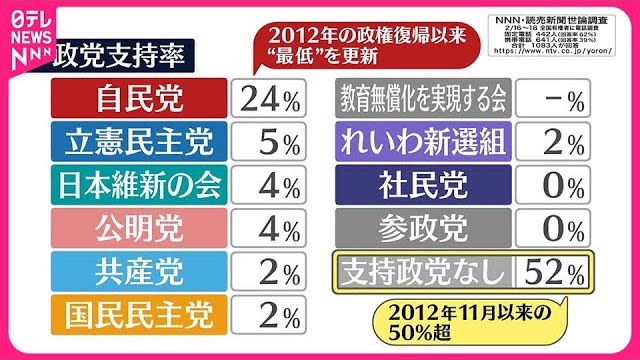
TOKYO, Feb 19 (News On Japan) - In a public opinion poll conducted by NNN and Yomiuri Shimbun from February 16 to 18, 52 percent of respondents said they did not support any political party, a 4-point increase from the previous January survey.

This marks the first time "no party support" has exceeded 50% since November 2012, during the final phase of the Democratic Party of Japan's administration.

The Liberal Democratic Party (LDP) saw a 1-point decrease from the January survey to 24%, the lowest since its return to power in 2012.

The Constitutional Democratic Party of Japan stood at 5%, Nippon Ishin no Kai at 4%, Komeito at 4%, the Japanese Communist Party at 2%, and the Democratic Party for the People at 2%. No respondents expressed support for the Party to Realize Free Education.

Reiwa Shinsengumi had 2% support, while the Social Democratic Party and Sanseito both had 0%.

In light of the political funding scandal involving LDP factions, 81% believed that strict measures should be taken against Abe faction executives involved in the incident.

Regarding the LDP's investigation into undeclared political funds, 77% thought it would not lead to a full understanding of the issue.

As for the dissolution of factions such as the Abe, Kishida, and Nikai factions, 76% did not believe it would restore trust in the LDP.

Regarding explanations to the public by faction executives, 93% felt they were insufficient, nearly unchanged from 92% in the January survey.

Support for the Kishida cabinet remained at 24%, tied for the lowest since the administration's inception.

When asked who is suitable for the next LDP president, former Secretary-General Ishiba was at 21%, former Environment Minister Koizumi at 17%, and Digital Minister Kono at 10%.

Foreign Minister Kamikawa rose to fourth place with 8%, while Prime Minister Kishida was tied for sixth place at 4%.

Regarding the government's proposal for a child-rearing support fund, with an average monthly burden of less than ¥500 per person, 60% did not approve of the plan.

Source: NNN

News On Japan
POPULAR NEWS

Kyoto City significantly raised its lodging tax from March 1st, increasing the maximum charge per person per night from 1,000 yen to as much as 10,000 yen, in a move aimed at tackling overtourism and funding the preservation of cultural assets, even as questions remain about its impact on visitors and the local economy.

A former emergency responder and foreign tourists worked together to rescue a woman in her 80s who was trapped inside an overturned light vehicle in Hakuba Village, Nagano Prefecture.

Tokyo Metro and Toshiba have launched Japan’s first demonstration test allowing passengers to pass through ticket gates without touching them by using their smartphones’ Bluetooth function.

The admission fee for the World Heritage-listed Himeji Castle in Himeji, Hyogo Prefecture, was revised on March 1st for the first time in 11 years, introducing a dual pricing system that significantly raises costs for visitors from outside the city.

An eight-year-old Australian girl died after a snowmobile overturned in Hakuba Village, Nagano Prefecture, at around 11 a.m. on February 28th, with authorities investigating the cause of the accident.

MEDIA CHANNELS
         

MORE Politics NEWS

Prime Minister Sanae Takaichi called on Iran to exercise restraint during a Lower House Budget Committee session on March 2nd, as tensions escalated following attacks on Iran by the United States and Israel, underscoring Japan’s commitment to diplomatic efforts aimed at calming the situation in the Middle East.

The name of a Japanese figure involved in a national government project has appeared more than 8,000 times in investigative records related to the late American financier Jeffrey Epstein, who was charged with sex trafficking and other crimes, sparking controversy and raising concerns over the future of the state-backed initiative.

The Tokyo Metropolitan Government has submitted to the metropolitan assembly Japan’s first ordinance proposal that would in principle ban the installation of new utility poles, but how far has the effort to remove poles from above ground across the capital actually progressed?

China has placed 20 Japanese companies and institutions under export controls, in what appears to be a further escalation of countermeasures following remarks by Prime Minister Takaichi concerning a potential Taiwan contingency.

February 22 marked “Takeshima Day,” designated by ordinance in Shimane Prefecture, and although the prefecture has continued to call for cabinet-level attendance at the annual ceremony, this year as well the only representative from the central government was a parliamentary vice-minister in charge of territorial issues.

Prime Minister Sanae Takaichi, who launched the second Takaichi Cabinet on February 18th, signaled strong determination to secure passage of next fiscal year’s budget within the current fiscal year, even as a proposal to drastically shorten parliamentary deliberations has triggered backlash from opposition parties accusing the government of disregarding the Diet.

The second Takaichi Cabinet was inaugurated on the evening of February 18th following the prime minister’s appointment ceremony and the attestation of ministers at the Imperial Palace, with all cabinet members reappointed.

One week after the Lower House election that saw a sweeping victory for the ruling Liberal Democratic Party under Prime Minister Sanae Takaichi, 66 newly elected lawmakers are preparing to make their debut in the Diet, with some already being labeled the so-called “Takaichi Children” in a nod to the party’s strong performance.