News On Japan

Solar Flares Ignite Rare Aurora Sightings Across Hokkaido

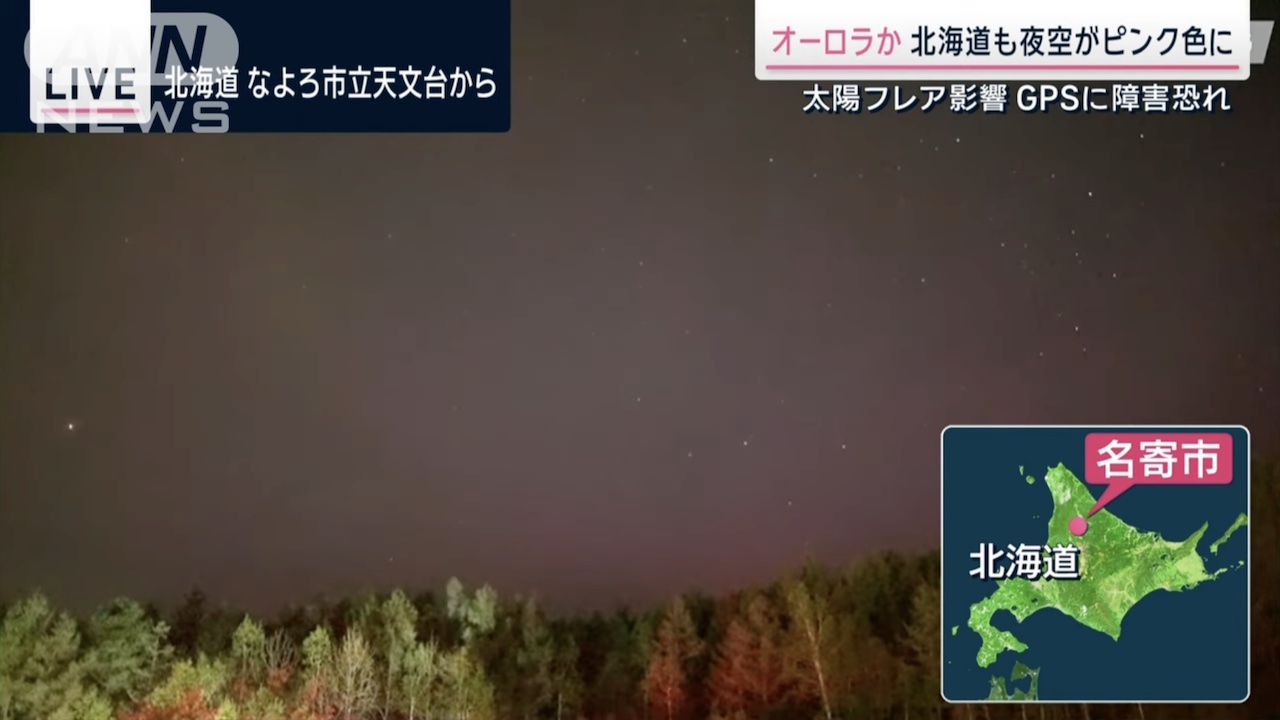
HOKKAIDO, May 11 (News On Japan) - Solar flares have been occurring in succession, resulting in aurora sightings around the world, including current footage from the Nayoro City Astronomical Observatory in Hokkaido.

On social media, there have been numerous posts reporting sightings of aurora-like phenomena across various parts of Hokkaido.

In the United Kingdom, auroras were observed in various places, including London, from the 10th to the 11th.

Due to the occurrence of six solar flares since the 8th, auroras have been observed at unusually low latitudes across the globe.

Meanwhile, the gases ejected by the solar flares may cause disruptions to GPS services and other technologies in the coming days.

However, the scale of the explosions has been small, and significant impacts on daily life, such as major power outages, are not expected.

Source: ANN

News On Japan
POPULAR NEWS

The death toll from the record-breaking heavy rain in Chiba Prefecture has risen to eight, with one person still missing and damage reported to at least 170 homes as flooding, landslides, water outages and transport disruptions continued on August 14.

Japan's weather agency raised the volcanic alert level for Mount Aso in Kumamoto Prefecture from Level 2 to Level 3 on August 14 after volcanic tremors strengthened and gas emissions increased sharply, warning people to stay away from areas within about 2 kilometers of the Nakadake No. 1 crater.

Typhoon No. 17 was moving east near Minamitorishima on August 14 and is expected to continue weakening before becoming a tropical depression by August 16.

Google opened its first flagship store in Japan in Tokyo's Omotesando district at 2 p.m. on August 13, marking the company's first flagship retail location outside the United States.

A mysterious red light stretching vertically across the night sky over Kanagawa Prefecture has been identified as a rare "sprite," a brief luminous phenomenon that occurs high above thunderclouds at roughly the same time as powerful lightning strikes.

MEDIA CHANNELS
         

MORE Sci-Tech NEWS

Security camera footage captured the moment part of the Hinagu Fault Zone broke through the ground during the Kumamoto earthquake on July 28, as strong shaking lifted the surface of a rice field and moved a nearby light truck violently.

New research is reshaping long-held assumptions about Tyrannosaurus rex, including suggestions that the giant predator may have lived to around 40 years rather than 28, while advances in fossil analysis are also offering new clues about dinosaur growth, posture and even color.

Japan's H3 Rocket No. 9 successfully placed the Michibiki No. 7 navigation satellite into its planned orbit after lifting off from the Tanegashima Space Center in Kagoshima Prefecture at 4:23 a.m. on August 11, marking the country's second consecutive successful H3 launch.

Requests for rapidly constructed "instant houses" are growing across areas of Kumamoto Prefecture devastated by the recent earthquake, providing air-conditioned temporary shelter for residents who have been sleeping in tents and vehicles beside their damaged homes.

University students in Shizuoka have designed a future lunar city using the globally popular game Minecraft and educational materials supervised by the Japan Aerospace Exploration Agency, combining programming and spatial design to explore how people could live safely and sustainably on the moon.

Toyota Motor has begun recruiting residents of Shizuoka Prefecture to live in Woven City, its experimental community for developing future technologies, with about 25 households expected to move into the site for two years from March 2027.

A 29-year-old Osaka University researcher is developing technology to produce sugar from carbon dioxide in the air, seeking to create a faster and more sustainable source of livestock feed as population growth, extreme weather and poor harvests raise fears of future food shortages.

The Kego Fault Zone running through central Fukuoka could produce an earthquake with a maximum seismic intensity of 7, leaving 1,800 people dead, 800 disaster-related deaths and 319,000 evacuees, according to prefectural damage estimates, as experts warn that an unruptured section may remain under stress.