News On Japan

Expo Plans in Disarray, India Abandons Pavilion

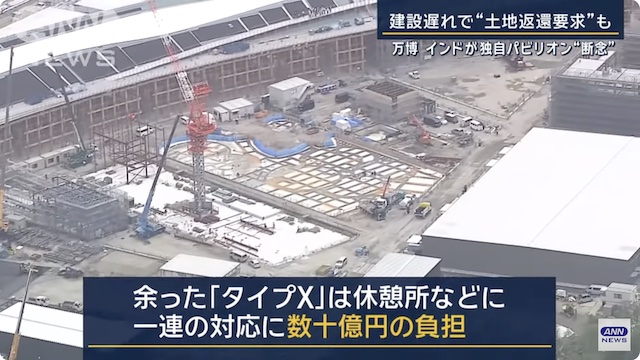
OSAKA - Countries are struggling to find contractors to complete the construction of complex pavilions before the opening ceremony of the Osaka-Kansai Expo on April 12 next year, while some participants feel uneasy about the potential for methane gas accidents.
Expo Plans in Disarray, India Abandons Pavilion

Osaka Governor Hirofumi Yoshimura stated, "With less than 10 months until the Expo opens, all project preparations are progressing swiftly and steadily." However, delays in preparations have also been noted.

A Polish representative mentioned, "The design of Poland's pavilion is complex and requires extensive construction time. We were delighted to finally find a contractor."

The Expo plans to host participants from 161 countries and regions. Of these, 51 countries aim to construct pavilions under the 'Type A' category, which allows for unique designs. However, 11 countries have yet to secure contractors.

One such country is India, which initially planned to build a pavilion inspired by the Himalayan mountains but has since abandoned this idea. Instead, India will use a prefabricated 'Type X' structure. The Expo Association has prepared nine of these 'Type X' pavilions for countries facing preparation delays. Despite this, only four countries, including India, have confirmed the use of 'Type X' structures. The remaining buildings will serve as rest areas for visitors. These adjustments will incur additional costs amounting to billions of yen, potentially requiring the use of contingency funds reserved for unforeseen events like disasters.

Internally, the Expo Association is considering asking countries that cannot complete 'Type A' pavilions on time to return their allocated land.

An Expo official stated, "If the land is returned at a point where we can no longer take action, it will remain vacant. However, we will make this request after considering each country's circumstances."

Besides construction delays, there are other concerns. The Expo site, Yumeshima, is an artificial island created from incinerated waste ash, and methane gas is being generated from some underground areas.

In March, an explosion occurred at a building under construction, likely caused by igniting methane gas.

The Polish representative commented, "While there seems to be no direct impact at this time, the risk is certainly present."

The Expo Association asserts that all necessary precautions have been taken, including installing methane gas emission devices at each facility.

Related: Osaka Expo Explosion: Unreported Damage Revealed by Worker

Source: ANN

News On Japan
POPULAR NEWS

Japan’s World Cup campaign ended in the cruelest possible fashion on June 29, as Gabriel Martinelli scored in the fifth minute of stoppage time to give Brazil a 2-1 victory over the Samurai Blue in their knockout match in Houston. Japan had led in the first half and were still level at 1-1 in the final moments, but Martinelli’s late strike sent Brazil into the Round of 16 and eliminated Japan from the tournament.

Strong earthquakes have continued to shake parts of Japan in recent weeks, with 11 temblors measuring lower 5 or above on the Japanese seismic intensity scale recorded across the country since April 2026.

A Kintetsu Railway train derailed inside Kyoto Station on the morning of June 29, forcing partial suspensions on the Kintetsu Kyoto Line for the rest of the day and causing long delays that hit commuters, students and tourists.

A section of stone wall at Hikone Castle, one of Japan’s few surviving original Edo-period castles and a National Treasure whose main keep remains intact more than 400 years after its construction, collapsed after heavy rain caused by Typhoons No. 7 and No. 8, Hikone city officials said.

Japan advanced to the knockout stage of the World Cup after a 1-1 draw with Sweden on June 25, finishing second in Group F and setting up a Round of 32 clash with Brazil in Houston.

MEDIA CHANNELS
         

MORE Travel NEWS

A section of stone wall at Hikone Castle, one of Japan’s few surviving original Edo-period castles and a National Treasure whose main keep remains intact more than 400 years after its construction, collapsed after heavy rain caused by Typhoons No. 7 and No. 8, Hikone city officials said.

The Japan Meteorological Agency said at around 2 p.m. on June 29 that the rainy season appeared to have ended in Okinawa, marking a later-than-usual start to summer after an especially wet period.

Japan’s weather agency carried out field inspections in Yamanashi Prefecture on June 28 after a powerful earthquake struck the Fuji Five Lakes area late on June 26, registering a lower 6 on Japan’s seismic intensity scale in Fujikawaguchiko and injuring six people.

According to updates on June 28, the double-typhoon system that brought record rain, flooding, landslides and fallen trees to parts of Japan has moved away, but Kanto remains under cloudy rainy-season skies, with intermittent rain still possible and saturated ground keeping the risk of landslides high in areas hit by heavy rain.

The Kanto region is experiencing an unusual June, with three typhoons approaching the area during the month and rainfall totals already reaching record levels in some locations.

Damage was reported across the Kansai region after a stationary seasonal rain front and an approaching typhoon brought torrential rain on June 26, triggering landslides in Seika, Kyoto Prefecture, flooding homes in Nara, and disrupting roads and railway services in Osaka and surrounding areas.

A powerful earthquake with a maximum seismic intensity of upper 6 struck off Iwate Prefecture at around 7:30 a.m. on June 25, shaking parts of Aomori Prefecture and leaving Hachinohe, which was hit by a similarly strong quake last December, facing fresh damage.

Rice field art depicting Los Angeles Dodgers star Shohei Ohtani and his dog Decoy is nearing its best viewing period in Oshu, Iwate Prefecture, Ohtani’s hometown.