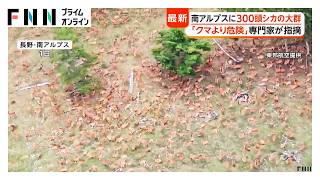
NAGANO - A herd of an estimated 200 to 300 deer has been filmed in the Southern Alps, highlighting a rapidly expanding population that experts warn is damaging mountain ecosystems, stripping vegetation, increasing landslide risks and creating problems across Japan ranging from crop losses to traffic accidents.
The footage was taken on August 1 by an aircraft mechanic aboard a helicopter transporting food and other supplies to a mountain lodge. It showed a vast herd covering the ground near Futagoyama, close to Southern Alps National Park, which spans Nagano, Yamanashi and Shizuoka prefectures.
The deer were spotted on the northwestern side of the mountain in Nagano Prefecture.
"There were probably 200 to 300 of them," mechanic Tatsumi Kawasaki of Toho Air Service said. "At first I thought the grass was a different color, but when I looked closely, they were all deer."
Shinobu Saito, manager of the Umanose Hut in the Southern Alps, said she had never seen a herd of that size. "I had never seen so many deer together, so I was simply astonished," she said. "It made me realize that their numbers have increased far beyond what we had imagined."
Wild deer generally live for six to seven years, and one of the main factors behind their rapid population growth is their high reproductive capacity.
Takayoshi Yamauchi, an associate professor at Iwate University, said deer can continue producing offspring rapidly as long as sufficient food is available.
Large herds have been observed in the area before. Footage from three years ago showed deer filling part of a hillside before suddenly scattering in all directions.
Their increasing numbers have become a serious problem in the Southern Alps, where alpine vegetation is being heavily damaged.
Saito said deer have eaten plants including the Japanese globeflower, a flowering species found in the mountains.
Although deer are herbivores, their impact on vegetation can also create risks for people.
A large landslide that occurred in Maibara, Shiga Prefecture, in 2024 is believed to have been linked to feeding damage caused by deer. Vegetation on the mountain was eaten away, leaving the surface exposed and allowing water to flow more easily down the slope, contributing to the collapse.
Similar damage is being reported across Japan.
At Anji Kamo Shrine in Himeji, Hyogo Prefecture, deer have reportedly been entering the grounds at night for about a decade and eating hydrangeas.
Chief priest Yoshiki Sanada said as many as 10 deer can sometimes be seen at once and that they have become so accustomed to people and vehicles that they often do not move out of the way when cars approach.
In Koriyama, Fukushima Prefecture, deer caused extensive damage to a field that was expected to produce about 1.8 million sunflowers for an annual festival in August.
Chihiro Muramatsu, head of the organizing committee for the Konan Festival in Koriyama, said the fields visible in every direction were supposed to be filled with sunflowers, but the plants had been almost completely destroyed.
Footprints believed to have been left by deer were found throughout the site in 2026, while security camera footage from a nearby field showed deer feeding on crops. The damage forced organizers to cancel the festival.
Deer are also creating growing risks on roads.
In Sapporo, Hokkaido, collisions involving deer occurred in urban areas in 2025. Across Hokkaido, the number of traffic accidents involving Ezo deer has been rising, reaching a record 6,705 cases in 2025.
In the Kanto region, another member of the deer family, the Reeves's muntjac, known in Japan as kyon, has also expanded rapidly.
During reporting in Isumi, Chiba Prefecture, on August 31, a muntjac was spotted in the area, followed by two more crossing a road.
Footage from a camera in the garden of a local home showed one of the animals noticing the camera before approaching while sniffing around.
According to Chiba Prefecture, Reeves's muntjac populations had become established in only five municipalities in 2004, but their range had expanded to 18 cities and towns by 2025. The population is estimated at 94,100.
One Isumi resident said the animals appeared to outnumber the city's human population and that people had begun growing plants and crops that muntjac were less likely to eat.
Residents have also built homemade fences, although the animals can jump over them from a standing position and move into neighboring properties. One resident said newly sprouting vegetables were particularly vulnerable.
The growing deer population is therefore creating a broad range of problems, including feeding damage, increased natural disaster risks and traffic accidents.
Yamauchi said the ecological consequences of deer can be more severe than those caused by bears because their numbers allow them to consume almost all of the undergrowth in forests.
"When there are large numbers of deer, they can eat all of the vegetation covering the forest floor, creating concerns about landslides and other disaster-prevention risks," Yamauchi said.
He said heavy rainfall has become more frequent and there have been repeated cases of muddy torrents resembling flash floods flowing down from mountain areas after intense rain, raising suspicions that deer-related vegetation loss may be contributing to the problem.
"The impact deer have on ecosystems is much greater than that of bears, so they are dangerous animals in that sense," he said.
Experts believe the worsening problem may also be linked to the declining and aging population of hunters as well as climate change.
Yamauchi said the number of hunters has fallen substantially and the remaining hunting population is aging, making it increasingly difficult to capture enough deer to control their numbers.
Declining snowfall associated with warmer temperatures is also allowing deer to expand into higher elevations where they were previously uncommon, he said, further extending their range into mountain ecosystems.
Source: FNN