

TOKYO - The government’s plan to cut the consumption tax on food is turning into a broader fight over public spending, ministerial accountability and whether Prime Minister Sanae Takaichi can keep her autumn Diet agenda focused on household relief rather than political damage control.
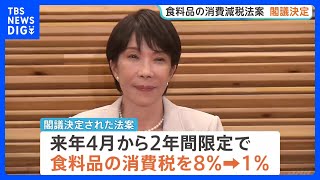
The administration submitted legislation on October 9 to lower the consumption tax rate on food from 8% to 1% for two years from April 2027, making the bill the centerpiece of the extraordinary Diet session. The measure is intended to ease the burden on households facing higher food prices, but it has also forced the government to explain how it will cover a large loss of revenue without relying on deficit-financing bonds.
Finance Minister Satsuki Katayama has moved to strengthen what the government calls its “Japan-style DOGE” initiative, a spending review modeled loosely on the U.S. Department of Government Efficiency. The review is intended to identify unused or underused public funds, subsidies and special-purpose reserves that can be returned to the national treasury or redirected to priority measures.
The fiscal stakes are high. Lowering the food tax from 8% to 1% is estimated to reduce national and local tax revenue by about 4.3 trillion yen a year. Takaichi has said the cut should basically be reflected in retail prices, and the government has calculated that the mechanical household benefit would be about 36,000 yen per person.
But opposition parties are pressing the government to show how much of the tax cut will actually reach consumers in lower prices. Retail prices are affected not only by tax rates but also by raw material costs, labor costs, logistics expenses and corporate pricing decisions. Takaichi has acknowledged that it is difficult to offer a firm forecast because shop prices move for many reasons.
The restaurant industry has also raised concern because dining out will remain taxed at 10%, while many food items will fall to 1%. The Japan Foodservice Association has warned that the gap could create a major disadvantage for restaurants, with many companies expecting a decline in customers. The industry has called for support measures such as meal vouchers.
The tax cut may also require compensation for farmers and related producers if price changes or distribution effects reduce income. That means the fiscal cost of the policy could extend beyond the headline revenue loss. The more support measures the government adds to soften side effects, the more difficult it becomes to keep the funding promise credible.
Katayama has said the government must “raise the gear” in its spending review, arguing that previous efforts were not sufficient. At the end of August, ministries had voluntarily proposed abolishing only three of 121 tax-preference measures under review, a result that left the Finance Ministry dissatisfied.
The focus has now shifted to government funds, including more than 200 special-purpose funds with balances of more than 7 trillion yen. These funds were created for specific policy purposes and accumulated through previous budgets, including supplementary budgets. The government is asking ministries to return money that is sitting idle or no longer needed.
The approach is politically attractive because it allows the administration to say it is finding money inside the existing budget rather than borrowing more. It also fits Takaichi’s effort to reassure markets that her government can combine tax relief with fiscal discipline.
But the review is likely to become a difficult fight inside the bureaucracy and ruling coalition. Many funds are tied to powerful policy areas, including space development, advanced drug research, vaccine development and industrial support. Ministries and industries that depend on those funds are expected to resist large cuts, especially if money is redirected from long-term investment to tax relief.
That tension goes to the heart of Takaichi’s economic strategy. She wants to cut taxes for households while also investing in strategic sectors such as artificial intelligence, semiconductors, shipbuilding, energy, space and quantum technology. If the government uses funds originally designed for growth or technology policy to finance the food-tax cut, critics may argue that short-term relief is being paid for by weakening long-term competitiveness.
The bond market is watching closely. Takaichi has pledged to cap new government bond issuance at around 40 trillion yen in the fiscal 2027 budget, even as budget requests for next year have reached record levels. With the Bank of Japan raising interest rates and reducing support for government bonds, investors are more sensitive to any sign that the tax cut will increase borrowing or inflationary pressure.
The government’s message is that the food-tax cut is temporary, targeted and fundable through reforms. The opposition’s message is that the government has promised relief before securing the money.
The Diet debate has also been complicated by the controversy surrounding Agriculture Minister Kazuo Yana. Yana has been under pressure over remarks suggesting that road budgets were cut for municipalities whose leaders did not support him in an election. He later withdrew the comments and apologized, but the issue has continued to widen.
The Land, Infrastructure, Transport and Tourism Ministry has said budget allocations for the affected municipalities were based on factors such as priority projects and construction schedules. It also said any inquiry from Yana did not affect the allocation process. Even so, opposition parties argue that suspicion has not been fully dispelled.
Yana has faced further questions over a report that supporters were transported free of charge on a shuttle bus arranged by his side during a past Lower House election, raising possible concerns under election law. He has said he is still confirming the facts and will explain once they are整理ed.
The controversy has grown inside the ruling party as well. At an LDP agricultural policy meeting, veteran lawmaker Muneo Suzuki rebuked Yana, saying he should first apologize and show a sense of responsibility before speaking about policy. Yana responded by apologizing to party members.
Takaichi has rejected calls to dismiss Yana, saying she told him to fulfill his responsibility to explain and to approach his duties with discipline. She has said she wants him to use his knowledge of agricultural policy to work harder than anyone else for food security.
That explanation has not ended the political pressure. Opposition parties, led by the Constitutional Democratic Party of Japan, are considering submitting a censure motion against Yana in the House of Councillors. In the Upper House, where the ruling bloc does not hold an outright majority, such a move could become a serious obstacle to Diet management.
The issue also gives the opposition an opening to attack Takaichi’s judgment. The food-tax bill is already complicated by funding questions, price effects and industry concerns. If the agriculture minister remains under scrutiny, opposition parties can connect the controversy to broader questions about fairness in budget allocation and the government’s ability to manage food policy.
The Japan Innovation Party, the LDP’s coalition partner, has also criticized Yana’s remarks as clearly inappropriate. Ishin has not openly demanded his dismissal, but it has said he must provide a careful explanation. That matters because Takaichi needs Ishin’s cooperation not only on the food-tax bill but also on Diet reform and Lower House seat reduction.
For the administration, the risk is that the Diet session becomes consumed by ministerial accountability before the government can build support for its main economic measure. The food-tax cut is meant to show that Takaichi is responding directly to household concerns. But if debate shifts toward Yana’s remarks, alleged election-law issues and questions over political influence on budget distribution, the government’s message on living costs could be diluted.
The controversy also intersects with the spending review. Takaichi and Katayama are arguing that budget discipline can be achieved by cutting waste, returning idle funds and reallocating money fairly. At the same time, one of the cabinet’s own ministers is being questioned over whether local budget allocations were influenced by political support. Even if the government denies any actual influence, the optics are damaging.
The political challenge is therefore twofold. The government must prove that the food-tax cut has a credible funding path, and it must show that budget decisions are being made transparently and fairly. Both are necessary if Takaichi wants to maintain confidence among voters, coalition partners and markets.
The next phase of the Diet debate will likely focus on how much money the Japan-style DOGE review can realistically produce. Finding idle funds is easier than sustaining annual revenue replacement for a two-year tax cut. If the review produces only one-time resources, the government will still need to explain how it will fund the policy across the full period without weakening other priorities.
Takaichi’s supporters will argue that the spending review shows seriousness about reform and that households need relief before a more permanent income-linked support system begins. Critics will argue that the administration is raiding existing funds, underestimating implementation costs and using a temporary tax cut to avoid harder decisions on social security, wages and fiscal reform.
The October 10 and 11 political picture shows the food-tax cut entering its most difficult stage. The bill has been submitted, but the funding battle has only begun. The government has identified more than 7 trillion yen in fund balances as a possible source of money, but turning that into usable fiscal space will require fights with ministries, industries and lawmakers. At the same time, Yana’s controversy threatens to pull attention away from the household-relief message and toward questions of accountability.
The central question is whether Takaichi can keep control of the Diet agenda. If Katayama can produce convincing savings and Yana contains the damage with a full explanation, the food-tax bill may remain on track. If the spending review stalls or the agriculture minister’s controversy deepens, the tax cut could become less a symbol of household relief than a test of whether the government can govern cleanly while promising expensive reforms.
What To Watch Next
The government must show how much of the food-tax cut can be funded through returned public funds, subsidy reviews and spending reforms.
Finance Minister Satsuki Katayama’s “Japan-style DOGE” review will face resistance from ministries and industries tied to special-purpose funds.
Opposition parties are likely to keep pressing the government on whether the 4.3 trillion yen revenue loss will actually translate into lower prices for consumers.
The restaurant industry’s exclusion from the 1% rate could become a separate political issue if businesses warn of lost customers and demand support.
Agriculture Minister Kazuo Yana’s explanations over road-budget remarks and the reported free shuttle bus issue will affect whether opposition parties proceed with a censure motion.
The Upper House will be important because the ruling bloc lacks an outright majority, making Diet management more vulnerable to ministerial scandals.
Bond yields and the yen remain important market signals as investors judge whether the food-tax cut can be funded without more debt.