TOKYO - Russian authorities have arrested a Japanese journalist working for the Hokkaido Shimbun newspaper on suspicion of espionage, releasing footage of a security operation and accusing the reporter of gathering military intelligence, in a case that threatens to further strain relations between Tokyo and Moscow.
Russia's Federal Security Service (FSB) announced on October 13 that it had detained the journalist in Yuzhno-Sakhalinsk, the capital of Sakhalin Oblast in Russia's Far East, north of Hokkaido, where the newspaper maintains a bureau. The journalist was subsequently transferred to Moscow and formally arrested.
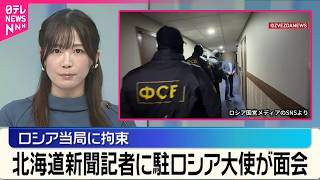
Footage released by the FSB shows several people dressed in black moving through a corridor before opening a door and rushing into a room. Their jackets bear the Russian abbreviation for the Federal Security Service. The video was presented by Russian authorities as evidence of the operation that led to the journalist's detention.
The FSB alleges that the journalist used his professional position as cover for intelligence activities that went well beyond legitimate reporting. According to Russian authorities, he collected and stored information about the number of reservists and military personnel mobilized from the Kuril Islands, including the Russian-held islands claimed by Japan as its Northern Territories, for deployment in Russia's invasion of Ukraine.
Russian officials claim the information was gathered under instructions from Japanese intelligence agencies and was intended to be passed to relevant organizations in Japan. The FSB described the alleged activities as threatening Russia's national security. The accusations remain claims made by Russian authorities.
Russia's Foreign Ministry also announced that the journalist had been detained for conducting intelligence activities on Russian territory.
According to Russia's Interfax news agency, a Moscow court ordered the journalist to remain in custody until December 12. A conviction for espionage could carry a prison sentence of between 10 and 20 years under Russian law.
The Kremlin defended the security service's actions, saying the FSB was carrying out its responsibilities. "The Federal Security Service has made the relevant announcement. They are performing their duties. If there are spies, they catch them," a Russian official said.
Japan's Foreign Ministry summoned the Russian ambassador to Tokyo on October 14 to lodge a strong protest over the detention and Russia's public handling of the case.
The ministry said the Russian side had detained a Japanese national and unilaterally released allegations without providing the Japanese government with any explanation. Japan strongly objected to the way the case had been handled.
The ambassador declined to comment when approached following the meeting.
The arrest follows previous cases in which Russia's security agencies have detained foreign journalists on espionage allegations.
In March 2023, the FSB arrested Evan Gershkovich, an American correspondent for The Wall Street Journal, on spying charges. After spending more than a year in detention, Gershkovich was sentenced to 16 years in prison in July 2024.
He was subsequently released in August 2024 as part of a major prisoner exchange between Russia and Western countries, including the United States.
The latest detention comes against a backdrop of worsening diplomatic relations between Japan and Russia, driven by the prolonged war in Ukraine, Japan's continued economic sanctions against Moscow, and their longstanding territorial dispute.
In August, Russian President Vladimir Putin made a surprise visit to Etorofu Island, one of the four Russian-controlled islands claimed by Japan as its Northern Territories. The visit prompted a strong protest from the Japanese government.
Putin has criticized Tokyo's position, accusing Japan of contributing to the deterioration of bilateral relations through its sanctions against Russia over the invasion of Ukraine.
Following the journalist's arrest, Russia's Foreign Ministry warned that the incident would become another factor contributing to a further deterioration in relations between the two countries.
Analysts suggest the detention may serve several purposes for Moscow, including exerting diplomatic pressure on Tokyo and restricting foreign media coverage of conditions inside Russia.
One expert said the prolonged invasion of Ukraine had made Russian authorities increasingly sensitive to reporting on domestic public opinion and the impact of the conflict on Russian society.
Russian officials are particularly reluctant to allow Western journalists to investigate public attitudes toward the war, the expert said, suggesting that pressure on foreign correspondents has become another means of controlling information about the conflict.
The case also raises questions about the ability of Japanese media organizations to continue reporting independently from Russia, particularly in regions closely connected to Japan through geography, historical ties and the territorial dispute.
The Hokkaido Shimbun said it would prioritize the safety of its detained correspondent.
"We will respond to the situation with the safety of our journalist as our highest priority," the newspaper said.