News On Japan

Fukuoka Airport Introduces Smart Lanes to Streamline Security Checks

FUKUOKA - Anyone who has experienced long security lines at Fukuoka Airport will be relieved to hear a new system aimed at alleviating chronic congestion started on Wednesday.
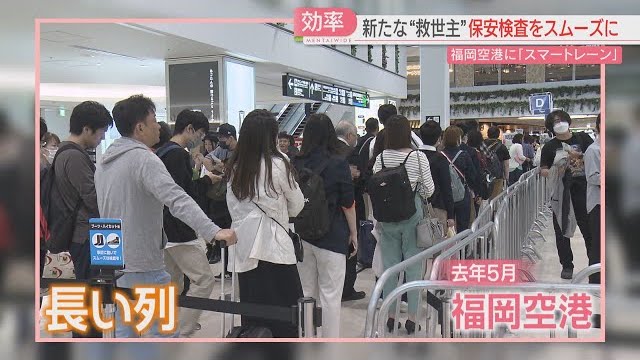
Fukuoka Airport Introduces Smart Lanes to Streamline Security Checks

With the Smart Lane system, passengers don’t need to remove items like laptops from their bags, significantly reducing queue times.

Smart Lane employs 3D technology for a clearer scan of the contents of carry-on luggage. This advancement means passengers no longer need to remove laptops or liquids from their bags, making the security check much more efficient.

Last year, during the busy holiday period, Fukuoka Airport's domestic terminal saw long lines at the security checkpoints. The congestion had become a regular occurrence, partly due to staffing shortages.

The Smart Lane system features automatic baskets, allowing up to four passengers to simultaneously place their luggage on the conveyor belt. With this new system, the number of passengers screened per hour per machine is expected to increase from 170 to approximately 250, significantly easing passenger congestion.

Tetsuya Iwamoto from Fukuoka International Airport stated, "Our goal is to make the airport more user-friendly, stress-free, and efficient for our customers."

The operation of two Smart Lane machines commenced on January 24th, with plans to install a total of 11 by the end of April.

Source: FBS福岡放送ニュース

News On Japan
POPULAR NEWS

Prime Minister Sanae Takaichi has drawn criticism over a social media post describing five hours of sleep as a rare luxury, as the extended Diet session prepares to begin Upper House debate on a controversial bill to establish secondary capitals outside Tokyo.

Japan began applying a new numerical alcohol threshold for dangerous driving offenses on July 21, introducing a clearer standard for cases involving impaired driving that could lead to fatal accidents.

Breathtaking 4K footage filmed from a helicopter offers a sweeping aerial view of Mount Fuji and its majestic surrounding landscape.

A covert network of shuttle tankers is carrying crude through the increasingly dangerous Strait of Hormuz as renewed fighting between the United States and Iran disrupts shipping and raises concerns over how Japan will secure the oil it needs.

Russian Deputy Foreign Minister Andrey Rudenko has criticized moves by Japanese and Ukrainian companies to cooperate on drone technology, warning that such ties would be regarded by Moscow as a "clear hostile act."

MEDIA CHANNELS
         

MORE Travel NEWS

Haneda Airport is emerging as a destination where visitors can spend an entire day, offering aviation-themed attractions, distinctive restaurants, unusual vending machines and observation decks with sweeping views of aircraft taking off and landing.

Japan’s newest luxury cruise ship, Asuka III, offers passengers the experience of a high-end hotel at sea, combining private balconies, fine dining, Japanese-style bathing and personalized service on voyages around the country.

The rainy season ended in the Kanto-Koshin and Tokai regions on July 20 as strengthening high pressure brought intense heat across Japan, with temperatures forecast to reach 38 C in Kumagaya, Saitama Prefecture, and Kofu.

Nagashima Jumbo Seawater Pool in Kuwana, Mie Prefecture, was packed with visitors on Marine Day, the final day of a three-day weekend, as families sought relief from intense summer heat following the end of the rainy season in the Tokai region.

A beach where visitors can swim alongside whales has opened in Taiji, Wakayama Prefecture, drawing families and children eager to see the animals at close range.

An interactive exhibition recreating the world of Studio Ghibli will open at Osaka's ATC complex on July 18, offering visitors of all ages the chance to experience famous scenes and characters from the studio's animated films.

Heavy rain flooded railway tracks in Hokkaido, forcing the cancellation of 32 trains, including limited express services linking Sapporo and Hakodate.

Japan is likely to face increasingly long and dangerously hot summers as global temperatures continue to rise, with advanced climate simulations also pointing to more frequent torrential rain, rising seas and accelerating ice loss by the end of the century.