News On Japan

Sakurajima Erupts: Plume Reaches 5,000 Meters

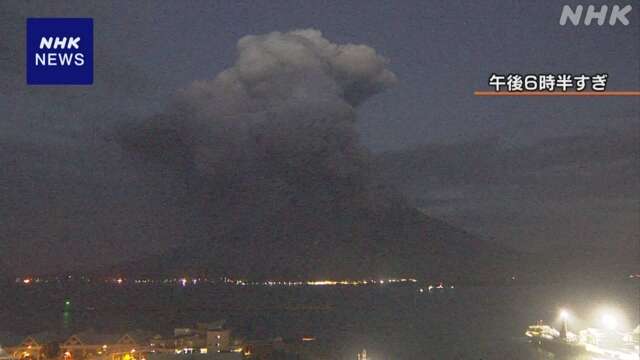
KAGOSHIMA, Feb 15, 2024 (News On Japan) - A volcanic eruption Wednesday evening from Kagoshima's active Sakurajima sent a plume of smoke 5,000 meters above the crater, the first time since August four years ago that ash has reached such heights.
Sakurajima Erupts: Plume Reaches 5,000 Meters

The volcanic alert level remains at 3, but Japan's Meteorological Agency is calling for caution as a "large amount" of ash is expected to fall on the island of Sakurajima by the early hours of Thursday.

According to the Meteorological Agency, an explosive eruption occurred around 6:30 p.m. on the 14th at the Minamidake summit crater of Sakurajima, sending a plume of smoke 5,000 meters above the crater. The last time a plume reached a height of 5,000 meters at Sakurajima was in August 2020. Additionally, it has been confirmed that large volcanic bombs were ejected from the crater, flying between 1,000 to 1,300 meters. Due to this eruption, the smoke drifted northeast, and until around 1 a.m. on the 15th, visibility was poor on the island of Sakurajima due to the swirling volcanic ash, and a "large amount" of ash fall covering the ground was expected. The Meteorological Agency has advised against unnecessary outings and driving. Furthermore, a "small amount" of ash fall that could lightly cover the ground is also expected in parts of Tarumizu City, Kirishima City, Soo City, Aira City, Isa City, Satsumasendai City, Satsuma Town, Yusui Town, as well as some parts of Miyazaki and Kumamoto Prefectures, so caution is needed.

Sakurajima has experienced frequent explosive eruptions in the past. The Meteorological Agency continues to issue a volcanic warning level "3" alert for the area around the craters of Minamidake summit and Showa crater, calling for caution against large volcanic bombs and pyroclastic flows that may accompany an eruption within an approximate 2-kilometer radius of these craters.

Source: NHK

News On Japan
POPULAR NEWS

Record rainfall caused 19 rivers to overflow across Fukui Prefecture, flooding roads and homes, triggering landslides and temporarily forcing authorities to issue the highest-level heavy rain emergency warning from early Sunday morning.

Drones were used to deliver food and daily necessities to an isolated mountain community in Himi City, Toyama Prefecture, on August 30 after torrential rain triggered a landslide that cut off road access, while volunteers continued flood recovery work in neighboring Ishikawa Prefecture.

Two typhoons east of Japan were moving northward on August 30, with Typhoon No. 23 (Banlan) overtaking Typhoon No. 22 (Artau), although neither storm is expected to have a direct impact on Japan.

A 9-minute, 13-second drone video filmed inside Aeon Mall Kumamoto two days after the deadly explosion has provided a detailed view of the destruction, showing collapsed ceilings, heavy dust and widespread damage that may have affected between one-third and nearly half of the shopping center.

Strong Typhoon No. 18 was moving northwest through the East China Sea on the night of August 26, gradually pulling away from Okinawa and the Amami Islands as lingering rain, strong winds and high waves were expected to ease. As of 9 p.m. on August 26, the typhoon was over waters north-northwest of Kume Island and moving northwest.

MEDIA CHANNELS
         

MORE Sci-Tech NEWS

The Japanese government has revised its assessment of active faults across the Kinki region for the first time in about 20 years, increasing the number of fault zones considered at the highest level of concern for earthquakes of magnitude 6.8 or greater from three to eight.

Residents in Minoh, Osaka Prefecture, have asked the city to take a more active role in explaining and reviewing plans for a large data center to be built on the former site of Osaka University's Minoh Campus, citing concerns over low-frequency noise, loss of sunlight and other potential effects on daily life.

A magnitude 5.9 earthquake centered in southern Ibaraki Prefecture shook a wide area of the Kanto region at around 2 a.m. on August 23, registering a maximum intensity of lower 5 on Japan's seven-level seismic scale in parts of Ibaraki, Saitama, Chiba and Tokyo.

A cognitive trait known as aphantasia, in which people are unable to voluntarily form images in their minds despite knowing what objects look like, may affect about 4% of people, highlighting significant differences in how individuals experience memory, imagination and everyday tasks.

Dangerous heat returned across Japan on August 19, complicating disaster recovery efforts in earthquake-hit Kumamoto and flood-damaged Chiba while unusually low rainfall and limited snowfall pushed reservoirs in several regions toward critical levels.

Japanese researchers are developing a lithium-air battery that uses oxygen from the atmosphere to store and generate electricity, promising nearly five times the capacity of conventional lithium-ion batteries at less than half the weight and potentially opening the way to far longer electric vehicle driving ranges.

Security camera footage captured the moment part of the Hinagu Fault Zone broke through the ground during the Kumamoto earthquake on July 28, as strong shaking lifted the surface of a rice field and moved a nearby light truck violently.

New research is reshaping long-held assumptions about Tyrannosaurus rex, including suggestions that the giant predator may have lived to around 40 years rather than 28, while advances in fossil analysis are also offering new clues about dinosaur growth, posture and even color.