News On Japan

"Raku Raku Yamato" Launches in Kansai, Hokuriku Shinkansen Reaches Tsuruga

NARA - The annual March timetable revision for JR has been implemented that includes a new commuter express train coinciding with the opening of the Hokuriku Shinkansen extension.
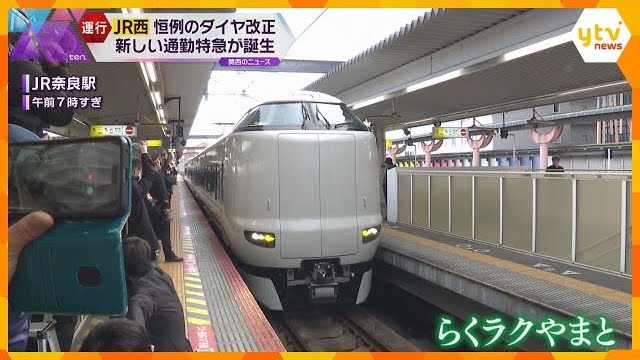
On the morning of the day, A departure ceremony was held at Nara Station for the commuter express "Raku Raku Yamato" on Monday morning. Connecting Nara to Shin-Osaka via Tennoji, "Raku Raku Yamato" operates as an all-reserved seating service with one round trip during the morning and evening commuting hours on weekdays.

An additional express fare is required, but the service aims to meet the demand for seated commutes. The departure ceremony was held to mark the start of the service.

A child at the event commented, "The front of the train was sleek and cool."

The excitement wasn't limited to the Kansai region. On March 16th, the Hokuriku region was buzzing with excitement.

Reporter Hayato Nakano said, "It's just past 4:30 AM. Many people have lined up in front of Tsuruga Station to welcome the opening day of the Hokuriku Shinkansen extension."

People from all over the country gathered in front of the station, aiming for a glimpse of the first Shinkansen train.

A visitor from Shizuoka Prefecture said, "I've been in line since 9 AM the day before yesterday. I wanted to be the first to board the first train."

The first train of the "Tsurugi" service, connecting Kanazawa and Tsuruga, sold out in less than a minute, while the "Kagayaki" service between Tokyo and Tsuruga sold out in four minutes. Both adults and children were dazzled by the popularity of the new Shinkansen.

However, for those traveling from Kansai to Hokuriku, the journey used to be direct on the "Thunderbird" express to Kanazawa Station, but now requires a transfer at Tsuruga Station. The transfer involves moving between the first and third floors via escalator and navigating crowded ticket gates, adding to the burden.

JR West estimates an 8-minute transfer time and has marked transfer routes with colored floor guides, with staff loudly directing passengers. There were no major disruptions on the first day.

A passenger who transferred said, "The transfer was smoother than expected."

Another commented, "It was confusing. I underestimated Tsuruga."

One traveler missed their connection, saying, "I was late. I went to platform 7 by mistake and had to get my ticket changed by a station attendant."

While the Hokuriku Shinkansen extension has brought convenience, the travel time reduction between Osaka and Fukui stations is just 3 minutes when including the transfer time, with a fare increase of 1,150 yen. The impact diminishes if transfer time increases.

A traveler returning to Kansai from Fukui remarked, "It's brief, but I do feel some inconvenience in transferring."

The Hokuriku Shinkansen extension has generated significant excitement, with expectations for it to be a catalyst for the Hokuriku area, which was affected by the New Year's Day earthquake on the Noto Peninsula.

Source: YOMIURI

News On Japan
POPULAR NEWS

The eruption alert level for Mount Tokachidake in Hokkaido was raised to Level 2 on June 18 for the first time in 12 years, prompting authorities to restrict entry within 1.5 kilometers of the crater and close parts of hiking trails just days before the mountain’s official opening for the summer climbing season.

Bear attacks and sightings are increasing across Japan, with multiple people injured on June 17 and experts warning that bears are becoming more accustomed to human environments, potentially leading to more dangerous and unpredictable encounters in the years ahead.

JR Central and JR West on June 17 announced pricing and service details for the new private-room seating that will be introduced on the Tokaido and Sanyo Shinkansen from October, creating a new top-tier class above the existing Green Car service.

A draft of the joint statement from the G7 summit in France has revealed that all proposals put forward by Prime Minister Takaichi on energy security and critical minerals have been incorporated into the agreement.

A Japanese man suspected of serving as a key coordinator for a Cambodia-based fraud syndicate that allegedly caused losses totaling billions of yen was arrested by Japanese authorities after being deported from Thailand on June 16.

MEDIA CHANNELS
         

MORE Travel NEWS

Kyoto's Myoshin-ji Temple, one of Japan's largest Zen temple complexes, is facing a growing problem that temple officials warn could eventually lead to costly restoration work and even pose safety risks to visitors.

A long-abandoned sightseeing boat that has sat tilted in a canal in Kawasaki, Kanagawa Prefecture, for nearly eight years is finally being removed by city authorities after officials determined the deteriorating vessel posed a serious safety risk.

Nara Prefecture has conducted a promotional tour for ambassadors and diplomats from member states of UNESCO's World Heritage Committee to showcase the Asuka and Fujiwara Palace Sites as the property moves toward formal inscription as a World Cultural Heritage site.

Shirahama, one of the Kansai region's leading tourist destinations, has approved the introduction of an accommodation tax, becoming the third municipality in the region after Osaka Prefecture and Kyoto City to adopt such a measure.

JR Ueno Station has unveiled "Ueno Canvas," a new 75-square-meter LED display featuring videos that highlight the area's cultural attractions, tourism destinations, and artistic heritage as part of a station renovation aimed at connecting people and the city through culture.

A magnitude 5.5 earthquake struck eastern Japan at around 7:46 p.m., with a maximum seismic intensity of lower 5 recorded in parts of Gunma and Saitama prefectures, though no injuries or major damage had been confirmed and there was no risk of a tsunami.

Aragi Island, a tongue-shaped plateau surrounded on three sides by the sharply winding Arida River in Aridagawa, Wakayama Prefecture, is drawing attention for its spectacular terraced rice fields, which create giant geometric patterns reflecting the sun and sky during the planting season.

Every spring, as visitors flock to Kyoto's Uji City to see landmarks such as Byodo-in Temple and sites associated with The Tale of Genji, another seasonal attraction appears in overwhelming numbers: swarms of tobikera, or caddisflies.