News On Japan

Kura Sushi Opens Ginza Store with Massive Sushi Train

TOKYO, Apr 25 (News On Japan) - Kura Sushi's latest store in Ginza opens today (April 25), featuring a 120-meter long conveyor belt, the longest in any of its restaurants.
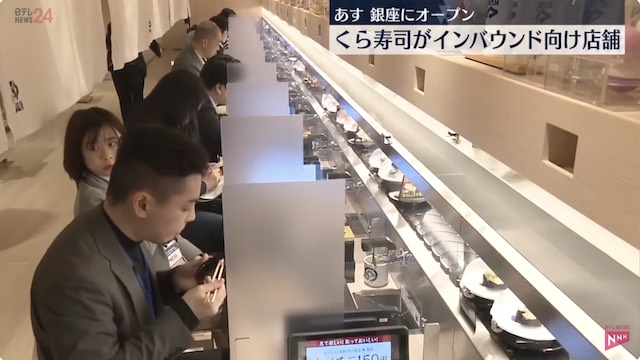
Visitors can also enjoy live demonstrations of sushi and tempura being prepared at the food stalls within the restaurant, adding an authentic and interactive dining experience.

As inbound tourism continues to thrive, this store will serve as the flagship among the five existing outlets aimed at foreign customers, with a strategy to attract even more patrons. However, due to the prime location in Ginza and the rising labor costs, the minimum price per plate at this outlet has been set at 150 yen, slightly higher than at other locations.

Source: 日テレNEWS

News On Japan
POPULAR NEWS

A fire that scorched the exterior wall of a company operated by a Pakistani national was discovered in Ebetsu, Hokkaido, on March 1st, just one day after a mosque located about 400 meters away caught fire, prompting police to investigate the possibility that the two incidents may be connected.

Police plan to arrest a Japanese doctor in his 60s who lives in the United States and is suspected of spraying an oil-like liquid at Naritasan Shinshoji Temple in Chiba Prefecture in 2015, with the suspect expected to arrive in Japan as early as March 4th, investigators said.

The Ministry of Land, Infrastructure, Transport and Tourism has announced plans to draw up guidelines for the introduction of a so-called dual pricing system that differentiates between foreign visitors and local residents.

Kyoto City significantly raised its lodging tax from March 1st, increasing the maximum charge per person per night from 1,000 yen to as much as 10,000 yen, in a move aimed at tackling overtourism and funding the preservation of cultural assets, even as questions remain about its impact on visitors and the local economy.

A former emergency responder and foreign tourists worked together to rescue a woman in her 80s who was trapped inside an overturned light vehicle in Hakuba Village, Nagano Prefecture.

MEDIA CHANNELS
         

MORE Travel NEWS

The Osaka Loop Line, which circles central Osaka, has 19 stations and runs for about 21 kilometers. Despite its circular design, surprisingly few trains actually operate in a full loop. During daytime hours, only about one in three trains runs the complete circuit, while destination boards often display locations such as Nara or Wakayama—names that seem out of place on a circular urban railway.

The Imperial Hotel Kyoto is set to open on March 5th in the heart of Gion, one of Kyoto’s most renowned districts, with the interior unveiled to the media on March 2nd ahead of its debut.

Kyoto City significantly raised its lodging tax from March 1st, increasing the maximum charge per person per night from 1,000 yen to as much as 10,000 yen, in a move aimed at tackling overtourism and funding the preservation of cultural assets, even as questions remain about its impact on visitors and the local economy.

Tokyo Metro and Toshiba have launched Japan’s first demonstration test allowing passengers to pass through ticket gates without touching them by using their smartphones’ Bluetooth function.

The admission fee for the World Heritage-listed Himeji Castle in Himeji, Hyogo Prefecture, was revised on March 1st for the first time in 11 years, introducing a dual pricing system that significantly raises costs for visitors from outside the city.

As the number of foreign visitors to Japan continues to rise, two uniquely Japanese cultural phenomena — food replicas and capsule toys, known as gacha — are drawing growing attention as unexpected tourist attractions and potential new souvenir staples.

Japan is known for keeping tradition amidst modernization. While travelers visit temples that date back centuries, they will also see modern day neon skyscrapers.

The main rites of the Buddhist practice known as "Shunie," widely referred to as "Omizutori," began on March 1st at Nigatsudo Hall of Todaiji in Nara, marking the arrival of spring in the ancient capital.