News On Japan

Japan's Corporate Bonuses Soar for Third Year, Hitting New Record

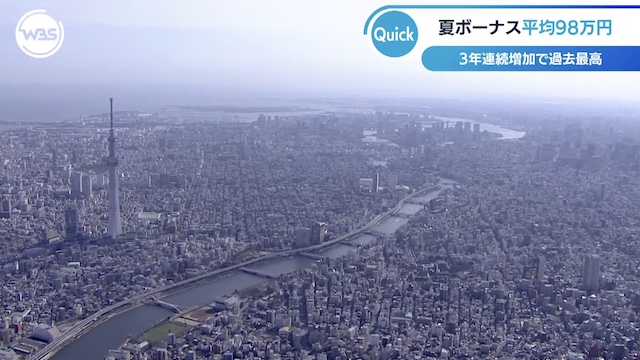
TOKYO - The Japan Business Federation (Keidanren) announced the results of its survey on summer bonuses for major companies this year. According to the survey, the average bonus payment increased by 4.31% compared to the previous year, reaching 983,112 yen.
Japan's Corporate Bonuses Soar for Third Year, Hitting New Record

This marks the third consecutive year of increases, setting a new record high for preliminary totals since 1981. In the breakdown, the manufacturing sector saw a 3.52% increase, with the average bonus exceeding 1 million yen for the first time, reaching 1,001,780 yen.

Source: テレ東BIZ

News On Japan
POPULAR NEWS

Typhoon No. 9 (Bavi) caused widespread transport disruption across Okinawa on July 11, grounding hundreds of flights, suspending ferry services and delaying mail and parcel deliveries as violent winds and dangerous seas continued to affect the prefecture's southern island chains.

Large and powerful Typhoon No. 9 (Bavi) continued moving northwest on July 11, bringing violent winds, torrential rain, and widespread power outages to Okinawa as authorities warned that dangerous conditions would persist well into the afternoon despite the storm's center gradually moving away.

A wave of bear sightings across Japan has forced the cancellation of traditional summer events, while one animal entered a home and came within inches of a sleeping resident's face.

Japan is expected to remain under intense summer heat through next week as the Pacific high-pressure system continues to dominate the country, bringing widespread temperatures above 30 degrees Celsius and increasing the risk of heatstroke.

Akie Abe, the wife of former Prime Minister Shinzo Abe, has said she is only now becoming able to grieve honestly over her husband’s death, four years after he was shot and killed during an election campaign speech in Nara.

MEDIA CHANNELS
         

MORE Business NEWS

NTT Docomo will begin offering banking services under the new "Docomo Bank" brand in August, with plans to build a network of more than 1,500 locations by fiscal 2030, far exceeding the branch networks of Japan's major banks.

Japanese stocks rose for a second straight session on Friday, July 10, with the Nikkei Stock Average climbing 813.88 points to close at 68,557.73 after strong gains in U.S. technology and semiconductor stocks fueled renewed buying of AI-related shares.

Japan’s domestic Corporate Goods Price Index, which measures prices charged for goods traded between companies, rose 7.1% from a year earlier to 135.4 in June, the Bank of Japan said on July 10.

A credit card payment processor with liabilities of about 125.9 billion yen has become Japan’s largest bankruptcy so far in 2026, disrupting card payments at restaurants and shops across the country and forcing many businesses to accept cash only.

Japan's planned rollout of mobile phone numbers beginning with 060 has been postponed after telecom carriers said they need more time to complete system preparations.

Tokyo stocks fell for a third straight session on July 8 as selling in semiconductor and AI-related shares continued, while rising Japanese government bond yields, Middle East tensions and concern over the Bank of Japan’s policy independence added pressure to the broader market.

Tokyo stocks fell sharply on July 7 as a selloff in South Korean chip shares triggered fresh concern over the sustainability of the AI boom, dragging the Nikkei 225 lower while banks and other value shares resisted the decline.

Japan’s long-term interest rate briefly rose to 2.83% on July 6, its highest level in nearly 30 years, as investors grew more cautious over inflation, the pace of Bank of Japan rate hikes and the government’s fiscal stance.