News On Japan

Summer Bonuses in Japan Surge to 940,000 Yen, Near Record High

TOKYO, Aug 08 (News On Japan) - The average summer bonus for major companies this year has exceeded 940,000 yen, marking the second highest level on record.
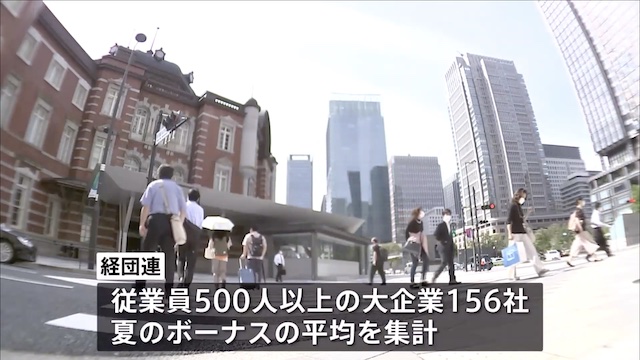
Keidanren, the Japan Business Federation, compiled the average summer bonus for 156 major companies with over 500 employees.

As a result, the average bonus increased by over 38,000 yen from last year, reaching 941,595 yen per employee. This marks the third consecutive year of increase and the second highest figure following 2018.

By industry, 16 sectors, including electric power and automobiles, saw increases. Conversely, three sectors—chemicals, electronics, and freight transport—experienced decreases.

Keidanren analyzed that the unprecedented wage hike in roughly 30 years during this year's spring labor negotiations was reflected in the bonuses. Many companies also saw improved performance due to the yen's depreciation.

Source: TBS

News On Japan
POPULAR NEWS

Bear sightings across Japan have already climbed to nearly twice the level recorded during the same period last year, prompting entry bans in mountain areas behind Kyoto’s Ninna-ji Temple and the cancellation of hiking events in Kansai, while new research suggests that the key to reducing encounters may lie in understanding what bears eat in each region.

Copper roofing panels were stolen from several shrines in Hamamatsu, Shizuoka Prefecture, including a city-designated cultural property, in the latest case amid a nationwide surge in copper thefts targeting shrines and temples across Japan, where soaring metal prices have fueled crimes that leave historic religious buildings damaged, exposed to the elements, and facing repair costs of millions of yen.

Flames broke out on the morning of May 20th on Miyajima Island in Hiroshima Prefecture, home to one of Japan's World Heritage sites, destroying Reikado Hall near the summit of Mount Misen.

Uncertainty surrounding the situation in the Middle East is beginning to affect daily life in Japan, as concerns over crude oil supplies spread to restaurants, cleaning services and even household garbage disposal systems across the Kansai region.

A 25-year-old woman arrested as a suspected ringleader in a robbery-murder case in Tochigi Prefecture once posted cheerful dance videos on social media and was remembered by those who knew her as an energetic and outgoing young woman.

MEDIA CHANNELS
         

MORE Business NEWS

The impact of tensions in the Middle East is spreading to familiar snacks in Japan, with Morinaga & Co. temporarily suspending sales of some caramel products, including its long-selling Hi-Soft brand, after difficulties emerged in securing certain raw materials.

The Nikkei Stock Average rebounded sharply on May 21st after falling below 60,000 at the previous day's close, briefly rising more than 2,200 points as hopes grew for progress in talks toward ending the fighting between the United States and Iran, while SoftBank Group gave the market a major boost following reports that OpenAI was preparing to file for an initial public offering.

Japan’s imports of crude oil from the Middle East plunged 67.2% in April from a year earlier, as the impact of the effective closure of the Strait of Hormuz began to ripple through the country’s trade and energy supply chains.

Sumitomo Mitsui Banking Corporation and Toshiba announced on May 20th that they had jointly developed a new stock index utilizing quantum technology.

TOTO, a major Japanese manufacturer of housing and bathroom equipment, reopened its showroom in London, England, on May 20th after undergoing its first major renovation in 16 years.

Uncertainty surrounding the situation in the Middle East is beginning to affect daily life in Japan, as concerns over crude oil supplies spread to restaurants, cleaning services and even household garbage disposal systems across the Kansai region.

U.S. President Donald Trump was found to have traded large amounts of stock, including shares in Kura Sushi USA, in a wave of more than 3,700 transactions over a three-month period that has sparked criticism over possible conflicts of interest.

As conflict in the Middle East drags on, shortages of naphtha — a key raw material used in a wide range of petroleum-based products — are beginning to affect even Japan's traditional cheap snacks, with manufacturers facing steep rises in packaging and material costs while trying to keep products affordable for children.