News On Japan

Newly Formed Typhoon No. 17 Could Near Kanto by Weekend

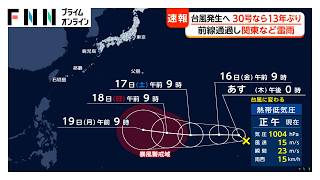
A large new typhoon formed near the Ogasawara Islands on August 12 and could approach Honshu around the end of the Obon holiday period, while the remnants of Typhoon No. 15 continue to bring unstable weather and a risk of heavy rain across a wide area of Japan.

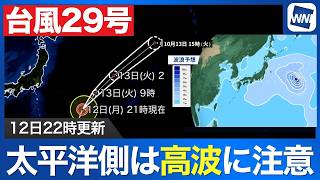
Typhoon No. 17 formed near the Ogasawara Islands at 9 a.m. on August 12 and was moving slowly northeast, with a central atmospheric pressure of 994 hectopascals. Maximum sustained winds near the center were 18 meters per second, with maximum gusts of 25 meters per second.

The storm is expected to continue generally northeastward for the time being before changing direction around August 14 in waters southeast of Honshu, creating the possibility that it could move closer to the main island.

Forecast uncertainty remains high, however, with considerable variation in computer simulations over the typhoon's direction and speed after it changes course.

Depending on its eventual track, Typhoon No. 17 could come significantly closer to the Kanto region and the Pacific side of Tohoku around August 15 to August 16, near the end of the Obon holiday period. People planning trips to the sea or mountains during the latter half of the holiday are being advised to closely monitor the storm's progress.

Typhoon No. 15, meanwhile, has moved into the Sea of Japan and weakened into a tropical depression. Despite the typhoon's weakening, moist air flowing in from the sea is expected to make atmospheric conditions unstable from Tohoku through Shikoku.

Heavy rain is possible from Tohoku through the Kinki region on August 12. Individual rain clouds are expected to be relatively small, but some could develop into thunderstorms, bringing sudden downpours and lightning during the afternoon.

Rainfall through midday on August 13 could reach as much as 150 millimeters in parts of Tohoku, Tokai and Kinki, and 100 millimeters in the Kanto-Koshin region.

Forecast highs on August 12 are 33 degrees Celsius in Sapporo, 25 in Kushiro, 29 in Aomori, 30 in Morioka, 27 in Sendai, 32 in Niigata, 29 in Nagano, 33 in Kanazawa, 29 in Nagoya, 27 in Tokyo, 28 in Osaka, 31 in Okayama, 33 in Hiroshima, 30 in Matsue, 34 in Kochi, 33 in Fukuoka, 33 in Kagoshima and 30 in Naha.

Nagoya is forecast to remain below 30 degrees for the first time since the start of August, bringing relatively cooler conditions.

Unstable weather is expected to continue on August 13 as moist air keeps flowing into Japan. Parts of Tohoku and western Japan could see sudden rain, thunderstorms and locally intense downpours.

There is also a risk of storm surges in eastern and western Japan as the effects of the tropical depression coincide with spring tides.

Source: TBS

News On Japan
POPULAR NEWS

A large new typhoon formed near the Ogasawara Islands on August 12 and could approach Honshu around the end of the Obon holiday period, while the remnants of Typhoon No. 15 continue to bring unstable weather and a risk of heavy rain across a wide area of Japan.

Hiroko Saito was 19 years old when she left Japan for North Korea in June 1961 with her Korean husband and their one-year-old daughter, persuaded by assurances that they were heading to a "paradise on earth" and that she could return to Japan after three years. Instead, she would spend four decades in North Korea, enduring chronic hunger, the deaths of her husband and children and a desperate struggle to survive before finally escaping and returning home in 2001.

Transport disruption caused by Typhoon No. 15 was easing across eastern Japan on the morning of August 12, with most major railway and airline services returning to normal after dozens of flight cancellations and widespread rail disruption during the storm's landfall in Ibaraki Prefecture the previous evening.

Japan's H3 Rocket No. 9 successfully placed the Michibiki No. 7 navigation satellite into its planned orbit after lifting off from the Tanegashima Space Center in Kagoshima Prefecture at 4:23 a.m. on August 11, marking the country's second consecutive successful H3 launch.

The Tokaido Shinkansen operated its first overnight service ahead of the Obon holiday period, offering travelers a 15,000 yen trip from the Tokyo area to Kyoto and Shin-Osaka while allowing them to save on hotel costs and arrive earlier than the first regular morning trains.

MEDIA CHANNELS
         

MORE Travel NEWS

Typhoon No. 15 continued moving west across central Japan on August 12, but heavy rain, strong winds and thunderstorms remained a threat far from the storm's center, with intense rainfall reported in parts of Tokyo and damage including fallen and broken trees in Ibaraki and Tochigi prefectures.

Typhoon No. 15 approached the Kinki region on the morning of August 12 before weakening into a tropical depression over the Sea of Japan, but authorities are warning that sudden thunderstorms and heavy rain remain possible across the region.

Summer festivals are in full swing across Japan, with distinctive local dances ranging from long-established traditions to unusual routines born at fishermen's banquets and even performances set to the music of American rock band Bon Jovi.

The Tokaido Shinkansen operated its first overnight service ahead of the Obon holiday period, offering travelers a 15,000 yen trip from the Tokyo area to Kyoto and Shin-Osaka while allowing them to save on hotel costs and arrive earlier than the first regular morning trains.

A fireworks festival that had been promoted as a simultaneous display of more than 10,000 fireworks across three cities on Lake Biwa in Shiga Prefecture was abruptly canceled on August 9, with organizers having failed to submit applications for permits required to hold the event.

Nara Park's famous deer are increasingly spilling into residential areas and farmland as their population reaches a record high, creating new problems for residents even as the animals remain a major attraction for visitors to the ancient capital.

Japan's dating scene has its own vocabulary, its own etiquette, and — for the arrangement style commonly known abroad as sugar dating — its own dedicated clubs.

Maids from Akihabara maid cafes joined shrine maidens from Kanda Myojin and members of the public on August 8 to sprinkle water across the shrine grounds in Tokyo, calling out "Cool down!" as they took part in a summer tradition aimed at easing the midsummer heat.