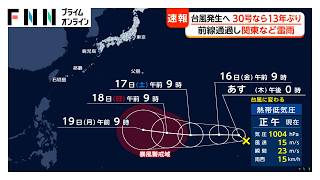


TOKYO - Japan experienced widespread thunderstorms, strong winds and sudden downpours on October 14 as a cold front swept across the country, while the Japan Meteorological Agency warned that a tropical depression south of Japan could develop into Typhoon No. 30 within 24 hours, marking the first time in 13 years that the annual typhoon count has reached 30.
Atmospheric conditions became highly unstable across much of the country, particularly along the Sea of Japan coast, where a band of rain clouds moved from west to east, bringing intense thunderstorms and damaging winds to several regions.
In Seiro, Niigata Prefecture, heavy raindrops pounded building roofs shortly before 1:30 p.m., while parts of the Kanto region experienced their first significant rainfall in some time.
Around Yokohama Station in Kanagawa Prefecture, sudden showers before noon caught pedestrians without umbrellas off guard. Some rushed for shelter, while one man attempted to shield himself from the rain using a heavy bag filled with study materials.
Hokkaido was among the hardest-hit regions, with torrential rain, strong winds and rough seas affecting several communities.
In Takikawa, rain struck the asphalt so forcefully that water appeared to ripple across the road surface. Sapporo also experienced rainfall from the morning, with heavy drops falling on trees that had begun changing color for autumn.
In Yubari, a deer with large antlers was seen wandering through the rain, accompanied by what appeared to be members of its family. The animals appeared to be searching for food despite the wet conditions.
Along the Sea of Japan coast in Rumoi, powerful waves repeatedly crashed against the shoreline, creating extremely rough conditions. Storm warnings were issued for Rumoi and surrounding areas as the developing weather system brought increasingly dangerous winds.
The strongest wind gust reported in Hokkaido reached 29.1 meters per second in Esashi, where a developing low-pressure system contributed to severe weather.
Further south, Fukui Prefecture experienced particularly intense rainfall and wind. In Fukui City, sheets of rain swept sideways across roads illuminated by streetlights, while neighboring Sakai was battered by large, heavy raindrops.
Kanazawa, in Ishikawa Prefecture, also experienced wind-driven rain that appeared to swirl through the city.
Shortly after 8 a.m., residents of Shimosuwa in Nagano Prefecture faced torrential downpours, with rain falling like a waterfall and striking the roofs of houses.
The cold front gradually pushed rain clouds from Shizuoka Prefecture into the Kanto region, bringing sudden showers to areas that had recently enjoyed relatively dry conditions.
In Tokorozawa, Saitama Prefecture, rain began falling unexpectedly around 11 a.m., prompting pedestrians to run toward the station.
Tokyo also experienced a return of rain, with people around Kamata Station rushing for cover or sheltering from passing showers.
An unusual seasonal phenomenon was also observed at Ueno Park, where several Somei Yoshino cherry blossoms had opened despite it being October.
The flowers, normally associated with spring, appeared after Tokyo recorded its ninth consecutive day with temperatures reaching at least 25 degrees Celsius on October 14.
The prolonged spell of unusually warm weather may have contributed to the out-of-season flowering, although the precise cause was not established.
Elsewhere in the Kanto region, autumn attractions continued to draw visitors despite the unsettled weather.
Hitachi Seaside Park in Ibaraki Prefecture was crowded with tourists even on a weekday, as bright red kochia bushes and yellow cosmos flowers reached their seasonal peak.
Light rain began falling shortly after 11 a.m., but visitors continued enjoying the autumn scenery under umbrellas.
In Oarai, also in Ibaraki Prefecture, tourists gathered at the famous Kamiiso no Torii, a shrine gate standing on rocks along the Pacific coast, where powerful white-capped waves surged toward the structure.
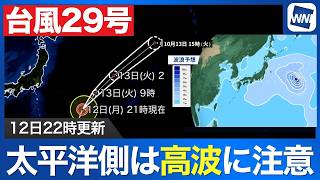
The rough seas had been partly influenced by Typhoon No. 29, which transitioned into an extratropical cyclone on October 14.
Attention has now shifted to another tropical depression developing over waters south of Japan.
The Japan Meteorological Agency announced that the system was expected to strengthen into a typhoon within 24 hours, potentially becoming the 30th named typhoon of 2026.
Japan last recorded 30 or more typhoons in a single year in 2013, making the possible formation of Typhoon No. 30 a notable development in this year's tropical cyclone season.
According to projections based on the meteorological agency's supercomputer models, rain clouds associated with the developing storm could begin affecting Japan's Pacific coast around October 23.
The system could subsequently have a significant impact on the Kanto region and other parts of eastern Japan, although its eventual track and intensity remain uncertain.
By 3:40 p.m. on October 14, heavy rain was continuing in parts of Hokkaido and along the Sea of Japan side of Honshu, while the front responsible for the earlier showers had already passed through much of the Kanto region.
With another tropical cyclone potentially forming south of Japan and the possibility of renewed heavy rain later in October, residents are being urged to monitor the latest weather forecasts and warnings as the storm's development becomes clearer.
Source: FNN