News On Japan

Observing different mating tactics in the Japanese scorpionfly

Jun 28, 2022 (phys.org) - Owing to the high competition and the prevalence of natural selection, many male insects must develop alternative tactics to mate with a female.

Weaker males who lose in a competition (or loser males) may resort to hovering or sneaking around in order to find a mate. Recent studies have also shown that alternative mating behavior is influenced by environmental factors such as food availability, predation, and population density. For example, scorpionflies—which are often used to study the mating behavior of insects—use three alternative mating tactics—gifting nutritious saliva, gifting food, and forced mating—to obtain a mate. Male Japanese scorpionflies also employ feeding mating (i.e., mating while females feed without gifting them anything or releasing pheromones).

Previous studies looking at alternative mating tactics in scorpionflies have shown that the weaker males of closely-related species employ varying methods to procreate, however no research has been done to find the alternative mating tactics of males within the same species from different geographical locations. To this end, Dr. Ryo Ishihara (who is affiliated to the School of Agriculture and a recipient of the Special Educational and Research Fellowship) and Professor Takahisa Miyatake (from the Faculty of Environmental and Life Science) of Okayama University, Japan, published a study in the Journal of Ethology on 15 June 2022. This study details the differences in alternative mating tactics of Japanese scorpionflies hailing from two different places—the Aichi and Okayama prefectures in Japan. ...continue reading

News On Japan
POPULAR NEWS

Japan launched a new national disaster management agency on November 2nd to strengthen its response to major emergencies, just days before a powerful earthquake struck Aichi Prefecture, injuring 24 people and renewing concerns over the possibility of a catastrophic Nankai Trough earthquake.

Northern Japan experienced record-breaking cold on the morning of November 11th, with temperatures plunging to minus 20.2 degrees Celsius in Horokanai, Hokkaido, marking the first time in Japan's recorded history that temperatures have fallen below minus 20 degrees during the first half of November.

East Japan Railway (JR East) announced on November 10th that it will introduce touch-free ticket gates at 40 stations, including every station on Tokyo's Yamanote Line, from spring 2028, allowing passengers using Mobile Suica to pass through without taking their smartphones out of their pockets or bags.

Japan's Children and Families Agency unveiled its first national guidelines on November 10th for parental involvement in children's internet use, dividing those aged 0 to 18 into six developmental stages as the government considers tighter regulations on social media platforms to protect young people from online bullying, exploitation, and other growing risks.

As of 3 a.m. on Wednesday, November 11, Typhoon No. 32 was moving east-northeast over waters east of Chichijima in the Ogasawara Islands, gradually heading away from the Japanese archipelago after passing near the island between late Tuesday night and early Wednesday morning.

MEDIA CHANNELS
         

MORE Sci-Tech NEWS

The Japan Mint conducted its annual coin inspection at its headquarters in Osaka's Kita Ward on November 9, confirming that all 19,300 coins examined met the required weight standards.

Japan’s changing urban landscape reflects a complex relationship between its architectural heritage, demographic transition, and modernization ambitions.

Scientists at Toyo University have identified a possible weakness in alligator weed, an invasive aquatic plant described as one of the world's worst, raising hopes of finding a way to control its extraordinary ability to regenerate as it spreads through Japan's waterways, threatens agricultural land, and creates growing concerns about flooding.

Japanese pharmaceutical company Sumitomo Pharma announced on October 30 that the first patient to receive its newly approved regenerative medicine treatment for Parkinson's disease underwent a successful brain cell transplant at Kyoto University Hospital in early October, with the woman in her 50s already returning to work and recovering well.

Japan's ports have long been the backbone of one of the world's most export-driven economies.

A company in Kagoshima has developed a new garbage collection station that uses specially shaped wires and rollers instead of conventional nets to prevent crows from scattering household waste, offering a cleaner and more convenient solution to a persistent problem in Japan's urban neighborhoods.

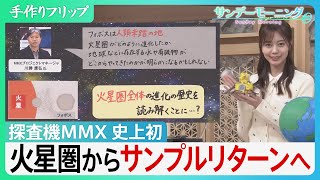
Japan has chosen a small, irregularly shaped moon orbiting Mars rather than the planet itself for its latest space exploration mission, taking advantage of Phobos' extremely weak gravity and lack of atmosphere to make collecting extraterrestrial samples and returning them to Earth far easier and less expensive, while potentially unlocking secrets about the history of Mars and the origins of water and organic materials in the solar system.

Japan's H3 rocket successfully launched the Martian Moons eXploration (MMX) spacecraft from the Tanegashima Space Center in Kagoshima Prefecture on the morning of October 20th, placing the probe into its planned orbit in the first stage of a mission to collect samples from one of Mars' moons and return them to Earth.