OSAKA - Osaka's Nipponbashi Tool District boasts a history even longer than Tokyo's Kappabashi, renowned for its unique shop owners and innovative gadgets, attracting foreign visitors who rave about their finds.
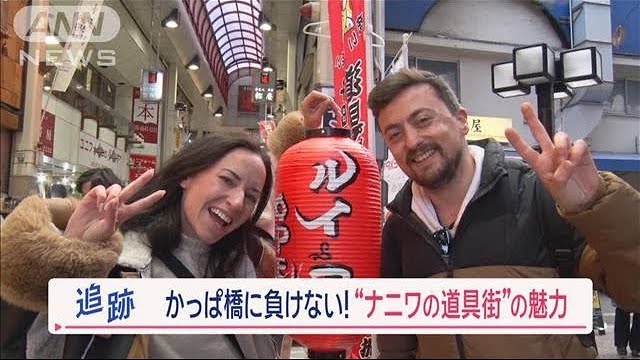
The 142-Year Legacy of Nipponbashi Tool District
Here's a quirky cooking gadget quiz: What do you think a giant clip, seemingly a hundred times larger than a regular clip, is used for in the kitchen?
A visitor from Canada guessed, "Is it for holding giant papers?"
No, it's actually a cooking tool.
A visitor from South Africa suggested, "Is it for holding fish and eating it while it's still clamped?"
The correct answer is a clip for grilling squid. This clip prevents the squid from curling up, allowing it to be grilled beautifully.
Such unique and handy gadgets can be found in the Nipponbashi Tool District, just a three-minute walk from Namba Station in Osaka. Spanning 150 meters, this specialty street is lined with over 40 stores offering a wide range of cooking tools.
A visitor from Australia exclaimed, "It's huge!" and "That's a massive takoyaki!"
Indeed, Osaka is famous for its oversized takoyaki pans, with a diameter of 8 centimeters. There's even a tiny takoyaki machine available, which can make "chobo-yaki," considered the precursor to takoyaki, sold in candy stores during the Taisho era.
A visitor from Finland remarked, "Kappabashi might be slightly larger, but the variety here is amazing."
The Nipponbashi Tool District traces its roots back to 1882, making it older than the Kappabashi Tool District. Its extensive product range draws tourists from all over the world.
Specialized Peelers and Chef-Approved Tongs
A Canadian visitor wondered, "Is this a frog? It looks like a frog."
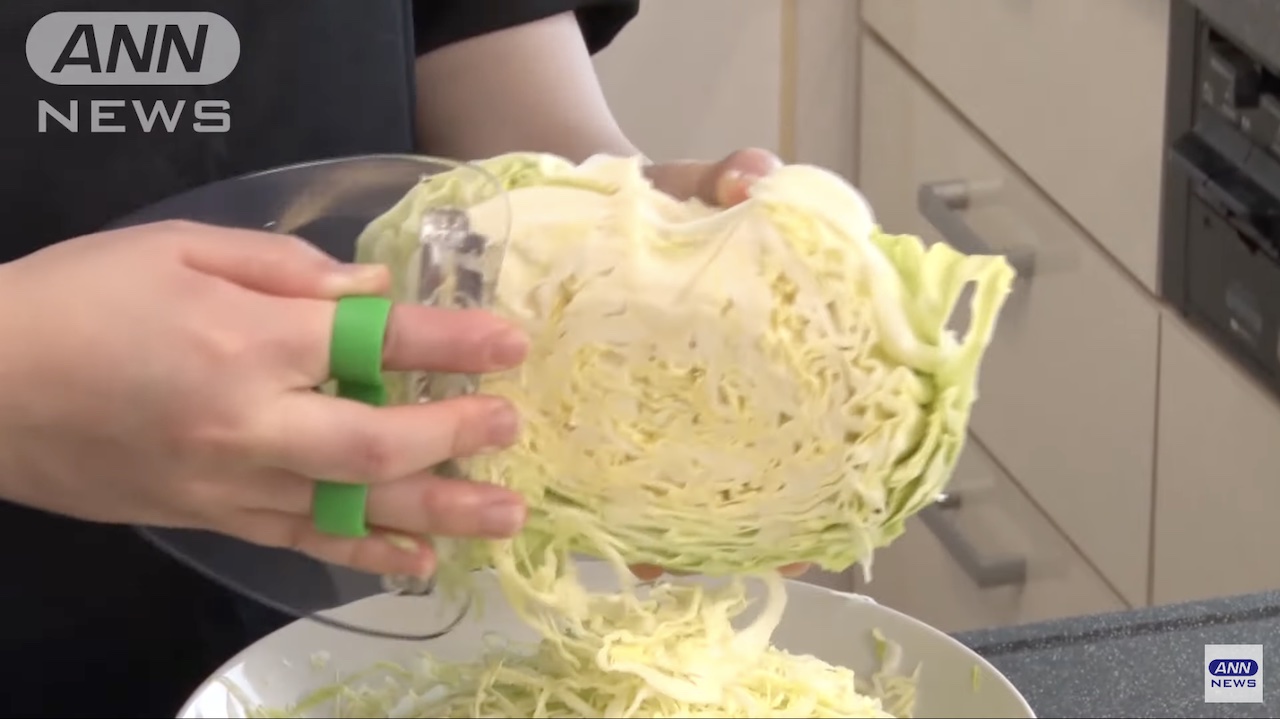
What appeared to be a frog to foreign eyes is actually a cabbage-specific peeler. Simply fit it in your palm and stroke the cabbage to easily shred it finely.
An American visitor said, "I've never seen such a tool before," and, using the palm cabbage peeler, added, "Oh! I always cut with a knife, but I've never been able to cut it this neatly."
Comparing the two, the difference is clear. The cabbage cut with the peeler is much finer and more uniform than that cut with a knife.
Yuken Chida, the owner of a cooking tool store, mentioned, "Products like these sell well. It's called 'Tsuma & Peeler,' and it has two blades."
The "Tsuma & Peeler," popular among foreigners, features different blades on each side. Not only can it peel, but the serrated blade can also julienne, making it a versatile tool for effortlessly preparing dishes like kinpira gobo without the need for a knife and cutting board.
Chefs and Foodies Beware: The Irresistible 'Idea Tongs'
An Australian visitor, a chef, was thrilled with the "Idea Tongs," saying, "These are chef tongs. He's a chef, a cook."
The excitement was palpable as the chef demonstrated the tongs, "See, it's open. It locks," and declared, "Very fun," while his daughter commented, "You're getting too into it."
These tongs function as regular tongs when facing down, but with a simple upward flip, they lock with one touch. This innovative design allows for smart storage without taking up much space.
The Quest for the Perfect Knife: Success After Three Hours?
Tobias, a 37-year-old visitor from Canada, was on a mission to find his ideal knife.
"It's a black knife," he said, while his friend Sam added, "It's a sexy knife."
Tobias was torn between the handle of one knife and the blade of another, spending nearly three hours searching through the 11 knife shops in the district.
"Are you still deciding?" Sam asked.
Tobias replied, "They all seem the same... I can't choose anymore."
However, he eventually found the perfect knife and was looking forward to using it for the first time back home.
"Are you happy?" Sam asked.
"I'm so happy to have this knife," Tobias responded.
A Unique Gift for a Cousin: A 'Noren' Curtain
Rosa, a 23-year-old visitor who had just completed a half-year study program at a university in Kyoto, was set to return to her home country, Hungary, the next day.
"I'm buying souvenirs to take back home. I want to give my cousin something unique," she said.
She chose a noren curtain from a takoyaki shop, saying, "I'll go with this one. The octopus is cute."
While the design is adorable, one wonders if it will be understood in Hungary.
Foreigners Praise the 'Mysterious Stone'
A visitor from Australia marveled, "This is truly an invention. I've never seen anything like it before. It seems very good."
There was also a captivating live demonstration that intrigued foreigners.
A visitor from France asked, "What is this made of?"
Keisuke Mikawa, the owner of a ceramics store, answered, "Stone, special stone."
Despite having no holes, this peculiar stone-like object allows water to pass through.
Mikawa explained, "It's made of Arita porcelain. When water passes through, it becomes softer, making Japanese tea taste better even overseas."
Made with Arita porcelain techniques, this eco-friendly filter can be reused repeatedly.
Mikawa added, "No detergent is needed for cleaning, just pour boiling water. Once a year, bake it in a toaster."
A visitor from Mexico commented, "It's very intriguing. It makes you realize how much paper we use daily. We should use more items like this. It's very good, bravo."
Osaka's Playful Food Samples
Even the food samples familiar in Tokyo's Kappabashi have a playful Osakan twist! Takoyaki becomes earrings, and a business card holder is heaped with spaghetti Napolitan.
A visitor from the USA said, "This looks like it would start a conversation."
The most popular food sample experience is, of course, making takoyaki.
A visitor from Hawaii joked, "This is tomorrow's lunch. I hope it doesn't spoil (laughs)."
Discovering a 'Mysterious Tool' in an Established Store
The 80-year-old Ebisuya Hardware Store is a treasure trove of quality tools.
A visitor from the USA said, "I always find good things in this store. Things I can't find in America, I find here."
The store's philosophy is to provide tools that customers can use for a long time and that are truly needed.
Isao Shibata, the owner of Ebisuya Hardware Store, said, "We have to keep things that customers might ask for, 'Do you have something like this?' We have a lot of tools that we just have to keep."
The store is filled with products that have stood the test of time. Among them is this curious item.
Hideyoshi Goto, an employee with 50 years of experience, said, "It's older than my 50 years here."
This brass roller is engraved with patterns of tangerines and cherry blossoms. But what is it?
Goto explained, "Don't you know candy drops? The ones in a tin can. I don't know the price. It's made of brass, so it should be somewhat expensive."
The mystery tool is a mold for drops. Although we couldn't find a company that uses the exact same tool, we did discover a food manufacturer in Kyoto that uses a similar principle.
Nowadays, machines automatically produce drops, but in the past, workers would manually turn the roller, pressing out a sheet that would be broken into individual drops.
Experience the love for tools that Naniwa merchants have. Why not give it a try?
Source: ANN