News On Japan

Japan's Commitment to Inclusive Employment Highlighted at OECD

PARIS, May 03, 2024 (News On Japan) - During his visit to France, Prime Minister Kishida, as chair at the OECD Ministerial Council, declared his commitment to removing employment barriers facing women and the elderly.
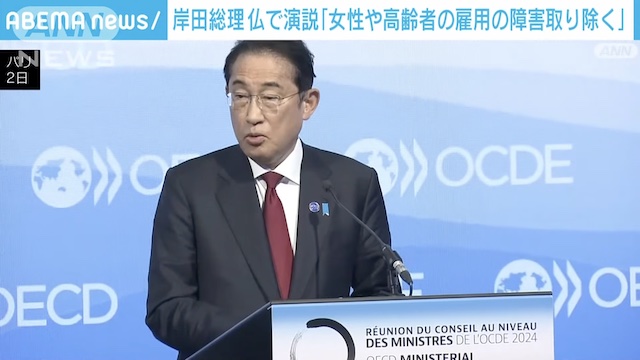
Japan's Commitment to Inclusive Employment Highlighted at OECD

Prime Minister Kishida stated, "Along with reversing the declining birthrate trend, we will eliminate employment barriers for women and the elderly to achieve sustainable growth."

On the topic of wage increases, he boasted that Japan is seeing the highest levels in about 30 years, emphasizing the need to revive Japan's earning power.

He also expressed concern over the challenges of achieving consensus in an increasingly diverse international community, particularly in light of emerging economies like China. "It's becoming increasingly difficult to find common ground as the rise of emerging countries progresses and the international community diversifies," he noted.

Furthermore, Kishida appealed for a collective understanding within the OECD to form an "international order that is free and open, based on the rule of law."

This year marks the 60th anniversary of Japan's membership in the OECD, which currently includes 38 countries, with Japan and South Korea being the only members from Asia.

Prime Minister Kishida emphasized his commitment to continue efforts to include emerging nations from Southeast Asia and Latin America, often referred to as the Global South, into the OECD.

Source: ANN

News On Japan
POPULAR NEWS

Large and very strong Typhoon No. 13 (Dolphin) was moving west-northwest near the Ogasawara Islands as of 9 p.m. on August 3 and is forecast to bring violent winds, heavy rain and waves exceeding 10 meters during its closest approach on August 4.

Six airlines, including All Nippon Airways, Japan Airlines and Air Do, will move the baggage check-in deadline for domestic flights at Haneda Airport to 30 minutes before departure from September 1.

The conflict involving Iran, the United States and Israel may be entering a more dangerous phase, with Tehran appearing increasingly willing to initiate attacks rather than merely respond to US strikes, while disruptions around the Strait of Hormuz threaten oil and liquefied natural gas supplies worldwide.

Authorities ended the five-day search and rescue operation at Aeon Mall Kumamoto on August 1 after confirming that all people reported missing had been accounted for, leaving seven dead and five others injured in an explosion that devastated the shopping complex shortly after the powerful Kumamoto earthquake.

Kyushu Shinkansen services between Hakata and Kumamoto resumed on a reduced schedule on July 31 after a three-day suspension caused by the earthquake, while extensive rail damage has left no timetable for reopening the section south to Kagoshima-Chuo.

MEDIA CHANNELS
         

MORE Politics NEWS

Prime Minister Sanae Takaichi entered August facing a sharper test of her economic leadership after Japan and the United States carried out a rare coordinated currency intervention to support the yen, turning the government’s cost-of-living agenda, fiscal policy and relationship with the Bank of Japan into one of the most politically sensitive issues of her administration.

U.S. President Donald Trump said the United States intervened to buy yen because of its strong relationship with Japan, describing the action as a sign of friendship and pledging that Washington would always support the country.

Japan and the United States conducted coordinated yen-buying intervention in the foreign exchange market to curb the currency's excessive decline, with Finance Minister Satsuki Katayama expected to announce the move on August 3, according to people familiar with the matter.

US Treasury Secretary Scott Bessent said the yen is undervalued, making an unusually direct assessment of the currency and signaling that Washington is unwilling to accept excessive weakness.

Prime Minister Sanae Takaichi announced that Japan will cut the consumption tax rate on food and beverages to 1% from April 2027, pledging to secure the necessary funding without relying on deficit-financing bonds and to restore the rate to 8% after two years.

Prime Minister Sanae Takaichi moved on July 30 to turn food-tax relief from a campaign promise into government policy, instructing the ruling Liberal Democratic Party to proceed with a temporary cut in the sales tax on food as the Bank of Japan began a policy meeting that could shape the next phase of Japan’s currency, inflation and fiscal debate.

Prime Minister Sanae Takaichi moved closer on July 29 to adopting a sharp temporary cut in Japan’s food sales tax, turning cost-of-living relief into the next major political test for her government as markets remained uneasy over the weak yen, rising bond yields and the administration’s expansionary fiscal agenda.

Prime Minister Sanae Takaichi’s government moved on July 28 to reassure investors that it respects the Bank of Japan’s independence, as Finance Minister Satsuki Katayama said relations between the government and the central bank remain smooth despite market concern over rising bond yields, yen weakness and the administration’s growth-oriented fiscal agenda.