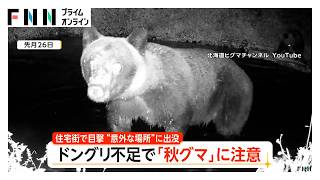
TOCHIGI - A man in his 70s was injured early on June 30 after being attacked by a bear near an elementary school in Tochigi Prefecture, as bear-related incidents continue to rise across Japan ahead of the full onset of summer heat in July.
The attack occurred shortly after 5 a.m. in Nasushiobara, Tochigi Prefecture, when the man was working in a field. He suffered facial injuries and was taken to a hospital.
The site is near a school, and bear sightings have been reported frequently in the area since the start of June. A nearby resident said he had seen a bear twice this month. "When I looked up, a bear was walking toward me, then it went into the grass around there and ran off. That was on June 16. On June 27, there is a net for the garbage collection area, and the bear was about 5 meters below the basket," the resident said.
The city is working with a local hunting association and police to remain on alert, but the bear has not yet been found.
In Kyoto, a man in his 40s from a hunting association was attacked by a bear on June 29 while involved in efforts to capture deer and other animals. He was bitten on the arm and required seven stitches.
Children have also faced danger.
Shortly after 11 a.m. on June 29, a bear appeared at an elementary school in Inawashiro, Fukushima Prefecture. Students evacuated into the school building, and no injuries were reported.
The bear's whereabouts remain unknown, and the school was forced to take safety measures, including asking parents to pick up and drop off their children. "I was a little surprised. I did not think one would appear around here," one parent said.
Akita Prefecture has recently seen a sharp increase in bear sightings. About 80 reports were received over the past three days, with more than 20 concentrated around urban areas of Akita, where residential districts are spread out.
Footage taken around 2 p.m. on June 28 showed a bear that appeared on the grounds of a sports park in the city center, walking boldly across the middle of a field surrounded by homes.
Because sightings have occurred in quick succession, officials say there may be multiple bears moving through the area.
A resident who saw a bear said: "There was a man walking his dog, and the bear was startled by that and came back. It went from the playground of the nursery school next door toward the mountains. It was nearby, so it was frightening."
The situation has grown more serious. Early on June 30, an Akita Shinkansen train bound for Tokyo collided with a bear and made an emergency stop.
Experts say the increase in appearances is linked to the risks unique to bears in summer.
"Right now, bears are eating wild vegetables, but that is gradually coming to an end," said Takayoshi Yamauchi, an associate professor at Iwate University. "Their intensive search for food overlaps with the breeding season. It is also the period when cubs separate from their mothers and become independent. They can suddenly appear in urban areas. The situation is one in which injuries to people are more likely than usual."
Yamauchi said food in the mountains is expected to become even scarcer through August, raising the risk that bears will appear more often near human settlements.
Against this backdrop, the Environment Ministry began a bear population survey on June 30 by installing cameras mainly in mountains across the Tohoku region.
"There is bait inside, and the scent of the bait comes out from here. When the bear smells it, it is photographed in this position," an official said.
The white crescent-shaped pattern on the chest of an Asian black bear differs from one bear to another. Officials say they can estimate the number of bears by luring them with strong-smelling bait made from honey and wine and photographing the chest markings.
The survey will cover six habitats, with more than 800 cameras to be installed. It will run through late September, and the results are expected to be released within fiscal 2026.
In Okoppe, Hokkaido, where brown bears live, cameras captured behavior typical of the breeding season on the night of June 27. A bear was seen rubbing its back, a behavior mainly used by male bears to signal their presence to females.
The bear was so large that it easily exceeded tape set at a height of 2 meters.
As July begins and the summer heat intensifies, authorities are urging greater caution over what experts describe as the risks posed by "summer bears."
Source: FNN