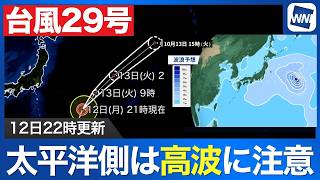
TOKYO - Transport disruption caused by Typhoon No. 15 was easing across eastern Japan on the morning of August 12, with most major railway and airline services returning to normal after dozens of flight cancellations and widespread rail disruption during the storm's landfall in Ibaraki Prefecture the previous evening.
Localized problems remained, however, particularly on railway lines in northern Ibaraki and Chiba, while ferry services between Ibaraki and Hokkaido continued to be affected.
As of 5:45 a.m. on August 12, JR East said the Suigun Line remained suspended in both directions between Hitachi-Omiya and Hitachi-Daigo because of a power outage caused by the typhoon on August 11.
No estimate had been given for when the section would reopen, and JR East said no replacement bus service would be provided. Some northbound services between Mito and Hitachi-Daigo were also canceled.
In Chiba Prefecture, some Kururi Line trains between Kururi and Kazusa-Kameyama were canceled because of the typhoon.
JR East also warned that the Sobu Main Line, Uchibo Line, Kashima Line, Sotobo Line, Togane Line and Narita Line could experience delays, destination changes or cancellations from the first trains because heavy rain and strong winds remained possible.
The situation elsewhere in the Tokyo metropolitan railway network had improved considerably by early Wednesday.
The Joban Line, which suffered cancellations during the typhoon's approach on August 11, was operating normally as of early August 12. Joban Line rapid and local services were also listed as operating normally.
The Hitachi and Tokiwa limited express services had also returned to normal operation after some Hitachi trains between Iwaki and Sendai were canceled on August 11.
The Utsunomiya Line, which was suspended on Tuesday evening after a fallen tree blocked the tracks, had resumed service. Some northbound trains between Koganei and Tokyo were experiencing delays early Wednesday because of a separate inspection following an abnormal noise between Koganei and Oyama.
Most other major lines in and around Tokyo were operating normally, including the Yamanote, Tokaido, Keihin-Tohoku, Yokosuka, Chuo, Keiyo, Musashino and Takasaki lines.
JR East continued to warn, however, that the Karasuyama and Nikko lines could experience delays or cancellations depending on the lingering effects of the typhoon.
Shinkansen Services Largely Normal
Japan's major Shinkansen network avoided large-scale disruption from Typhoon No. 15.
As of 5:47 a.m. on August 12, JR East reported no canceled services on the Tohoku, Joetsu, Hokuriku, Yamagata or Akita Shinkansen.
The Yamagata and Akita Shinkansen were specifically listed as operating normally, while no typhoon-related cancellations were reported for the Tohoku, Joetsu or Hokuriku routes.
The Tokaido and Sanyo Shinkansen also avoided the widespread planned suspensions that sometimes accompany major typhoons, although travelers were still being advised to check current conditions as heavy rain shifts westward across Japan.
Flights Return Toward Normal
Air travel was also returning toward normal on August 12 after significant disruption at Haneda and Narita airports on Tuesday.
ANA said in its latest operating outlook that there were no airports where major disruption from a typhoon or other large-scale weather disturbance was currently expected. Individual flights could still be affected by local weather or operational issues.
Japan Airlines similarly removed Typhoon No. 15 from its list of airports expected to suffer weather-related disruption on Wednesday morning.
As of 5 a.m. on August 12, JAL's weather-related warnings concerned poor visibility at Kushiro, Tajima, Okinoerabu and Yoron rather than Typhoon No. 15. No airport in Tohoku, Hokuriku, Kanto, Tokai or the main Kinki region was listed as being at risk from the storm.
The improvement followed significant disruption on August 11 as the typhoon approached and made landfall in southern Ibaraki.
By Tuesday afternoon, ANA had canceled 58 flights and JAL six, affecting routes through Haneda and Narita as well as some services using airports in Tohoku. JAL said its six cancellations announced by 3 p.m. affected 864 passengers.
Ferry Cancellations Continue
Sea travel continues to face disruption even as air and rail services recover.
MOL Sunflower canceled its 7:45 p.m. departure from Oarai in Ibaraki Prefecture to Tomakomai in Hokkaido on August 12 because of rough seas associated with Typhoon No. 15.
The corresponding August 11 evening services had also been canceled.
The company said its August 13 early-morning service from Oarai is scheduled to operate using a replacement vessel, although arrival at Tomakomai could be significantly delayed.
The prolonged ferry disruption reflects rough conditions remaining offshore even after the typhoon's center moved inland and weakened.
Highway Risk Shifts West
Expressway operators had warned that accumulated rainfall from the typhoon could cause closures from August 11 into August 12.
NEXCO East previously identified the Ken-O Expressway between Inashiki Interchange in Ibaraki and Daiei Junction in Chiba as a section where heavy rain could require a closure from around midnight on August 12.
Weathernews also warned that the Higashi-Kanto Expressway and Ken-O Expressway could face speed restrictions or closures as rainfall accumulated, with the risk subsequently shifting toward Koshin, Tokai and Kinki as the storm moved west.
By Wednesday morning, however, the most significant confirmed continuing transport impact from Typhoon No. 15 was on localized conventional railway and ferry services rather than Japan's main intercity transport network.
The recovery comes during the busy Obon holiday period, when large numbers of travelers are using airports, Shinkansen services and expressways.
Passengers traveling through Ibaraki and Chiba on August 12 should continue to check local railway conditions, while ferry passengers using the Oarai-Tomakomai route face continuing cancellations. For most travelers using major airports and Shinkansen routes, conditions had returned much closer to normal by early Wednesday.
Source: TBS