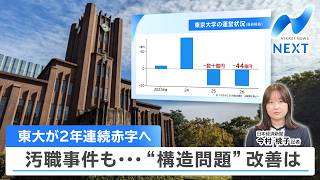
TOKYO - The University of Tokyo is expected to post a 4.4 billion yen deficit for fiscal 2026, marking its first two consecutive years in the red since becoming a national university corporation in 2004, as inflation, rising personnel costs and long-standing structural constraints place growing pressure on its finances.
The Ministry of Education, Culture, Sports, Science and Technology said 12 national universities, including the University of Tokyo, recorded deficits in fiscal 2025, with the university expected to remain in the red in fiscal 2026.
Inflation has sharply increased the cost of research equipment and materials, while personnel expenses have also risen. Universities have expanded their workforces as they take on broader roles, including increased industry-academia cooperation and internationalization, while salaries have also been raised in response to inflation.
The University of Tokyo has sought to increase outside revenue through measures such as joint research with companies, but those gains have not been enough to keep pace with rising expenses. Reducing staff quickly is also difficult for a university corporation.
The ministry estimates the university has assets of about 1.5 trillion yen and a positive cash flow of around 2.5 billion yen, meaning it is not considered at immediate risk of running out of funds.
However, prolonged financial pressure is already affecting management decisions. The university has begun postponing renovations of aging buildings and restraining spending on new initiatives, raising concerns that continued deficits could further limit its ability to invest in research and new programs.
Such constraints come as Japanese universities face a shrinking domestic population and declining number of children while also needing to strengthen their international competitiveness. Financial pressures could make it increasingly difficult to pursue projects that do not generate immediate revenue.
About 30% of the university's income comes from operating grants provided by the government, while other revenue includes income generated by its hospital operations. Major expenses include personnel costs and spending on laboratory equipment, materials and other goods.
The financial difficulties also reflect structural problems in the way national universities are funded and regulated. Unlike ordinary companies, universities are responsible for education and research and cannot simply discontinue activities because they do not generate profits.
Operating grants, which form a major source of income for national universities, were reduced for years following the transition to the national university corporation system as Japan experienced deflation.
More recently, the government has increased support in response to inflation, including through supplementary budgets and higher allocations, but those increases have not been sufficient to offset the rise in university expenses.
The University of Tokyo has already raised tuition from fiscal 2025 to about 640,000 yen, reaching the upper limit permitted under current ministry rules.
The standard annual tuition for national universities is around 530,000 yen, and increases are subject to restrictions. Any further substantial increase at the University of Tokyo would therefore require changes to the existing system.
Higher tuition also does not translate directly into an equivalent increase in revenue. As a national university, the institution must provide support such as tuition exemptions to eligible households, which increases associated costs.
Increasing the number of students would present similar challenges because additional enrollment may require more research equipment, teaching staff and other resources, potentially raising expenses as well as income.
Another constraint stems from the original design of the national university corporation system, under which universities calculate the funding needed for research and other operations each fiscal year and receive support on that basis, effectively aiming for revenues and expenditures to balance.
Profits generated through improved management can be carried forward, but doing so may require approval from the education minister, and restrictions can apply to how funds are accumulated and when they may be used.
Japanese universities, including the University of Tokyo, have also sought to develop investment models similar to major overseas universities, using donations as capital to generate investment income.
Their efforts remain relatively small, however, because Japanese universities have not accumulated endowments on the same scale as leading overseas institutions and Japan lacks a comparable culture of large-scale university donations.
Regulations have gradually been relaxed in recent years to give national universities more ways to generate and manage their own funds, including allowing them to issue university bonds and broadening the range of assets in which they can invest.
Even so, transforming the University of Tokyo into an institution capable of generating substantial independent income is expected to take time. Large overseas universities can earn significant investment returns because they already possess sizable pools of capital, while Japanese universities must first build those funds.
The education ministry is also considering changes that would link operating grants and tuition more closely to increases in prices and personnel costs. Such proposals remain under consideration, however, and could take years to implement because changes are generally incorporated through multi-year institutional planning cycles.
The discussion also indicated that a corruption case may be connected to the University of Tokyo's management problems, although details of that issue were not included in the provided segment.
Source: テレ東BIZ