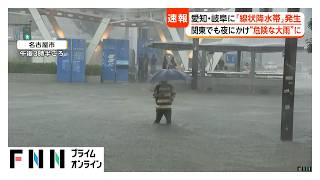
NAGOYA - Torrential rain caused widespread flooding across central Japan on September 8, inundating roads in central Nagoya and other cities as linear rainbands formed over Aichi and Gifu prefectures and authorities warned that similar conditions could develop in the Kanto region through September 9.
The Japan Meteorological Agency announced shortly after 4 p.m. that a linear rainband had developed over western Aichi Prefecture and the Mino region of Gifu Prefecture, sharply increasing the risk of rain-related disasters after an unusually prolonged spell of wet weather.
In Nagoya, where a Level 4 heavy rain danger warning was issued, roads outside Sakae Station in the city's main downtown district were submerged. Floodwaters became deep enough that the boundary between sidewalks and roadways was no longer visible, while water rose to nearly the level of the entrance steps of a stopped bus.
Around 100 millimeters of rain was estimated to have fallen near Nagoya within one hour, prompting the weather agency to issue information on record-breaking short-term rainfall.
Flooding was also reported in Inazawa, Aichi Prefecture, where trucks stopped on submerged roads with their hazard lights flashing.
One driver whose vehicle became stranded said he had attempted to reach higher ground to avoid flooding. "I thought the car wouldn't be submerged if I went somewhere higher, but it became submerged on the way," the driver said. "There were quite a few other cars driving around, so I thought I could make it, but I couldn't."
Heavy rain also struck Wakayama, where visibility was reduced by intense downpours and drainage systems were unable to cope with the volume of water.
Roads became flooded as vehicles moved slowly through standing water in lines. Water was particularly deep in lanes closest to sidewalks, and pedestrians attempting to cross roads were seen hesitating before wading through water reaching their ankles.
Rain had continued in Wakayama from early morning, with 112.5 millimeters recorded over the 12 hours through 3:40 p.m.
Severe conditions were also reported in Mie Prefecture. In Tsu around 2 p.m., rainwater flowed along roads like rivers as vehicles drove through the flooding and sent up large sprays of water.
Yokkaichi recorded 79.5 millimeters of rain in one hour, classified as extremely heavy rainfall. Drainage channels overflowed as they became unable to handle the volume of runoff.
Water also erupted from manholes at several locations in Yokkaichi. At one site, a powerful column of water was blown by the wind and rose to nearly the height of a traffic signal, suggesting that underground drainage systems had become overwhelmed.
Roads were also flooded at multiple locations in Suzuka, Mie Prefecture, where trucks were seen driving through deep standing water and creating large waves.
Heavy rain was falling in Shizuoka shortly after noon, with strong winds driving water horizontally across asphalt surfaces.
The widespread rainfall developed as the tropical depression that had previously been Typhoon No. 24 merged with an autumn rain front, producing persistent heavy rain along Japan's Pacific coast.
The prolonged rainfall also caused unusual conditions at tourist destinations.
At Fukuroda Falls in Ibaraki Prefecture, a nationally designated Place of Scenic Beauty measuring about 120 meters high and 73 meters wide, the volume of water increased sharply. Two streams that normally appear separated around the center of the falls had merged into a single broad flow as runoff surged following the heavy rain.
Rain also reached Tokyo and surrounding areas.
At 1:30 p.m., the Japan Meteorological Agency issued a half-day advance forecast warning of the possible formation of linear rainbands in the Kanto region.
The agency warned that the risk of serious rain-related disasters could rise rapidly in Tokyo, Saitama, Kanagawa, Chiba and Ibaraki prefectures from the night of September 8 through the early hours of September 9.
In Yamanashi Prefecture, the period of greatest concern was forecast from the evening through late on September 8.
Authorities urged residents in affected areas to remain alert for flooding, landslides and other rain-related disasters as the prolonged spell of severe weather continued.
Source: FNN