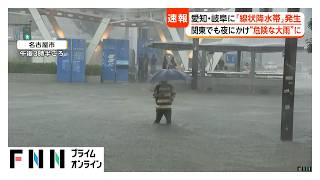
IBARAKI - Prolonged heavy rain across Japan has transformed waterfalls, damaged flower fields and disrupted sightseeing, while linear rainbands formed over Aichi and Gifu prefectures on September 8 and authorities warned that dangerous rainfall could continue in several regions.
At Fukuroda Falls in Daigo, Ibaraki Prefecture, footage taken on the morning of September 7 showed a dramatically increased volume of muddy brown water compared with normal conditions.
The falls, one of Japan's three most celebrated waterfalls and a major tourist attraction in Daigo, are normally known for their changing appearance through the four seasons, but persistent heavy rain caused by a stalled weather front has transformed the landscape.
One visitor said the volume of water was far greater than expected. "It had been raining until recently, so I was surprised by how much water there was," the tourist said. "It looked like about 1.5 times as much water as I imagined. I feel like I came at a good time."
Naoki Fujita, manager of the Fukuroda Falls observation facility, said the rain was also affecting visitor numbers. "When it rains, fewer people come, and the number of visitors has not really returned to what it was before," Fujita said. "More water can make the falls more powerful, but if there is too much, the spray can make it difficult to see them. It is a difficult balance."
Heavy rain has persisted particularly across the Kanto and Tohoku regions under the influence of a stationary autumn rain front.
In Iwaki, Fukushima Prefecture, 12-hour rainfall reached 193 millimeters, setting a September record.
In Niijima, one of the Izu Islands administered by Tokyo, rainfall from September 2 through the morning of September 8 totaled 783.5 millimeters, more than twice the area's average rainfall for an entire month.
Oshima recorded 581.5 millimeters of rain over 24 hours on September 7, the highest September total since observations began there, leaving damage across the island and disrupting visitors' travel plans.
One tourist said worsening rain and ferry cancellations left them unable to leave the island. "We arrived the day before yesterday, and after that the rain became much worse," the visitor said. "The ferries were canceled and we couldn't get off the island, so we had no choice but to stay inside the hotel. The place where we first stayed was in a landslide warning area, so on the first day we had to evacuate to Oshima High School."
The tourist said the severe weather forced changes to the planned itinerary from the first day of the trip.
Although conditions improved during the reporting period and the sea appeared calm enough for diving, warnings remained in place. Two groups with diving reservations for September 8 were unable to enter the water.
"We finally saw the sea calm down today and were saying, 'We can dive now,' but the warning still hasn't been lifted," a local operator said. "So we are refraining from diving."
Heavy rain also caused damage at Tokyo German Village in Sodegaura, Chiba Prefecture, where intense rainfall struck on September 7.
At one of the park's popular photo spots, where flowers cover a broad hillside, part of a field containing around 40,000 marigold plants approaching peak bloom was washed away by the rain.
Kota Yamano of Tokyo German Village said the sloping terrain helps the flowers grow but also allows rainwater to flow quickly downhill. "These marigolds are only just coming into their season, so seeing them knocked over is the hardest part," Yamano said.
Cosmos seedlings that had only recently begun to emerge were also partly buried by soil and sediment washed into the flower beds.
Asked how workers could respond, Yamano said removing the soil risked damaging the plants. "We can't really move this soil," he said. "If we try to remove it, we could tear up the cosmos as well. All we can do is hope they grow strongly through it."
Heavy rain continued across a wide area of Japan on September 8 under the influence of the autumn rain front and the remnants of former Typhoon No. 24, which had weakened into a tropical depression.
In Nagoya, Aichi Prefecture, torrential rain caused roads to flood around 3:30 p.m., with passing vehicles sending waves of rainwater across inundated streets.
A Level 4 heavy rain danger warning was in effect for Nagoya and surrounding areas, and the Tokaido Shinkansen suspended operations on part of its route because of the weather.
The Japan Meteorological Agency announced on the afternoon of September 8 that linear rainbands had formed over western Aichi Prefecture and the Mino region of Gifu Prefecture.
In Suzuka, Mie Prefecture, intersections were flooded, with water sprayed by passing vehicles rising as high as nearby parking lot fences.
Neighboring Yokkaichi recorded 79.5 millimeters of rain in one hour, an intensity comparable to a waterfall, while water surged from manholes like fountains.
Heavy rain also began falling in central Tokyo around 3 p.m.
The weather agency issued half-day forecasts warning of the possible formation of linear rainbands in areas including Kanto-Koshin and Shikoku, heightening concern over further flooding and landslides.
The risks can remain even after the rain stops.
Footage from Akame 48 Waterfalls, a gorge in Nabari, Mie Prefecture, taken in June 2026 after a typhoon showed sections of a normally accessible walking trail submerged under floodwater. Even after the typhoon had passed, muddy torrents continued to rush through the gorge.
Nobuyuki Tsuchiya of the Riverfront Research Center said river levels can remain elevated for two to three days after heavy rain because water absorbed into the ground is gradually released and drains into rivers.
When the soil is already saturated, additional rain cannot readily soak into the ground and instead flows directly into waterways, meaning even relatively light rain can cause sudden rises in river levels for about a week afterward.
Tsuchiya said the amount of rain that has fallen before a visit is therefore important even when the weather itself appears sunny.
He urged people visiting mountains and gorges to carry lightweight life jackets and helmets to help protect themselves.
Linear rainbands may form in the Kanto region from the night of September 8 into September 9, and authorities are urging continued caution over flooding, landslides and rapidly rising rivers.
Source: FNN